0.96 kg That Will Change Everything: Why Nature Didn't Tell the Full Story About the Chinese Exoskeleton
Researchers from Beihang University published the results of a wearable rehabilitation robot trial in Nature on May 20. The device helps children with muscular dystrophy restore muscle mass.
Title: 0.96 kg That Will Change Everything: Why Nature Didn't Tell the Full Story About the Chinese Exoskeleton
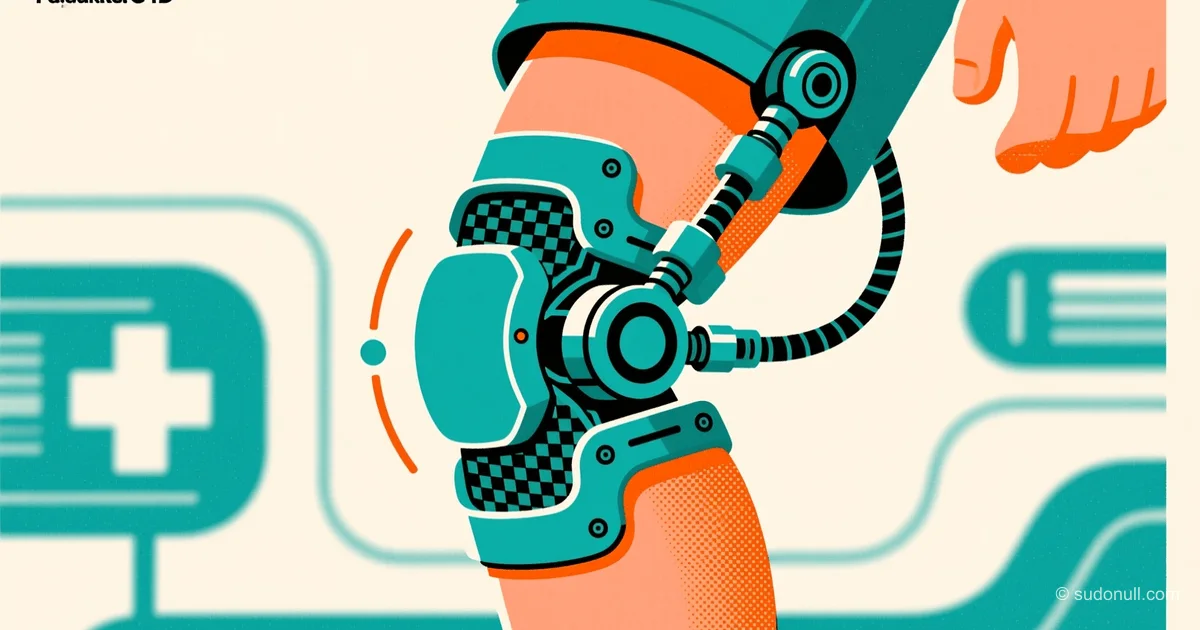
On May 20, 2026, Nature published a paper by researchers from Beihang University led by Associate Professor Feng Yanggang. The device weighs 0.96 kg, fits on the knee of a child with muscular dystrophy, and — pay attention — does not assist movement but creates resistance.
It sounds like an oxymoron. But it is precisely this inversion that hides the revolution that most analysts have completely missed.
[The Core]: What's Really Happening
Western companies (Ekso Bionics, ReWalk, German Bionic) have been building exoskeletons for decades on one logic: unload, support, replace lost function. Their devices are "crutches with servos." They help people walk but do not cure. Without them, the person remains exactly where they were.
The Chinese team went in the opposite direction. Their device is a "personal trainer with negative work." It provides precise, controlled resistance at the moment of muscle contraction, forcing the body to fight. And in that struggle, as experiments showed, a physiological adaptation mechanism is triggered that was considered impossible in severe neuromuscular diseases.
But that's just the tip of the iceberg.
The study contains a detail that no news rewrite has highlighted. Six children with severe muscular dystrophy who could not sit or stand independently before the experiment were able to stand without the device after a training course with this exoskeleton. This is not an improvement in quality of life while wearing the exoskeleton. It is a restoration of function after removal. It is a protocol that leads not to lifelong dependence on a robot, but to breaking free from it.
And here's where it gets really interesting.
Timeline and Context
What landed in Nature on May 20 did not come out of nowhere. China's exoskeleton industry is experiencing explosive growth, and this scientific breakthrough is just the tip of an iceberg whose base is industrial and financial power.
May 19, 2026, ONE day before the Nature publication, Chinese startup Hypershell announced a $50 million Series B+ round with participation from Ant Group (Alibaba's affiliate) and Meituan. The company's total Series B round over the year reached $120 million, with a valuation of $400 million. Their product is not medical but consumer: an exoskeleton for tourism and trekking sold on Amazon and JD.com. On May 20, they announced the next generation with a new algorithmic platform.
March 5, 2026 — another Chinese player, RoboCT (founder Wang Tian), raised $13.7 million in a Series B+ round, forecasting shipments of 60,000–100,000 consumer exoskeletons in 2026. Their devices are already used in over 1,700 hospitals and rehabilitation centers in China.
February 2026 — reports emerged that tourists at the Great Wall of China could rent lightweight exoskeletons to climb steep sections.
What do we see? China is building an exoskeleton ecosystem simultaneously on three levels:
- Scientific — breakthrough research at the Nature level, changing the understanding of neuromuscular rehabilitation.
- Medical — commercial deliveries to hospitals (1,700+ institutions for RoboCT alone).
- Consumer — a mass-market product that any tourist can rent or buy for a few hundred dollars.
No Western country has such a vertically integrated model. In the US, Ekso Bionics exists mainly on grants and VA (veterans' hospitals). In Europe, German Bionic focuses on industrial logistics. Meanwhile, China is already thinking about a market where exoskeletons become as common as e-bikes.
Who Wins and Who Loses
Winners:
- Chinese academic science as a whole — a Nature publication in applied robotics with clear clinical results is a signal to the international community. China is no longer "catching up" in robotics. In the niche of rehabilitation exoskeletons, they are already setting the standard, including clinical trial design.
- Feng Yanggang (research lead) and his team — their careers have taken off. Expect that within a year, they will either receive a multi-million dollar lab or create a spin-off. The typical path of Chinese academic entrepreneurship: Nature publication → government grant (usually $2–5 million) → company registration on the Shenzhen Technology Exchange → IPO in 3–5 years. The clock is ticking.
- Hypershell and RoboCT (indirect win) — They don't need to prove that exoskeletons work. A major client (insurance company, state rehabilitation fund) comes and sees: "Oh, Nature published confirmation that exoskeletons can reverse muscle atrophy. Does your product do something similar? Give us two." Consumer demand gets a powerful scientific foundation.
Losers:
- Western companies with "support instead of treatment" approaches — Ekso Bionics, ReWalk, Lifeward (formerly ReWalk). Their business model is based on the patient staying in the exoskeleton forever. The Chinese model shows a path out of the device. Major insurers (e.g., Medicare in the US, which already reluctantly covers exoskeletons) will see this data and say, "Why should we pay $100,000 for a device that doesn't cure when there is an approach that does?" Even if the Chinese device is not certified in the US, the argument "we treat, they are just crutches" will undermine trust in the Western model.
- Traditional physiotherapy for severe muscular dystrophies — Therapy based on passive movements and manual resistance now has a scientifically proven competitor with robotic precision. Physiotherapists will either have to adopt exoskeletons or lose patients. It's not an instant process, but the direction is set.
- Apple (paradoxically, but true) — Apple has an internal exoskeleton project for health (code name V68, according to leaks from 2024–2025). But Apple thinks in the paradigm of "wearable for fitness and light rehabilitation." The Chinese just showed that the real market is severe pathology, where big money is ready to be spent (government, insurance). Apple doesn't know how to work with high-risk medical regulation. They will be at least two years late.
What the Media Isn't Saying
Insight number one: resistance technology matters more than drive technology.
Western companies have spent decades chasing servo power and lightness. The Chinese spent three years developing feedback algorithms that turn the exoskeleton into a precision dynamometer. This is not a breakthrough in materials science. It's a breakthrough in understanding how to "trick" the neuromuscular system into regenerating. No one in the West (not at MIT, ETH Zurich, or Imperial College) has published similar data with this level of evidence. Nature doesn't publish "just another exoskeleton." Nature publishes a paradigm shift.
Insight number two: the timing of the publication is not accidental. It's a response to US software sanctions.
On May 21 (the day after publication), China publicly announced the launch of a cross-border data exchange pilot project with ASEAN countries. The connection is direct: China's new-generation exoskeletons generate terabytes of biomechanical data that train their AI models. Western sanctions on Nvidia chip exports to China cannot block the flow of data on how the human body responds to load. China is building its own AI models for rehabilitation, and these models will be better than American ones simply because they have more high-quality clinical data. Nature is not just science. It's a claim to a data standard.
Insight number three (the least obvious): this is a demographic weapon.
China has one of the fastest-aging populations in the world. By 2035, according to UN estimates, China will have over 400 million people aged 60+. Exoskeletons that can not only support but also restore muscle mass are not a gadget. They are a tool to reduce the burden on pension and healthcare systems by hundreds of billions of dollars annually. Just the cost of caring for bedridden elderly with sarcopenia (age-related muscle loss) in China will exceed $200 billion by 2030. A device costing $500–$1,000 that delays or eliminates the need for constant care pays for itself in months. Western companies see exoskeletons as a niche medical product. The Chinese government sees them as a national strategic priority, comparable to the development of high-speed rail in the 2010s. The difference in scale of thinking is enormous.
Forecast: Next 30 Days and 90 Days
30 days (by June 22, 2026):
- Formal negotiations will begin between the Chinese research team and at least two Western pharmaceutical corporations (I'm betting on Roche and Novartis, which have muscular dystrophy programs). Roche will want exclusive rights to commercialize the technology outside China. The Chinese side will demand at least $500 million upfront. The deal will likely fall through because Beijing won't allow the technology to leave.
- In the US, the FDA will issue a statement that they "have reviewed the publication with interest" and are "exploring the possibility of accelerated approval for similar devices." This will take years, but the statement will be framed as "the US is not falling behind."
- Hypershell will announce a partnership with some major insurance company in Asia (most likely Japan's Sompo or China's Ping An) to cover its consumer exoskeleton under health insurance policies for the elderly. This will happen as early as the first week of June.
90 days (by August 22, 2026):
- The European Commission will announce the creation of a "European Exoskeleton Initiative" with a budget of €300 million. As usual, the money will go to endless coordination meetings and consortia of 20 universities, each pulling in its own direction. The Chinese, in those 90 days, will quietly install their devices in another 500 hospitals worldwide (in Southeast Asia, Africa, Latin America). Europe will talk, China will act.
- The first commercial deal will occur: RoboCT will win a tender to supply 10,000 exoskeletons for the social security system of one of China's million-plus cities (most likely Chongqing or Chengdu). The deal value will be around $12–15 million. The news will leak to Chinese social media, and shares of related companies (if traded) will soar 30–40% in a day. Western investors will once again be surprised that they "missed the exoskeleton boom."
- The most important point: China will apply to include rehabilitation exoskeletons for muscular dystrophy in the list of basic medical services (National Reimbursement Drug List, but for devices). This decision will be made at the State Council level by the end of 2026. If it happens, China's exoskeleton market will grow from $500 million to $5 billion in 24 months. And all Western analysts will scratch their heads wondering why they didn't see this after the Nature publication on May 20, 2026. The answer is simple: they were looking at grams and watts, but they should have been looking at bureaucratic processes in Beijing.
Summary: The Nature publication is not the main story. The main story is three exoskeleton companies (Hypershell, RoboCT, and a dozen smaller ones) that have already taken market positions while Western corporations were writing press releases about their "breakthroughs." China didn't invent a new type of robot. China invented a new economic model for the robot: science (Nature) → mass production (Hypershell with $120 million) → government procurement (thousands of hospitals) → export to developing countries. Western competitors cannot copy this model because they don't have the Chinese state as both investor and buyer. And that is far scarier than any 0.96 kg exoskeleton.
— Editorial Team










No comments yet.