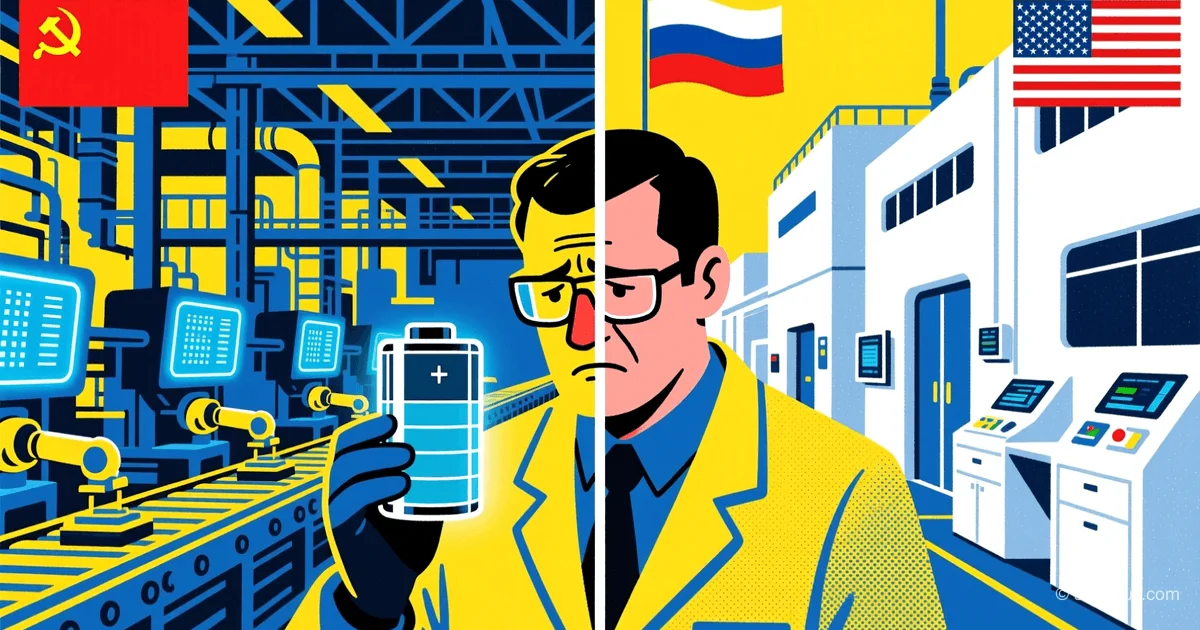
Russian Scientists Find Way to Improve Solid-State Battery Efficiency
Specialists from the Institute of Metallurgy of the Ural Branch of the Russian Academy of Sciences (UB RAS) reported on May 21 the development of a new additive for polymer electrolytes. This discovery solves the problem of low ionic conductivity, accelerating the creation of safer and more capacious batteries.
Headline: The $37 Billion "Additive": Why Russian Scientists from UB RAS Accidentally Confirmed China's Victory
On May 21, 2026, specialists from the Institute of Metallurgy of the UB RAS reported the development of a new additive for polymer electrolytes, solving the problem of low ionic conductivity. The news was picked up by Russian media as a local success of fundamental science.
Colleagues, my view is different. This is not a success. This is an official acknowledgment that Russia has finally fallen out of the global solid-state battery race, and its scientists are now working on problems that China and South Korea solved two years ago.
[The Essence]: What Is Really Happening
The problem "solved" in Yekaterinburg—low ionic conductivity of polymer electrolytes at room temperature—was the main barrier for solid-state batteries in 2022-2023. But not in 2026.
If you open recent issues of Energy Advances or Journal of Power Sources, you will see the numbers. Korean researchers from Cheongju University published a paper on May 8, 2026, with a composite solid electrolyte PEO-PAN-SiO₂, achieving ionic conductivity of 3.81 × 10⁻⁴ S/cm at elevated temperature. The Chinese reported in the same month 2.54 × 10⁻⁴ S/cm at room temperature—using "particle-to-particle bridging" technology that increases conductivity 18-fold.
What did UB RAS do? According to the official statement—they found a new additive. No numbers. No comparison with the global level. No mention that their result (likely at the level of 10⁻⁵ S/cm) is an order of magnitude worse than what already exists in industrial prototypes.
But the most important thing is hidden in what the news does not contain.
Timeline and Context
The picture of the world you won't see in Russian announcements:
2024 — China launches semi-solid-state batteries on a GWh scale. The technology based on polymer and oxide electrolytes already delivers a specific capacity of 151.4 mAh/g with Coulombic efficiency of 99.8%.
2025 — Total funding for global SSB projects exceeds $1.3 billion. QuantumScape launches the automated pilot line Eagle Line. Toyota, with over 1,300 patents in solid-state batteries, announces the launch of the first EVs with SSB in 2027-2028.
2026 (May) — Global SSB companies hold IPOs and go public. WeLion New Energy, QingTao Energy, Factorial Energy accelerate listings. Factorial has already signed contracts with Mercedes, Stellantis, Hyundai/Kia.
And against this backdrop—a report from Yekaterinburg about a "new additive."
Who Wins and Who Loses
Winners:
- Chinese Academy of Sciences (formally) — They don't need to do anything. Every such report from Russia, India, or Brazil automatically shows how deep the gap is. Chinese scientists have already moved in 2025-2026 from questions of "how to increase conductivity" to "how to scale production without solvents"—Oak Ridge National Laboratory published a paper in May 2026 on a solvent-free UV-curable technology with up to 55% inorganic filler.
- QuantumScape and Factorial Energy — They also benefit from any news showing that "laboratory successes" no longer matter. Only "manufacturability" matters. QuantumScape has already shipped B-samples to automakers, and Factorial is launching the first US production project with Karma Automotive (2027).
Losers:
- Russian battery industry (catastrophically) — While the RAS searches for additives, China, Korea, and the US are building factories. Russia has no commercial producer of solid-state batteries. No pilot lines. No contracts with automakers. And worst of all—no understanding that the problem is no longer about "additives."
- Rosatom and Renera (if they still had hope) — In 2024-2025, there was talk of localizing lithium-ion battery production in the Kaliningrad region. Solid-state technologies were not even considered. Now it's too late: by 2028, Chinese SSBs will be cheaper than Russian conventional lithium-ion batteries due to economies of scale.
What the Media Leaves Out
Insight number one (most important): Russia is funding 2022 science in the era of 2026.
Look at the topics of global leaders in 2026. They are not concerned with "how to raise conductivity from 10⁻⁵ to 10⁻⁴" (that's solved). They are concerned with:
- How to make production solvent-free (Oak Ridge, May 2026).
- How to suppress dendrites for 6,532 hours of cycling (China, May 2026).
- How to maintain interface stability at high voltage of 4.5 V (IOP Science, April 2026).
- How to integrate AI for optimizing separator microstructure (QuantumScape + Corning, 2025-2026).
The Institute of Metallurgy of UB RAS is solving a problem that the world solved in 2024. It's like announcing the creation of the first iPhone in 2025—when the iPhone 15 is already out.
Insight number two: The geopolitical subtext is unspoken.
May 21, 2026 (the day of the news) is exactly one day after the US allocated $2 billion for quantum technologies, and three days after Modi presented 24 deep-tech startups in Bangalore. Russia is trying to show: "We also have deep science." But the format—"scientists found an additive"—betrays a desperate position.
In the world of deep tech in 2026, no one measures success by laboratory samples. Success is measured in pilot lines, patents, contracts with automakers, and IPOs. Russia has none of these.
Insight number three (most subtle): This message is for domestic consumption, not for the world.
The news was published on May 21—a Friday before a long weekend (May 23-24 are holidays in Russia). A classic technique: release a "good news" story at the end of the week so no one asks uncomfortable questions. Compare: global breakthroughs (QuantumScape, Factorial) are announced at the beginning of the week, with numbers, investor names, and commercialization dates. The Russian "additive"—no numbers, no names, no plans.
Forecast: Next 30 Days and 90 Days
30 days (by June 22, 2026):
- The Russian scientific community will try to build on the success—2-3 more similar reports will follow from other RAS institutes. All will be about "breakthrough additives," "unique composites," and "promising results." None will contain specific conductivity numbers at room temperature. Why? Because those numbers (likely 10⁻⁵ S/cm or lower) would show a gap of an order of magnitude.
- Chinese media will not react to the Russian news at all. For them, it's "another laboratory study from a country with no battery industry." This silence is the most damning assessment.
90 days (by August 22, 2026):
- QuantumScape and Factorial will make new announcements. QuantumScape (partnership with Corning has already yielded results in separator yield) will announce the start of C-sample shipments. Factorial will announce a second automaker signing a contract for FEST® technology. Global media will write about this as a "breakthrough," not even mentioning the Russian "additive."
- A major Chinese company (CATL or BYD) will announce a 20-25% price reduction for its semi-solid-state batteries compared to 2025. This will make SSBs economically accessible for mass-market EVs (segment $25,000-30,000). Russian "new additives" will become completely irrelevant—because even if they work, there is no one to produce them and no price to compete with.
- Finally, a landmark event will occur that is currently unspoken. The European Investment Bank will announce €500 million for building a solid-state battery plant in France or Germany—jointly with Chinese Gotion High-Tech. Europe will publicly admit it cannot catch up with China and Korea on its own and invites them to build factories on its territory. This will be a moment of truth for all who still believed in "technological sovereignty." Russia will not even participate as an observer in this deal.
Summary: The news from UB RAS on May 21, 2026, is not a breakthrough. It is an epitaph for Russian battery science as a global player. The world has moved on to scaling, automation, and AI-optimized production. Russia remains at the stage of "scientists in a lab searching for an additive." The gap between these two realities is now not measured in years—it is measured in epochs. And reports about "additives" will not close it.
— Editorial Team





No comments yet.