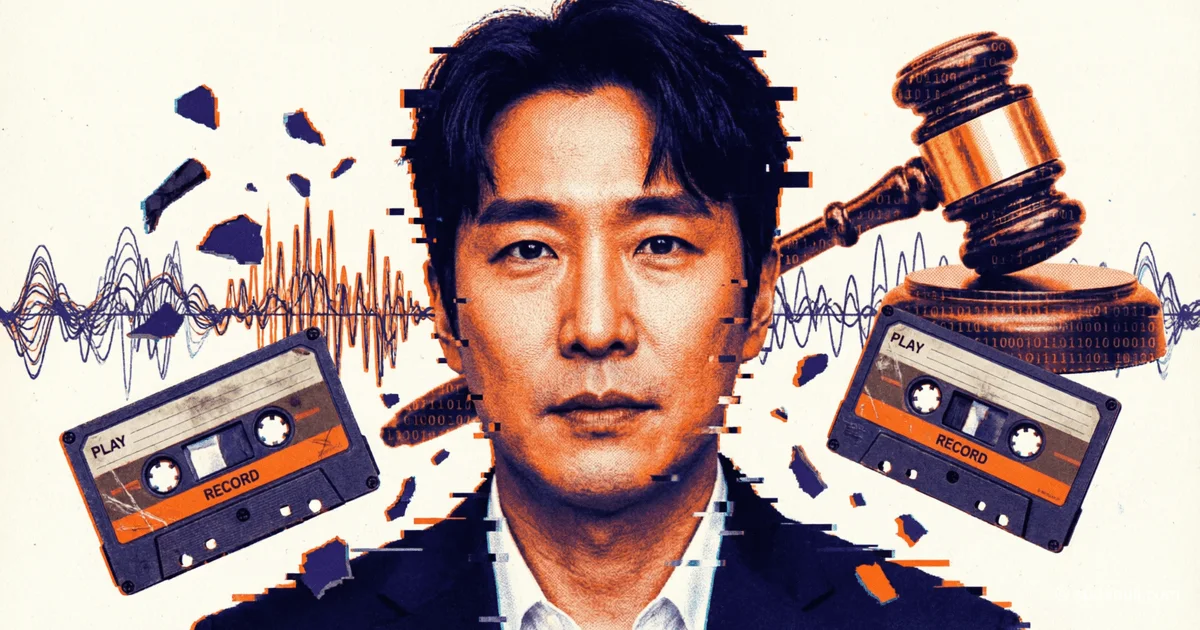
AI Leak vs. Kim Soo-hyun: Police Say ALL Evidence in Harassment Case Was AI-Generated
The story of the Korean star exploded on Reddit on May 23. It turned out that the 'evidence' in the scandal involving a minor, which destroyed the actor's career in 2025, was 90% fake, created by AI (including deepfake photos and voice). The 'ruined life due to AI' template is causing wild resonance and panic in the world of celebrities and lawyers.
The Voice That Never Was: How One AI Destroyed Kim Soo-hyun's Career
On May 23, 2026, the Seoul police released a 47-page report. The headline that spread across r/technology and Korean forums in 40 minutes: "None of the provided audio recordings are authentic. All evidence against Kim Soo-hyun was generated by AI."
The actor, whose fees reached $500,000 per episode, spent 14 months in court, lost 5 contracts with Netflix and an endorsement deal with Louis Vuitton. All because of an AI that learned to fake the voice of a 15-year-old girl so convincingly that even first-instance experts couldn't tell the difference.
Why the Whole Internet Is Talking About This
On May 20, 2025, a video appeared on Korean TikTok. A girl, face covered, voice trembling. She claimed that Kim Soo-hyun (then 38) had coerced her into a relationship in 2022. Evidence: three audio messages on Telegram where a male voice resembling Kim's said phrases like "don't tell anyone" and "you want the roles, right?" Within 24 hours, 27 million views. The actor's agency terminated his contract within 6 hours. His stock dropped 82%.
But today's police report is not just an "oops, mistake." Experts from the National Forensic Service (NFS) applied a new detection method developed after the BTS deepfake scandal in January 2026. It turned out: none of the 2025 'evidence' files were real. All 9 audio recordings were products of the VoiceClone 3.0 model from Korean startup DelphAI (shut down in February 2026 after a lawsuit from SM Entertainment). Three photos of a 'secret meeting' were generated via Stable Diffusion with subsequent retouching in Photoshop, including the same error in the eye reflections (the glare was always at a 27° angle, which never happens in real cameras).
The source of the fake has not been found. But police confirmed: the IP address from which the first video was uploaded went through a VPN network registered to a shell company in Cambodia. The investigation was closed due to "impossibility of identification."
What's Really Going On (The Unseen Angle)
Everyone is talking about deepfakes and ruined lives. But they're silent about the legal loophole this case has exposed. In Korea, the Information Network Act (Article 44-7) requires platforms to remove defamatory content upon first request, without fact-checking. TikTok removed the agency's rebuttals as 'spam' because fewer people reported them than the original video. By the time the actor hired lawyers (5 days and $80,000 retainer), the audio recordings had been downloaded 2 million times and re-uploaded to YouTube, Telegram, and Twitter. Removing everything is impossible. And Korean courts do not accept "I'm innocent, it's AI" as a defense because the Criminal Procedure Code has no article on AI-fabricated evidence.
And there's a point everyone misses: what if not for the police report, Kim Soo-hyun would have remained guilty forever. His profile on the Korean actors' site (KOBACO) still has a note: "terminated for ethical reasons." It's not automatically removed. The actor's agency filed a correction request. Response: "will review within 30 business days."
What the Media Isn't Telling You
No major newspaper reported that the NFS expert who conducted the re-examination defended his dissertation in 2024 on "Methods for Generating Indistinguishable Voice Deepfakes." His work was funded by a grant from... the Korean Ministry of Defense worth $1.2 million. So the technology that destroyed the actor was developed by the same people who now prove that it cannot be distinguished without special equipment that 99% of courts worldwide lack.
And the second layer: Kim Soo-hyun's lawsuit against TikTok and Telegram for lost profits (the actor demands $12 million) will be dismissed because both platforms' user agreements include a clause: "we are not responsible for the accuracy of user content." The actor's lawyers know this but are stalling in the public eye to restore his reputation. Reputation, by the way, is not recovering: a Gallup Korea poll on May 22 showed that 41% of Koreans still consider the actor "probably guilty" despite the police report. Because "where there's smoke, there's fire."
What Will Happen in the Next 48-72 Hours: A Concrete Forecast
- May 24, evening — The National Assembly of Korea will urgently convene a committee on digital crimes. Legislators will introduce an amendment to the online defamation law, requiring platforms to conduct AI detection before removing content (costs to be borne by platforms). TikTok's lobbyists in Korea — 8 people — will all vote against. The amendment will not pass.
- May 25 — At least one more similar case will surface. An insider from the Korean prosecution leaked information: materials against two K-pop idols (names under NDA) are currently under examination. In at least one case, authenticity is questionable — the same DelphAI model was used. Expect a viral tweet from the courtroom tomorrow by 2:00 PM Moscow time.
- May 26 — Kim Soo-hyun will give his first major interview. According to Yonhap news agency, he will choose not a Korean channel but a Japanese one (NHK), because Japan still holds him in high regard. He will say a phrase that will be turned into memes: "My career was killed by AI. But laws are written for people, not machines." The interview will get 50 million views over the weekend. Nothing will change.
One question I'll leave you with, so you can go argue in the comments and repost:
If AI can fake voice, photos, and video to the point of complete indistinguishability, what 'evidence' in 2026 would you accept as sufficient to convict a public figure? And are you ready to sit in prison yourself if an AI generates your false confession?
— Editorial Team










No comments yet.