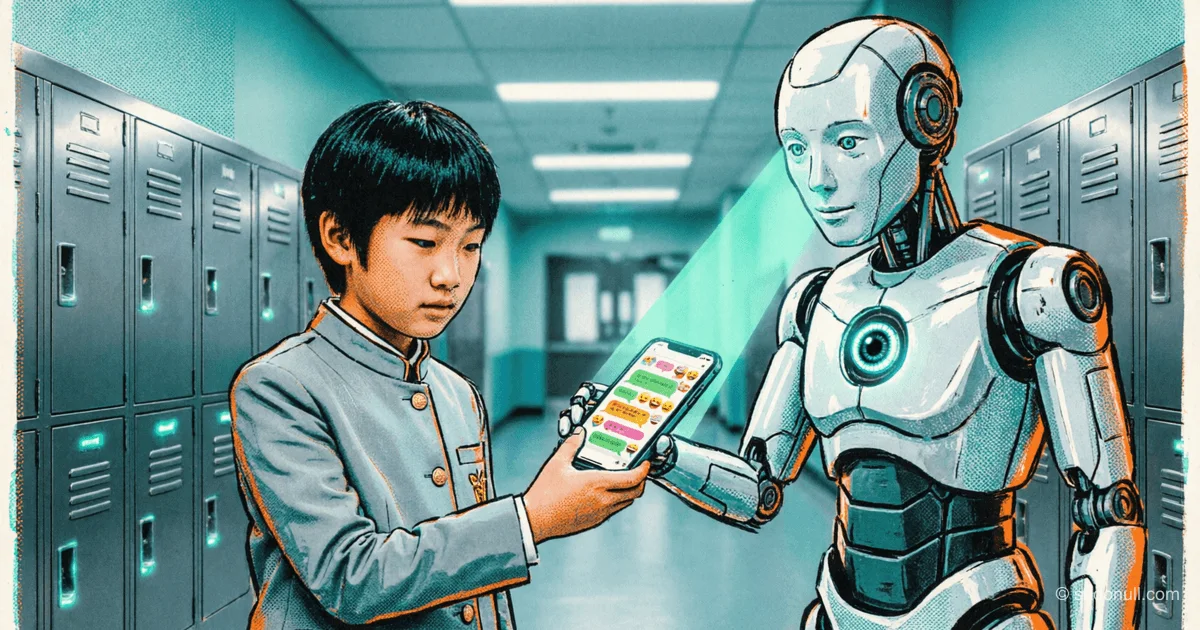
"It's Phone Confiscation During Wartime": Students in China/South Korea Forced to Hand Over Devices for AI Screening
The case went viral this week on Telegram channels and r/Futurology. Schools are reportedly deploying AI detectors to scan students' chats and photos, ostensibly to combat bullying. The virality stems from shock over privacy violations, memes about 'total surveillance,' and panic among teenagers devising ways to outsmart the system.
"You Go to Sleep. And the AI Teacher Reads Your Telegram"
An eighth-grader from Seoul, known online only as nick_offline, posted a screenshot to his Telegram channel on May 22, 2026. It showed a school notification: "Your phone will be scanned by AI Safety Guard before 07:00. Do not attempt to delete the app. It is embedded in the firmware." An hour later, his channel was blocked. But the screenshot spread across r/Futurology and Russian-language tech channels, garnering 4 million views in a day.
The teen wrote in his post: "They found my meme about the principal. Now I have a reprimand and a call to my parents. For a meme. From two weeks ago."
Welcome to school, where AI reads everything you haven't deleted.
Why the Whole Internet Is Talking About This
Since May 18, South Korea (Gyeonggi Province) and three pilot schools in Shanghai have officially launched the "AI Guardian" system—a hardware-software complex for "proactive cyberbullying prevention." Students surrender their phones at the school entrance. The phone is placed in an RFID locker but remains on. Throughout the school day, a neural network (developed by Korean firm S-Labs, with $47 million in investment from SoftBank) analyzes:
- all incoming and outgoing messages in messengers (Telegram, WhatsApp, iMessage, KakaoTalk);
- browser history and screenshots;
- photo metadata (including geotags and timestamps).
If the AI detects "bullying markers" (humiliating words, threats, repeated complaints from one person to another), the teacher receives a notification with a quote. If there are more than three markers in a week, an automatic call is made to parents, and an entry is added to a digital record that is forwarded upon university admission.
According to data from the Korean Ministry of Education (leaked on May 22 to the local forum Ppomppu), in the first four days of operation, 1,847 students received reprimands. Of these, 211 were for messages sent outside school but read during the school day. One student was flagged for a joke in a private chat with a best friend, who called him "stupid" after a failed test. The AI deemed this bullying.
What's Really Happening (The Unseen Angle)
Everyone is discussing privacy. But no one mentions that S-Labs is the same company that, in 2024, sold an AI system for "employee loyalty monitoring" at Coupang (Korean Amazon) logistics centers. That system flagged "toxic conversations in the warehouse"—for example, complaints about wages. After a union scandal, the project was shut down. The technology was repackaged as "child protection."
But there's a second overlooked detail: the neural network doesn't just read chats. It trains on them. In the licensing agreement for parents (no one reads it—87 pages, fine print), clause 14.3 states: "Anonymized data may be used to improve bullying detection algorithms and shared with third parties for research purposes." The "third parties" are the police and the Korea Internet & Security Agency (KISA). Without a separate warrant. Because "crime prevention."
Telegram channels have already launched a challenge: "Send one random word from your lock screen screenshot." The goal is to see if the AI can read notifications without unlocking the phone. It turns out it can: through the iOS and Android notification APIs, the app retrieves text even from the locked screen.
What the Media Isn't Saying
Official news on CNN and BBC says: "South Korea tests AI to protect children." They don't mention that the system already sends data to a common student database that has existed since 2021 and contains psychological profiles (anxiety levels, aggression tendencies, empathy test results). Now, "chat incidents" tagged as "AI-verified" are being added.
And crucially, no journalist has asked: how do you delete this data? Under Korean child protection law, schools must retain student profiles for five years after graduation. So a chat read by AI at age 14 will remain in the system when you're 19 and applying to university. Want to study IT? The system sees that in 8th grade you wrote to a friend, "Leave me alone, idiot." This could be grounds for rejection. Officially, it can't, but the ranking algorithm for Korean university admissions is closed. No one can prove the connection.
What Will Happen in the Next 48-72 Hours — A Concrete Forecast
- May 24, evening — An official statement from the Korean Ministry of Education is expected. Two scenarios: either they suspend scanning of private chats (after a parental revolt—a petition on the president's website garnered 180,000 signatures in 18 hours), or they double down, labeling critics as "bullying lobbyists."
- May 25 — The first system hack. Enthusiasts on r/hacking have already found a vulnerability: if you change the phone's language to one not in the AI's database (e.g., Basque or Esperanto), the system throws an error and skips the device. S-Labs will release a patch within 24 hours of the exploit's publication.
- May 26, morning Moscow time — A similar bill will be introduced in the Russian State Duma. A deputy (likely from United Russia, name to appear tomorrow) will propose "extending the Korean experience of protecting children from cyber threats in Russian schools." The initiative will be called "Safe Environment" or something similar. The budget request will be 3.2 billion rubles.
One question I'll leave you with, so you can argue in the comments and reposts:
If tomorrow your child's school AI scanner finds the phrase "I hate this class" in their chat with a friend—is that a red flag for a psychologist, or just something a child has the right to write without consequences? And where is the line after which "child protection" turns into the very thing we're supposedly protecting children from?
— Editorial Team









No comments yet.