Oncolytics Biotech to Present Pancreatic Cancer Immunotherapy Data at ASCO 2026
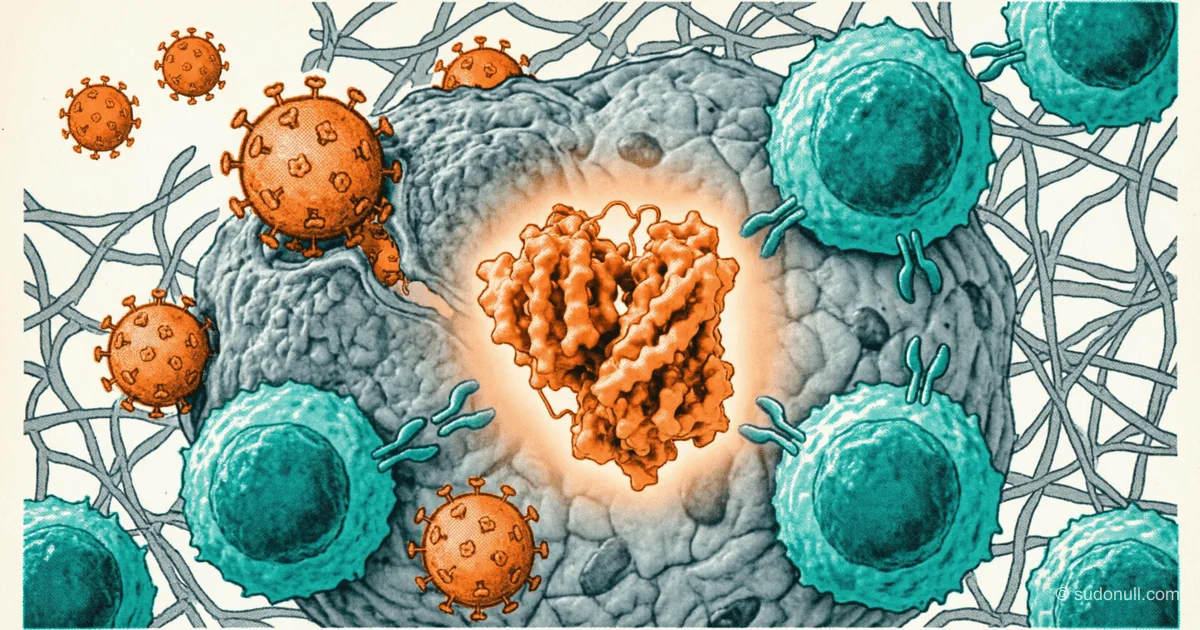
Oncolytics Biotech will present data from the GOBLET and AWARE-1 studies at ASCO 2026. The viral drug pelareorep has demonstrated activation of T cells against mutant KRAS, inducing tumor regression in pancreatic cancer.
Virus vs. KRAS: Why ASCO 2026 Will Bury Old Immunotherapy Dogmas
Author: Analytical Note, Internal Review
May 29, 2026, Chicago will host the ASCO Annual Meeting. The agenda is packed, as always. But there is one poster — abstract number 2664, booth 454, presenter Richard Trauger — that most major media will skip. And that's a mistake. Because Oncolytics Biotech just announced: their viral drug pelareorep expands pre-existing KRAS-specific T cells in the blood, and this correlates with tumor regression.
Sounds like another immuno-fairy tale. But no. There's a real bomb buried here. We're used to "hot" tumors being melanoma, kidney cancer, lung cancer. But pancreatic and KRAS-mutant colorectal cancer are "ice deserts" where even Merck's Keytruda (pembrolizumab) is useless. Oncolytics' data shatters this paradigm. And Merck has already realized it.
[The Core]: What's Really Happening
By May 22, 2026, Oncolytics Biotech (NASDAQ: ONCY, market cap ~$100M) reported that ASCO 2026 will feature translational data from two studies: GOBLET (pancreatic cancer, phase 1/2) and AWARE-1 (early breast cancer). But the essence isn't the design — it's the mechanism.
A typical oncolytic virus kills a cell and "teases" the immune system with new antigens. Pelareorep works differently. The data show a two-step process: first, the virus induces an antiviral response via dsRNA signaling and TLR3, and then — most importantly — clonal expansion of mutant-specific KRAS T cells occurs.
Non-obvious insight: This is proof of "antigenic mimicry." The virus forces the immune system to remember it has already seen KRAS-mutant cells and expands existing T-cell clones, rather than teaching it to recognize new targets. This completely overturns the concept of "cold" tumors. Previously, it was thought there were no T cells there. But Oncolytics' data says: T cells exist, but they are dormant. And pelareorep simply wakes them up.
Richard Vile from Mayo Clinic, a member of the company's scientific advisory board, stated directly: "Pelareorep works by expanding pre-existing tumor-reactive immune cells, not by introducing new antigens."
[Timeline and Context]
You need to understand the evolution. This isn't a first attempt.
- 2018: Pelareorep + Gemcitabine. Median survival 10.2 months. Simply "not worse than chemo."
- September 2025: Breakthrough in REO 022 (second-line colorectal cancer). Median progression-free survival 16.6 months vs. 5.7 with standard of care. A 2.5-fold difference. Overall survival 27 months saved instead of 11. Stock soars.
- Late 2025: FDA grants Fast Track for colorectal and pancreatic cancer.
- January-March 2026: Oncolytics receives IP extension and aligns with FDA on registration path.
- April 2026: SABCS data (breast cancer) shows association of blood TIL expansion with tumor shrinkage.
- May 22, 2026: ASCO announcement. We see confirmation: expansion of T-cell clones against mutant KRAS.
Chronological deception: The ASCO press release mentions "pancreatic cancer and breast cancer." But the most interesting part is colorectal cancer with KRAS mutation (MSS — microsatellite stable). That's 96% of all colon cancers. Immunotherapy fundamentally doesn't work there. Oncolytics' colorectal data will be presented, but it's not in the headline. Why? Saving it for a closed session.
[Who Wins and Who Loses]
Winner (strategically): Merck (MRK).
Non-obvious favorite. Keytruda loses patent protection in the late 2020s. Generics (biosimilars) are already on the way. But if Merck buys Oncolytics, it can sell Keytruda + pelareorep as a combo pack for "cold" tumors. Keytruda biosimilar alone is useless — it doesn't work in pancreatic or KRAS-mutant colorectal cancer. Pelareorep is needed. Merck becomes a monopolist in a segment where it had no sales. HC Wainwright analyst already raised ONCY price target from $5 to $10. Company valuation is $100M. Merck could buy it for $500M and not even notice.
Winner: Roche (atezolizumab, Tecentriq).
Roche supplies atezolizumab for Oncolytics' studies. If pelareorep reaches the market, Tecentriq gets a second chance in GI cancer combinations where it lost to Keytruda.
Loser (catastrophically): Gilead, Pfizer, other oncology players.
If Merck captures the "virus + checkpoint" category, competitors are left with nothing. Their own viral platforms are either too toxic or lack systemic action. Pelareorep is administered intravenously and reaches metastases. That's critical.
Loser: Carisma Therapeutics and other "macrophage" startups.
They are trying to reprogram macrophages for tens of millions of dollars. Oncolytics offers a simple intravenous virus. Carisma's technological bet collapses if viral TLR3 stimulation solves the "cold" tumor problem cheaper and more effectively.
[What the Media Isn't Saying]
First. The TLS (tertiary lymphoid structures) effect.
AWARE-1 data (breast cancer) shows that pelareorep induces CXCL13 — a chemokine linked to TLS formation. TLS are artificial "tonsils" in the tumor where T and B cells mature. Until now, it was thought impossible to create TLS in the pancreas. Oncolytics says: we can.
Second. "Pre-ASCO data" is a deal trigger.
ASCO tradition: good data is published Saturday morning. May 30, 2026, 1:30 PM Central Time. But pharma giants get access to presentations 48 hours early. If ONCY stock starts an abnormal rise on Thursday, May 28, it means rumors of a Merck or Bristol Myers Squibb acquisition are confirmed. Watch the ticker.
Third. The KRAS G12D problem.
The press release carefully writes "mutant KRAS-specific T-cell clones." But KRAS mutates differently: G12D (pancreatic), G12V (colon), G12C (lung). The data doesn't specify which mutation the clones target. If all of them — it's a "universal vaccine," the holy grail. If only G12D — the market is narrower but still huge (90% of pancreatic cancer).
[Forecast: Next 30 Days and 90 Days]
30 days (ASCO 2026, May 29 – June 2, 2026):
May 30 — Richard Trauger's poster presentation. Expect specific numbers: fold expansion of KRAS-targeting T cells and correlation with RECIST response. If correlation >0.7, it's a strong signal for the FDA. Immediately after ASCO, June 3-4, likely an announcement of a new partnership with Merck or Bristol Myers. The deal size could range from $500M to $2B.
90 days (by August 2026):
The company will announce the start of a pivotal phase 3 study in metastatic pancreatic cancer. According to protocol data, it will be a combination of pelareorep + atezolizumab + FOLFIRINOX vs. FOLFIRINOX. Patient enrollment in 2027, first data in 2029. But ONCY stock could rise 3-4 times from current levels ($0.88 as of May 2026) if the deal is confirmed.
Bet: Watch Exelixis. They have a deal with Merck for STELLAR-316 (colorectal cancer). Exelixis is a direct competitor to Oncolytics in the KRAS-mutant niche. If Exelixis announces negative data in August, Oncolytics will spike instantly.
Verdict: Pelareorep is not just another virus. It's proof of concept that the immune system already knows how to see KRAS — we just put it to sleep with chemo. Oncolytics Biotech is an ideal acquisition target. And ASCO 2026 will be the trigger. Don't look at the posters. Look at the rows in the closed meeting rooms between Merck and Oncolytics booths. The deal is inevitable.
— Editorial Team










No comments yet.