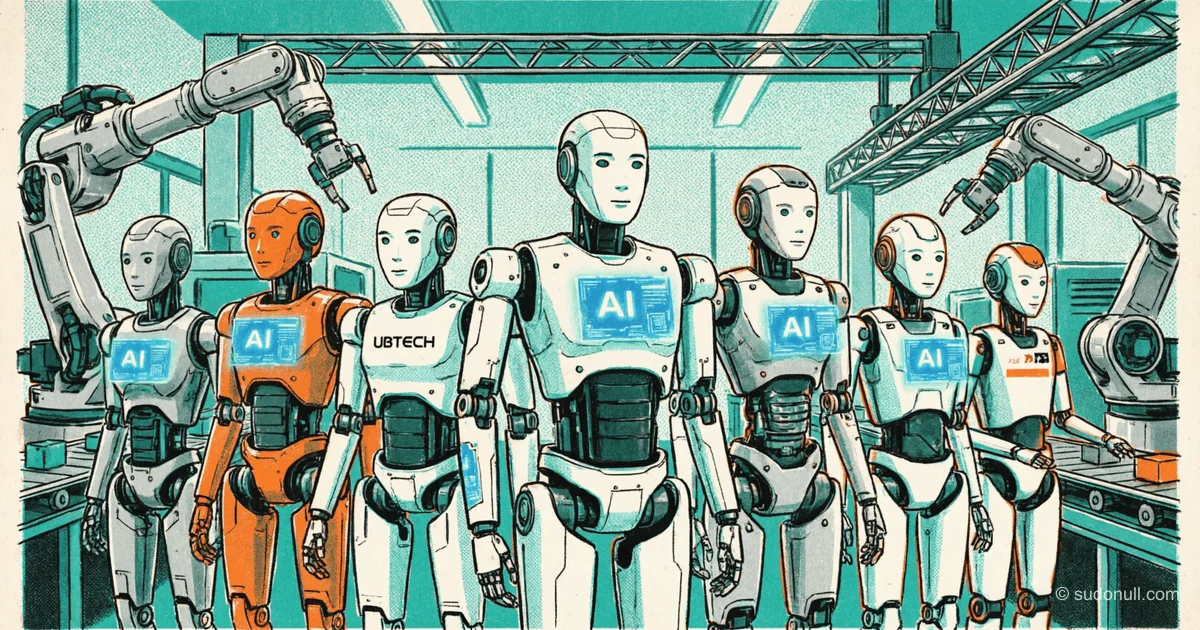
China Unveils 7 Humanoid Robots for AI Hardware Race in Asia-Pacific
Chinese Unitree, UBTech, and AgiBot, along with Japan's Kawada and Alter3, lead the race in the Asia-Pacific region. New models target industry, elderly care, and integration of large language models for motion control.
Seven Asian Humanoids: Why Tesla Is Losing a Race That Hasn't Even Started
Author: Analytical Note, Internal Review
On May 20–21, 2026, analytical agency eWEEK published a review of seven humanoid robots defining the AI Hardware race in the Asia-Pacific region. The list looks impressive: China's Unitree G1, UBTech Walker S2, AgiBot A2, Fourier GR-2, South Korea's Rainbow Robotics HUBO, Japan's Kawada NEXTAGE, and Alter3. Media outlets write "the race has begun." That's a lie.
The race is over. The winner is known. And it's not the US.
While Tesla has been testing Optimus for years and Figure AI builds factories, China already deployed 16,000 humanoid robots in 2025—with a market share of over 80%. And these aren't "prototypes." They are working machines at BMW and BYD factories, Amazon logistics centers, and even Chinese nursing homes. Americans are playing "who can bend an arm cooler." The Chinese are already collecting failure statistics in real-world conditions.
[The Gist]: What's Really Happening
The seven robots from the eWEEK report are not "newcomers." They are seven different answers to one question: "How do you make a humanoid that doesn't just walk, but works?"
Unitree G1 (Hangzhou). Positioned as an "affordable platform for developers." Unitree already holds 27% of the global humanoid market. Their strategy is cheap hardware and an ecosystem for those who want to write software. The R1 costs $5,900. That's the price of an iPhone Pro.
UBTech Walker S2 (Shenzhen). 5% market share. The main feature is autonomous battery swapping. The robot drives itself to recharge when its battery runs low. For a factory, it's a "workhorse," not a "pet." According to TrendForce, UBTech is already testing Walker S at BYD factories for quality control.
AgiBot A2 (Shanghai). Market leader—31% of all global shipments in 2025. Their bet is not hardware but the "stack": proprietary datasets, training tools, and APIs for LLM integration. AgiBot doesn't sell a robot. AgiBot sells the ability to make your robot smart.
Non-obvious insight: China won the humanoid race not through technology, but through data. Morgan Stanley analysts call this the "proving ground strategy." The US tests one robot for years. China deploys 1,000 robots in factories, collects 100,000 hours of operational data, and releases a firmware update three months later. The gap in training data between the US and China is not 2x or 5x. It's orders of magnitude.
[Timeline and Context]
- 2023: China includes "embodied AI" in its 2026–2030 five-year plan as a "new engine of economic growth."
- 2024: First commercial contracts. UBTech supplies Walker S to BYD factories.
- 2025: Global humanoid market—16,000 units. China—80%. Robotics investments in China exceed $7 billion in the first three quarters.
- January 2026, CES: AgiBot debuts in the US with the A2, G2, and X2 lines. Bloomberg confirms: AgiBot is the leader in shipment volume.
- May 2026, eWEEK report: Seven Asian robots recognized as "defining the race."
Chronological deception: Media write about a "race" in May 2026. In reality, the race took place in 2024–2025. Now we are in the "scaling" phase. China has already chosen its strategy: cheap hardware, massive data, vertical solutions for industries.
[Who Wins and Who Loses]
Wins (totally): Chinese industry.
The cost of a humanoid robot dropped from $50,000–$250,000 in 2023 to $30,000–$150,000 in 2024. Unitree sells the R1 for $5,900. That's not a typo. When the price falls below $10,000, a robot becomes cheaper than the annual salary of a Chinese factory worker. The economics flip.
Wins: BYD (automaker).
BYD is increasing its humanoid fleet from 1,500 units in 2025 to 20,000 in 2026. Because UBTech and AgiBot supply them with robots that work 24/7, require no insurance, and don't go on strike. BYD uses humanoids on EV assembly lines. Irony: Tesla develops Optimus for its own factories, but its Chinese competitor has already deployed someone else's robots faster than Tesla deployed its own.
Loses (catastrophically): Tesla Optimus.
Tesla has 5% of the global humanoid market. One of the lowest shares among the top five. While Elon Musk promises "millions of Optimus by 2027," the Chinese have already shipped 16,000. And crucially—they shipped them into working enterprises. Every day a humanoid works in a factory is data for training the model. Tesla doesn't have that data. AgiBot has thousands of hours.
Loses: Japan.
Kawada NEXTAGE and Alter3 are technologically interesting. Alter3 uses an LLM to generate movements from text commands. But Japan lacks scale. The humanoid market is a volume game. China produces millions of smartphones, EVs, and drones. The same supply chain and the same "fast and cheap" culture works for robots. Japan remains in the "premium research" niche. But premium doesn't feed $7 billion in investments.
[What the Media Aren't Saying]
First. They write about "7 robots." But they stay silent about the KAI robot from Kinetix AI, which debuted in April 2026. KAI has 115 degrees of freedom—72 of them in the hands. For comparison: Tesla Optimus has about 40. KAI can thread a needle. And it costs less than $40,000. Mass production is slated for late 2026.
Why the silence? Because KAI isn't for factories. KAI is for the service sector. And it demonstrates tactile sensitivity—18,000 sensors on its body. This means China has already moved beyond "heavy industry" and is targeting retail, concierge services, and home assistance. A market orders of magnitude larger than factory automation.
Second. The media don't talk about fall recovery. Xpeng IRON (a Chinese EV maker) publicly fell flat on its face during a demo in early 2026. That's not a failure. That's reality. Humanoids fall. Often. The issue isn't whether they fall. It's how quickly they get up and how much repairs cost.
Chinese companies have been producing cheap spare parts for phones and cars for decades. Robot servo broken? Replacement—$50. Delivery—tomorrow. In the US, replacing an Optimus servo costs $500 and takes three weeks. China wins not through technology, but through repair logistics.
Third. Nobody writes about wall-climbing robots from RobotPlusPlus. This is a 90 kg humanoid on a magnetic chassis that climbs chemical tanks, welds, inspects defects, and removes rust. It has accumulated 100,000 hours of operation. It replaced humans at heights of 50 meters without safety harnesses. This isn't a "robot-human." It's a "robot-worker" in an environment where humans die.
[Forecast: Next 30 Days and 90 Days]
30 days:
By mid-June 2026, expect news of the first commercial contract for KAI with a retail chain in China. Kinetix AI announced mass production for late 2026, but pre-orders from major retailers will appear as early as June. If KAI goes into production at $40,000, that will be the moment humanoids enter the consumer sector not as toys, but as employees.
90 days (by August 2026):
Watch for the Japanese KyoHA initiative (Kyoto Humanoid Association). In April 2026, they promised a prototype of a "national" humanoid. By August—first tests at Toyota and Fanuc factories. Japan has no chance of catching up with China in volume, but it has a chance to create a safety and interoperability standard. If KyoHA proposes an open protocol and China stays in its closed ecosystems, the market will split into two blocs. The Japan + US + Europe bloc will be 3 times smaller in volume than China's, but 5 times more expensive.
Bet: Keep an eye on BMW and Mercedes-Benz. They are already testing Figure 02 (US) and Apollo (Apptronik). If by August German automakers place an order with AgiBot or Unitree, it's a signal that even European brands have surrendered to price and data pressure. Because Chinese robots will be 70% cheaper with 90% of the functionality.
Verdict: The "humanoid race" is a headline for the masses. The real drama isn't "who makes a human-like machine first." The real drama is "who makes a human-like machine that can be repaired for pennies and trained in a week." China won that back in 2025. 2026 is the year the rest of the world realizes it. The US allocates $2 billion to quantum computing (see previous analysis)—that's an investment in the distant future. But China's $7 billion investment in robots is a bet on the next decade. And that bet has already paid off.
— Editorial Team










No comments yet.