China's 'Zhuigong' Project Tests Space Wireless Charging Technology for Satellites
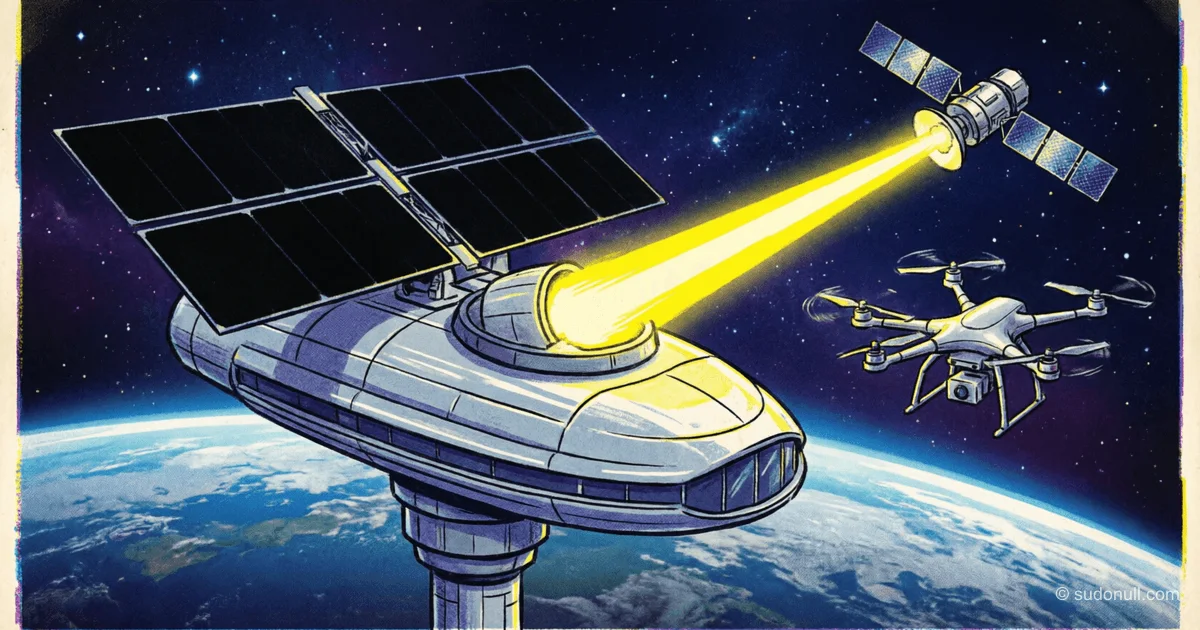
The Zhuigong project has made progress in building a ground-based system to verify microwave wireless power transmission. The technology will enable energy transfer from orbit to satellites, creating 'space wireless charging stations' to overcome reliance on solar panels.
The Zhuigong Project: Space Charging as a Trojan Horse for a New World Order
Author: Analytical Note, Internal Review
While the world was discussing Starship and quantum grants, from May 19-22, 2026, a Chinese team led by Academician Duan Baoyan from Xi'an University of Electronic Technology quietly reported successful ground tests of the 'Zhuigong' system (逐日 — 'Chasing the Sun'). The media wrote: 'China tested wireless charging for satellites.' That's like saying Apple released a new cable.
In reality, an event occurred that shifts the balance of power in space, energy, and military affairs simultaneously. The Zhuigong system is not a charger. It is the world's first operational ground model of a space solar power station (SSPS) with the ability to simultaneously recharge multiple moving targets. The numbers speak for themselves: 1180 W over 100 meters, 20.8% DC conversion efficiency, 143 W to a drone at 30 km/h. This is not a laboratory curiosity. It is an engineering breakthrough that starts the countdown to 2030—the year China will begin deploying a megawatt version in orbit.
[Essence]: What's Really Happening
Forget 'satellite charging.' That's the frontman, not the essence. The Zhuigong project solves three different tasks with one technology—directed energy transmission via microwave beam.
First. Killer of orbital shadow segments. Today, any satellite spends 30-40% of its time in Earth's shadow, where its solar panels are useless. The satellite either drains batteries or simply idles. Zhuigong in geostationary orbit (36,000 km) is in sunlight 99% of the time. A single beam from GEO can recharge dozens of satellites in low orbit, extending their lifespan from 5 to 15-20 years. This means a satellite operator (Starlink, OneWeb, China's GuoWang) can launch 3 times fewer satellites for the same coverage because each operates 24/7.
Second. A weapon disguised as energy. The technology is the same as an active phased array radar (APAR). A gigawatt-power microwave beam is not a 'charger.' It is directed energy weaponry. Duan Baoyan publicly stated: the same beam can be used to heat atmospheric moisture and control typhoon trajectories. Military applications are obvious: electronic suppression, disabling enemy satellites, creating interference. But officially, it's 'climate research.'
Third. Cross-border energy monopoly. When the system operates at full capacity (gigawatts of power from GEO), China can transmit energy to any point on Earth, bypassing power grids and pipelines. Imagine: Beijing tells Jakarta—'we will build you a solar power station in orbit and sell electricity at $0.01 per kWh.' This kills the oil, gas, and coal economies in developing countries. And it makes China the sole energy arbiter for half the world.
Non-obvious insight: The Zhuigong project and the recently funded startup Orbital Chenguang ('Orbital Dawn') are two halves of the same puzzle. On April 23, 2026, Orbital Chenguang received $8.4 billion in credit lines from 12 Chinese banks to build a space data center with over 1 GW capacity at an altitude of 700-800 km. Note: Zhuigong provides energy from GEO, Orbital Chenguang builds computing power in low orbit. China is creating a vertically integrated space infrastructure: energy (GEO) → transmission (microwave beam) → computing (low orbit) → communication with Earth. No country has anything like this even on paper.
[Timeline and Context]
This is a 12-year story that has only now emerged from the shadows.
- 2014: Duan Baoyan proposes the 'Omega' concept—a ring-shaped solar power station in GEO.
- 2022: A 75-meter ground test tower is built in Xi'an—a full replica of the future space system.
- 2023: Transition from 'one giant ring' to 'swarm of small modules'—an engineering solution that reduces risks and simplifies assembly.
- May 2025 (estimated): First successful 'one-to-many' tests—one transmitter charges multiple targets simultaneously.
- April 2026: Orbital Chenguang receives $8.4 billion for a space data center. The link with Zhuigong becomes obvious.
- May 19-22, 2026: Public announcement of results: 1180 W over 100 m, 143 W to a drone, 20.8% efficiency.
Chronological deception: The tests were completed not in May, but much earlier—likely in March-April 2026. But the news was held until May 19 to synchronize with the launch of the SMILE mission (May 18-19). This is a classic Chinese information strike: two breakthroughs in space technology in one week. SMILE—'soft' scientific diplomacy with Europe. Zhuigong—a hard technological demonstration for domestic audiences. Together, they create a narrative: 'China is the leader in all things space.'
[Who Wins and Who Loses]
Wins (totally): China's space program. They have just legitimized a technology that the US and Japan have been researching for decades. Caltech conducted MAPLE (power transmission from orbit to Earth) in 2023, but it was a 1-meter demonstrator. China has a working ground model with concrete numbers. The gap in practical engineering is 5-7 years in China's favor.
Wins: Orbital Chenguang and Chinese commercial satellite operators. $8.4 billion in loans is an advance on future energy from Zhuigong. Their business model (24/7 data center in orbit) makes no sense without a cheap and constant energy source. Zhuigong makes this business viable. Investors understood this and provided the money.
Wins: The Global South (Africa, Southeast Asia, Latin America). In theory. If China offers them orbital energy at prices below ground-based solar (which is realistic at scale), they gain access to electricity without building hydro, nuclear, or coal plants. This is a revolution comparable to the advent of mobile phones without copper wires. But the price will be political influence.
Loses (catastrophically): Competing US and Japanese space energy projects. Caltech MAPLE is at the 'proof of concept' stage. Japan's JAXA project is on paper. They have no 75-meter tower and no 1180 W over 100 meters. And they don't have $8.4 billion allocated for practical application. Private US startups (Virtus Solis, Solaren) will die if they don't find money in the next 12 months.
Loses: Future oil and gas corporations. If orbital energy becomes a reality by 2035, demand for fossil fuels for electricity generation in developing countries will collapse. Exxon, Shell, Saudi Aramco will lose trillions in potential sales. That's why they are now lobbying for sanctions against China's space program—but it's too late.
[What the Media Aren't Saying]
First. The 20.8% efficiency figure is both a breakthrough and a deception. Yes, it's the best result in the world for a 'one-to-many' system with moving targets. But commercial viability requires 40-50%. NASA achieved 54% in 1975, but under static conditions without beam auto-tracking. China remained silent on how much energy is lost to 'holding' the beam on a moving target. If 20.8% is the peak, and in real orbital conditions it's 10-12%, then the economics don't add up.
Second. Radiation safety is not discussed. A gigawatt-power microwave beam passing through the atmosphere—what does it do to clouds, birds, aircraft? Chinese sources avoid this topic. But if a passenger jet enters the beam's reception zone, its electronics will fail. If the beam deviates toward a city, the consequences are unpredictable. This is a weapon, and everyone knows it. No one says how China will control the beam to prevent it from 'accidentally' hitting something it shouldn't.
Third. Double game with Europe and the US. In the same May 2026, China launches SMILE—a joint mission with Europe to study the magnetosphere. Europe provides technology, China provides money and the launch vehicle. Three days later, China announces Zhuigong—a technology Europe also wants to develop but lacks the resources. China cooperates on some projects while racing ahead on others, using European knowledge to build its own competencies. Europe is the junior partner that doesn't realize it's being used.
[Forecast: Next 30 Days and 90 Days]
30 days:
By mid-June 2026, expect the first official statement from NASA or ESA in response to Zhuigong. Most likely, it will be 'we are working on this too' with a promise to allocate $200-300 million to accelerate their own programs. The US cannot ignore a competitor's breakthrough—it's a matter of prestige. If no such statement appears, it means the Americans admit they are behind and are switching to other technologies (laser power transmission, nuclear reactors in orbit).
90 days (by August 2026):
Watch for political reaction at the UN. Russia or the US will introduce a question in the UN Committee on the Peaceful Uses of Outer Space (COPUOS) about 'regulating energy transmission through outer space.' Under the guise of 'safety,' there will be an attempt to ban or restrict microwave power transmission because it gives China too great an advantage. China will veto (or simply ignore). This will set a precedent: international law cannot keep up with technology, and China operates in a gray zone.
Bet: Watch for contracts to launch Zhuigong demonstrators. The China Academy of Space Technology (CAST) may announce the launch of the first test module into low orbit as early as 2027, not 2030. If this happens, it means ground tests were so successful that they are shortening the timeline. The launch date of the demonstrator will be the main indicator of how confident China is in its technology.
Verdict: Zhuigong is the moment when 1970s science fiction (the idea of a space solar station) becomes 2020s engineering reality. But unlike many technologies, this one has immediate military, economic, and political consequences. China is not just building a 'satellite charger.' It is building infrastructure that will make it the energy hegemon of the 21st century. The US and Europe can either catch up (which will take 10 years) or accept the new reality. I bet on the latter. And get ready—in 90 days, this issue will be on the UN General Assembly agenda. Don't miss it.
— Editorial Team









No comments yet.