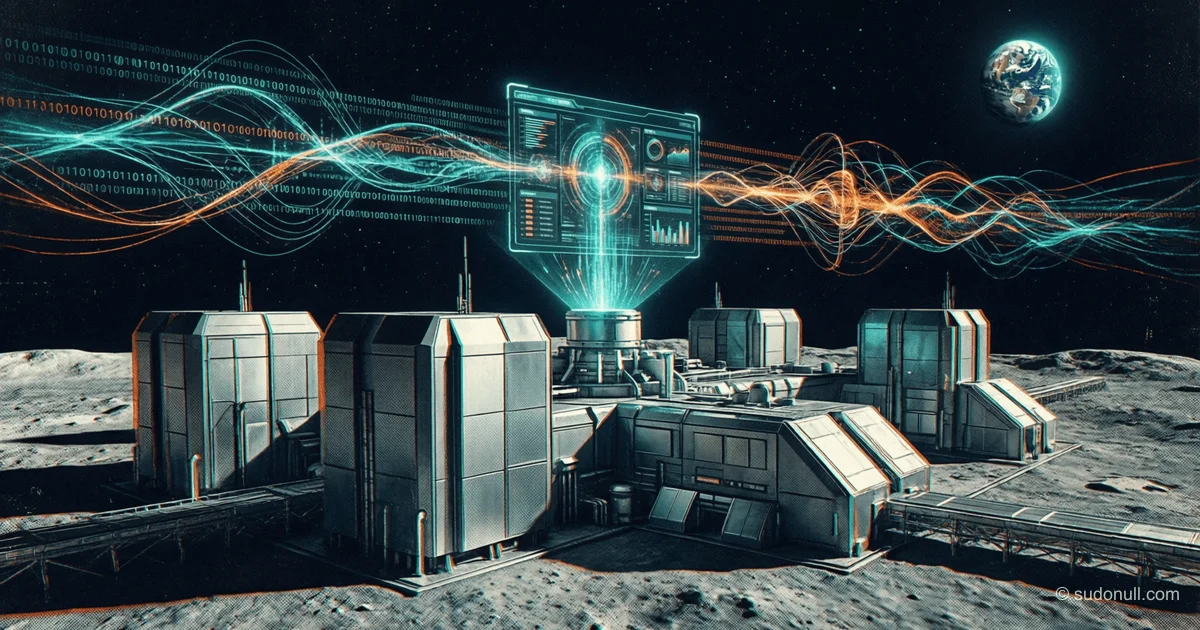
Russian Scientists to Use Digital Twins for Designing Lunar Nuclear Power Plant
Together with the Kurchatov Institute, specialists plan to develop digital models of a nuclear power plant on Earth's satellite, as the project 'has no right to fail'.
Digital Twin of the Moon: Why Rosatom Is Preparing a Nuclear Strike on Space with Software
[The Gist]: What Is Really Happening
On May 22, 2026, Vladimir Koshlakov, Director General of the Keldysh Center (part of Roscosmos), announced: work has begun on creating digital twins of a lunar nuclear power plant. Together with the Kurchatov Institute and the Lavochkin Association, specialists have planned a "comprehensive set of works incorporating digital technologies within the national project 'Space' and the federal project 'Atom'."
Koshlakov's phrase — "we have no right to fail. We must fly there, set it up, and be sure it works" — sounds grand, but behind it lies a harsh engineering reality. Delivering one kilogram of cargo to the Moon costs approximately $1.5–2 million. A nuclear power plant weighing several tons represents investments comparable to the budget of a small European country. A design error would cost between $5 and $10 billion in direct losses, plus a program delay of 5–7 years, because the next launch window isn't tomorrow.
But there is a detail almost no one noticed. This is not about a "digital twin" as a fancy presentation. It is about forced import substitution at the most critical stage.
Timeline and Context
This project has deep roots. Back in late 2025, Roscosmos signed a government contract with the Lavochkin Association to develop a lunar power plant through 2036. In early 2026, Vasily Marfin, Director General of the Lavochkin Association, clarified: three launches would be required in 2033–2035. Mikhail Kovalchuk, President of the Kurchatov Institute, gave an even more optimistic timeline — 5–7 years to deliver the station.
But the key event occurred at the CIPR-2026 conference in Nizhny Novgorod on May 21, 2026. That is where Koshlakov made his announcement. Coincidence? No. CIPR is Russia's main digital platform for industry. And it was there that Rosatom reported 92% import substitution in key software classes.
The synchronization is simple: while the conference reports on digital sovereignty, a project is announced that would be dead without that sovereignty.
Who Wins and Who Loses
Winners: Rosatom and its IT structures — Greenatom, RASU, TVEL. They have the AtomMind platform for industrial AI (version 2.0 release in Q4 2026) and the Operator Information Support System (OISS), already operating at the Kursk NPP and Rooppur NPP in Bangladesh. The lunar contract provides government funding to test technologies that will later be sold on Earth.
Winners: The Kurchatov Institute. They gain a testing ground for their extraterrestrial nuclear technologies. The status of a "lunar NPP" is a ticket to the superpower club, which includes only the US (Kilopower project) and no one else.
Losers: European and American suppliers of engineering analysis software — Siemens, Dassault Systèmes, Ansys. Their place in the lunar project has been taken by Russian PLM systems. Losses for Western vendors: contracts worth $50–100 million just from this project.
Losers: Private space companies like SpaceX or Blue Origin. Not because they are competitors, but because government projects of this scale drain budgets and expertise from the commercial sector in favor of state corporations.
What the Media Isn't Saying
The most non-obvious — and most important — point. When people say "digital twin of a lunar NPP," the average reader thinks of a 3D model. In reality, it is about a system that must operate under conditions where there is no real-time communication. The Earth-Moon signal delay is 1.3 seconds. For a nuclear reactor, that is an eternity.
Insight missing from the news: A real digital twin for the Moon is not just a copy of the station on an Earth server. It is a system that must operate autonomously, making decisions without human intervention. No existing digital twin of an NPP on Earth is capable of this. They all require a constant connection to the control center.
What does this mean? Rosatom will have to create the world's first fully autonomous digital twin for managing a nuclear installation beyond Earth. Algorithms must predict reactor behavior under temperature swings from -170°C to +120°C, in a vacuum, under radiation levels that kill ordinary electronics in days.
And the date no one is discussing: testing will begin not in 5 years, but in 2027 — on mock-ups in ground-based thermal vacuum chambers. The results of these tests will be classified immediately. If something goes wrong, we won't know.
Forecast: Next 30 Days and 90 Days
Next 30 days:
- Expect an announcement of specific deadlines for the first phase of the digital twin — likely November–December 2026.
- The first contracts between participating organizations will appear: Keldysh Center, Kurchatov Institute, Lavochkin Association. Amounts range from 500 million to 1 billion rubles (approximately $5–10 million) for the initial stage.
- Rosatom will showcase a live demonstration of the OISS at one of the forums (possibly Army-2026) as part of a PR campaign to justify lunar spending.
Next 90 days:
- A presidential decree or government resolution will be signed granting the lunar NPP the status of a project of national importance, with personal responsibility assigned to top-level supervisors. Without this, funding from the National Welfare Fund cannot be obtained.
- Development of a "roadmap" for creating the digital twin will begin, with specific milestones: mathematical model of the reactor (2027), integration with control systems (2028), ground tests in lunar simulation (2029).
- International reaction will emerge. The US, through NASA, will announce intentions to use their digital twins for Kilopower — to keep pace. A race will begin, not of hardware, but of software.
Digital technology in space is not about efficiency. It is about program survival. Rosatom and Roscosmos have no right to fail not because it is expensive. But because there may not be a second chance. Budgets are being cut. Government attention is diverted to other fronts. If the lunar NPP fails due to a design error, such a window of opportunity will never open again.
The digital twin is insurance not for the station, but for a political project. And its price is tens of millions of dollars already allocated in national projects. The only question is whether the programmers can keep up with the hardware. Historical experience says: usually not. But an attempt is not torture, especially when the status of a nuclear space power is at stake.
— Editorial Team






No comments yet.