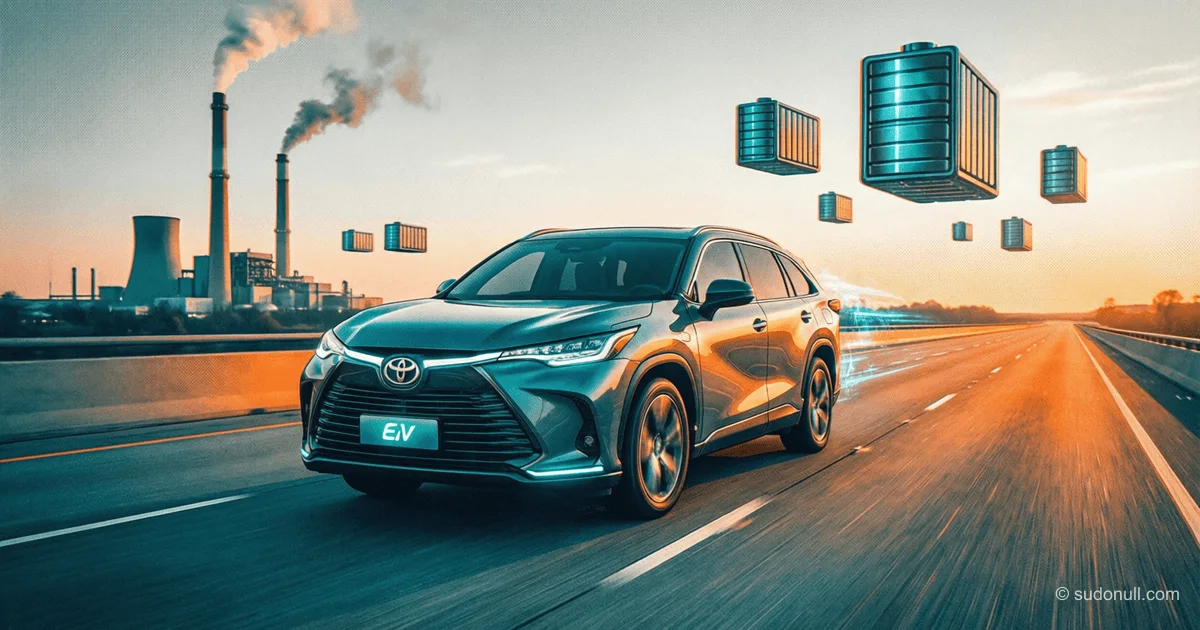
Toyota Invests $1 Billion in US Plants to Produce First Mass-Market Electric Vehicle
The company is upgrading its Georgetown plant to produce the electric Highlander crossover, aiming to increase its EV market share from 2% to 15%.
$1 Billion as Bait: Why Toyota Is Finally Shifting Gears
[The Gist]: What's Really Happening
The news looks like a belated sprint: on May 22, 2026, Toyota announces a $1 billion investment in plants in Georgetown, Kentucky, and Indiana. $800 million goes to modernizing the main Georgetown plant—Toyota's largest manufacturing asset worldwide. The goal is to start mass production of the electric Highlander by the end of 2026.
The official figure is "increase EV market share from 2% to 15%." Nice, ambitious. But it's not about market share. It's about survival.
What's really going on? Toyota can no longer drag its feet. Hybrids—their sacred cow—are profitable, but US and European regulators are killing the internal combustion engine. California will ban the sale of new gasoline cars by 2035. The Biden-Trump administration (depending on who's in charge) either imposes 15% tariffs on Japanese imports or promises subsidies for local production. Toyota is caught between a rock and a hard place: if they don't produce EVs in the US, they'll simply fall out of the market.
But the most interesting part isn't the Highlander itself. It's that Toyota is pretending the Highlander is their "first mass-market EV." In reality, they already had the bZ4X. It just flopped—fewer than 20,000 sales in the US in 2025. Now they're rebooting through their best-selling model. The Highlander is a bestseller with 3.6 million sold since 2001. They're taking a proven name and slapping a battery on it.
Timeline and Context
This news is the tip of an iceberg that has been building for years but accelerated sharply in the last six months.
December 2021: Toyota promises 280 GWh of batteries by 2030. Looks ambitious, but mostly for hybrid setups, not full EVs.
August 2022 – October 2023: The company adds another 40 GWh for BEVs and 30 GWh for the US market. Noticeable, but still slow.
March 2026: Toyota officially announces a $1 billion investment in Kentucky and Indiana—$800 million for Georgetown, $200 million for Indiana for the Grand Highlander. Highlander EV launch is slated for late 2026. By this point, they have only 2% of the US EV market.
May 2026 (now): A news item surfaces that no one connected to the previous one—Toyota filed an application to build a $2 billion plant in Texas, creating 2,000 jobs under the code name "Project Orca." Construction will start in late 2026, launch in 2030.
Connecting the dots. The $1 billion investment is not a "one-off." It's the first tranche. Behind it lies another $2 billion for Texas. Plus, in April 2026, Toyota and LG Energy Solution announced a joint venture for battery recycling in North Carolina. They're closing the loop: production—disposal—recycling. Directly, to bypass the Chinese monopoly on cobalt and lithium.
Who Wins and Who Loses
Kentucky and Indiana win: Toyota plants are the largest employers in the region. Although no new jobs are created directly (the money goes to retooling, not expanding headcount), maintaining 8,000+ jobs at the Georgetown plant is critical for the local economy.
LG Energy Solution wins: Their joint venture with Toyota on battery recycling starts in 2026. Toyota becomes not just a customer but a partner across the entire chain.
Whoever comes after Trump wins: The investments are planned for 5-10 years. The $2 billion in Texas will only start paying off by 2030. Toyota is hedging against political risks: invest money in the US—so you're in the game, regardless of who's in the White House.
Tesla loses: Not directly. Tesla still dominates the EV market, but their problem is a limited model lineup. Toyota is launching the Highlander, Grand Highlander, and two more new EVs (a total of over 6 models planned by the end of 2026). In the three-row SUV segment, Tesla only has the Model X, which starts at $80,000. The Highlander will cost $50,000–60,000. That's a direct hit.
Ford and GM lose: They've already lost the EV race (Ford loses $4.5 billion a year on its EV division, GM $2.5 billion). Toyota's arrival with their legendary manufacturing efficiency (lean production, kanban, just-in-time) means EV prices will drop, and margins will shrink even further. Ford and GM can't compete with Toyota on assembly cost.
What the Media Isn't Saying
The most important insight, completely ignored in the news: Toyota is betting not on "pure" EVs, but on a multi-fuel platform. They won't build a separate architecture just for battery cars.
What does that mean? The Highlander EV's high-voltage platform must be compatible with hybrid, hydrogen (Toyota is still investing in the Mirai despite poor sales), and possibly even gasoline versions. It's an engineering compromise. An EV on such a platform will always be worse than a dedicated EV from Tesla or Rivian. Less range, slower charging, interior space not optimized for the battery.
But. This approach has a hidden advantage that no one is discussing. Toyota can switch production lines between ICE, hybrids, and EVs in a matter of days. If EV demand drops (and it is already dropping in the US in 2026), they can simply go back to producing gasoline Highlanders without retooling the plant. Tesla can't do that. Ford can't. GM can't.
And most importantly: they're not saying how much the Highlander EV will cost. A range of 320 miles is about 515 km. Competitive. But the price will be $10,000–12,000 higher than the gasoline version. In the current economy, with US inflation still at 4-5%, buyers aren't ready to pay +25% for "eco-friendliness." Toyota knows this. So they're not rushing. They're waiting for battery prices to drop to $80 per kWh (currently around $110). Only then will they fully step on the gas.
Forecast: Next 30 Days and 90 Days
Next 30 days (by end of June 2026):
- Toyota will announce a partnership with another US battery manufacturer. Likely SK Innovation or Panasonic. They already have LG; they need a second source.
- Tesla (TSLA) shares will take a short-term hit of 5-7% on competition fears, but will recover when investors realize the Highlander EV is not a "Tesla killer" but a "Ford Mustang Mach-E killer."
- In Texas, public hearings on "Project Orca" will begin. Locals will oppose. Toyota will spend $2-3 million on lobbying.
Next 90 days (by end of August 2026):
- Toyota will officially announce prices and trims for the Highlander EV. Key bet: base version from $52,900 ($8,000 more than the gasoline version). That's $27,000 less than the Tesla Model X.
- First test drives for journalists will begin. Expect glowing reviews about "typical Toyota quality" and restrained ones about "outdated platform."
- Most importantly: Toyota will announce the transfer of Highlander EV battery production from Japan to the US. This will allow them to qualify for the full $7,500 tax credit under the IRA (Inflation Reduction Act). The effective price for buyers will drop to $45,400. And then—a real market shock.
Toyota has finally woken up. But not as a "revolutionary." As an "incrementalist" with a $10 billion budget and patience that Tesla, Ford, and GM lack. They're not trying to overtake Tesla tomorrow. They're trying to outlast it in 10 years, when battery prices drop, charging infrastructure becomes ubiquitous, and buyers stop dividing cars into "electric" and "regular." Then it will become clear who knows how to make cars—and who only makes batteries on wheels.
— Editorial Team










No comments yet.