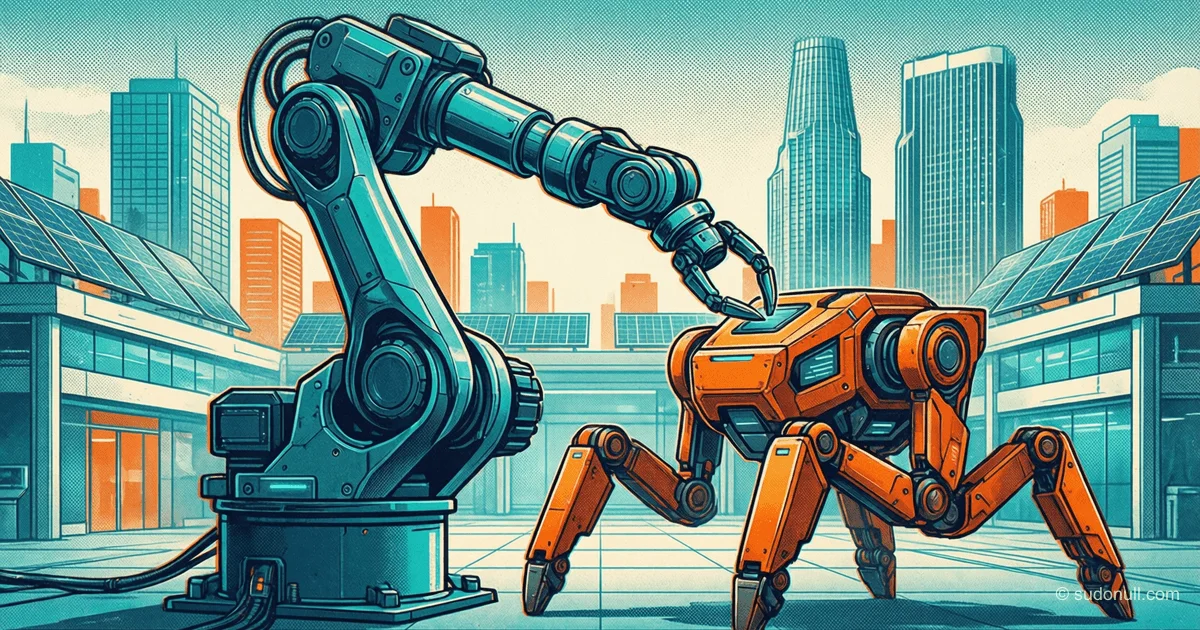
NVIDIA and Kawasaki Heavy Industries to Build Robotics Center in Silicon Valley
The companies announced the construction of a joint research center to develop new solutions in industrial robotics and automation.
When samurai meet silicon: why the NVIDIA-Kawasaki center in San Jose is not about robots
[The Gist]: What's really happening
At first glance, the news from May 21, 2026 looks like a routine collaboration: Japanese industrial giant Kawasaki Heavy Industries (market cap ~$5.1 billion) is leasing space from NVIDIA in Silicon Valley to jointly build "physical AI." Officially — a center in San Jose, launch in 2026, focus on medicine, mobility, and the four-legged robot carrier Corleo.
But the essence runs deeper. This is not a deal between two companies. It's an architectural shift flying under the headlines.
Notice the resident lineup of the new center. Besides NVIDIA (NVDA) and Kawasaki (KWHIY), Analog Devices (ADI), Microsoft (MSFT), and Fujitsu are moving in. This is not an IT meetup. ADI makes analog chips and sensors for extreme conditions. Fujitsu does heavy software and mainframes. Microsoft brings the cloud.
Kawasaki is deliberately building not a "lab" but an ecosystem hub on foreign soil. Why would a Japanese company with its own factory capacity set up a center in San Jose? Because the old ways of working are dead. Physical AI is not when you buy a controller and program a conveyor belt. It's when you train a neural network in simulation, then load it into hardware running on Foxconn lines. And you have to do that where the brain of this universe sits — NVIDIA.
Timeline and Context
To grasp the scale, overlay this news on NVIDIA's event map over the last 90 days:
- March 2026 (GTC): NVIDIA announces the Physical AI platform. Jensen Huang declares: "Every industrial company will become a robotics company." He unveils Cosmos (world foundation models) and Isaac GR00T N1.7 for humanoid robots.
- April 16, 2026: NVIDIA expands its partnership with Cadence. The goal is to close the simulation-to-real gap using digital twins.
- May 21-22, 2026 (now): Announcement of the center with Kawasaki and an immediate market reaction — Kawasaki shares surge 12% in a day, pulling up Fanuc (+8%) and Yaskawa (+6%).
Notice the synchronization. Kawasaki announces the project two months after GTC. This is no coincidence. It means negotiations were ongoing all that time, and the result was not a chip supply deal but a shared engineering environment.
Who Wins and Who Loses
NVIDIA wins: They are selling not just GPUs (H100/B200) but a platform. The Kawasaki center is a showroom for the world. Every Japanese, German, or Korean machine tool maker now sees: if you want to do Physical AI, you go to NVIDIA's rack, not write your own software from scratch.
Kawasaki wins: They get a backdoor into NVIDIA's architecture. Kawasaki engineers will now sit in the same building as Isaac Sim and Omniverse developers. This cuts the error-fix cycle from months to days. Plus, Kawasaki is increasing robotics investment by 100 billion yen (about $630 million) in the next fiscal year. They are going all-in.
Microsoft Azure wins: The center will use Microsoft's cloud for computing. That's tens of millions of dollars in annual contracts.
European controller giants lose (Siemens, Bosch Rexroth): Their business was built on "hardware solves everything." Now intelligence moves to the cloud and GPUs, leaving only drives to the factory. Margins shrink.
Tesla Optimus loses (in the long run): Not because Tesla is bad. But because Tesla is trying to make a universal humanoid robot for everyone. NVIDIA, through Kawasaki, is building a network of specialized industrial solutions. On a Toyota factory floor, you don't need an Optimus that can dance. You need a manipulator that knows how to tighten a bolt to 2.5 Nm in a vibrating environment. Kawasaki has that data. Tesla doesn't.
What the Media Isn't Saying
The most important insight — what press releases stay silent about — concerns Corleo.
Yes, formally it's a "four-legged personal transporter." But look at the partner lineup: Analog Devices (sensors), Fujitsu (system integration). Corleo is not about transporting a person. Corleo is the legacy code on which the death of old programming is tested.
Understand: Kawasaki's industrial robots from the 1980s were programmed manually. An engineer wrote code for every movement. Corleo is an attempt to build a robot that learns on its own in the NVIDIA Isaac Sim environment. If successful, all the old production lines sitting in Toyota, Honda, and Boeing factories could be upgraded without physical restructuring. Just replace the controller with Jetson Thor and retrain the AI. The market for such modernization in the US and Japan is estimated at tens of billions of dollars.
The second hidden point is safety. FDA, ISO 13485, and medical robot standards are nearly impenetrable for AI startups. But when Kawasaki (with its 50 years of certification experience) and NVIDIA (with its simulations) go into medicine together, they create a prototype for regulatory approval of AI hardware. Whoever first gets a certificate for a "trainable" surgical robot will split a $40 billion market.
Forecast: Next 30 Days and 90 Days
Next 30 days (by end of June 2026):
- CEO change or restructuring at Kawasaki? The market demands acceleration. Given the 12% stock surge, Kawasaki's board may announce the spin-off of its robotics division into a separate company or hire a top manager from FAANG to lead the San Jose center.
- Announcement of a "hardware" partner. Currently the center has ADI (chips) and MSFT (software). No "hardware." Within a month, expect news that either Festo (pneumatics) or Schaeffler (mechanics) will join the project to close the loop.
Next 90 days (by end of August 2026):
- First "digital twin" of a factory. NVIDIA and Kawasaki will demonstrate a full replica of a Kawasaki motorcycle assembly plant in Omniverse. AI will control real robots through this twin. If the test succeeds, both companies' stocks will get a new boost.
- EU regulator reaction. The European Union, which already fines Microsoft and Google, may launch an antitrust investigation against NVIDIA. Argument: "NVIDIA is creating a closed ecosystem for industrial AI." This will slow but not stop the project, as the center is physically in the US.
My year-end forecast: By December, we will see the first Kawasaki robot sold not as a "CNC machine" but as a "Physical AI subscription" (Robots-as-a-Service). And you will pay not for the hardware, but for compute hours on NVIDIA GPUs. That is the goal of this entire deal. Not to sell a chip. To sell an eternal annuity.
— Editorial Team



No comments yet.