UC Berkeley Engineers Train AI to Automatically Design Transformer Robots
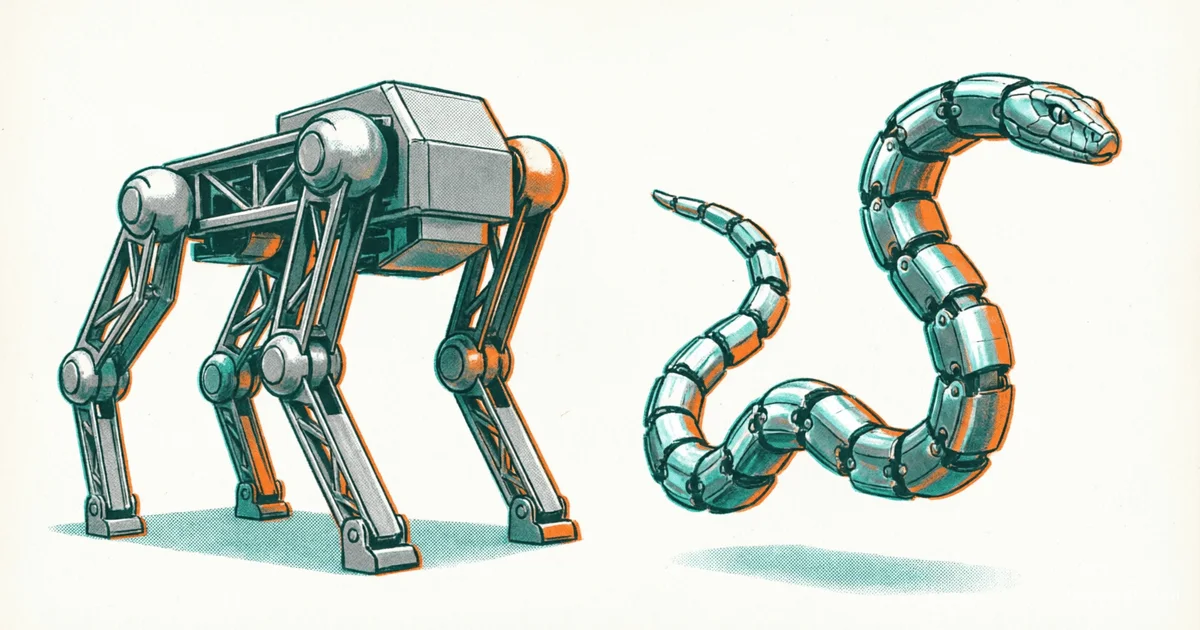
Researchers have developed an AI framework for optimizing the design of modular, shape-shifting robots. The system can automatically create machines capable of, for example, changing the shape of a helmet or moving on all fours.
'Metatransformers' from Berkeley: Why the AI architect designing robots is more important than the robot itself
[The Gist]: What's Really Happening
On May 11, 2026, a team led by Professor Linin Yao from the University of California, Berkeley (with participation from Carnegie Mellon and Georgia Tech) published a framework for the automatic design of 'metatransformer' robots.
The media writes about 'robots that change shape like octopuses.' Headlines scream about a miracle AI that designs robots by itself. This is true, but only the tip of the iceberg.
Here's what's really happening: the researchers cracked the curse of dimensionality in modular robotics design. They solved a problem that has plagued this field for decades—the exponential growth in control complexity with each added moving element.
Robots made of metatrusses (metal trusses with hundreds of beams and rotating joints) can theoretically take any shape: compress like an accordion, morph from a quadruped to a snake-like form, change the contours of a helmet to fit a user's head. But practical control is a nightmare. If you have 200 joints, each with several positions, the combinatorial state space explodes to astronomical numbers.
The usual approach is to manually group actuators into controllable networks. As Professor Yao says, this is 'tedious and labor-intensive.' The Berkeley team simply said: 'Forget it. AI will find the optimal grouping itself.' And it did.
Timeline and Context
To understand why this May 2026 event is not ordinary but tectonic, we need to look at Berkeley's prior work in robotics:
- March 2025: Sergey Levine (the renowned Berkeley professor, co-founder of Physical Intelligence) gives a lecture at the University of Toronto on 'foundation models for robots,' where the main problem is data collection. Without data, no learning; without learning, no autonomy.
- January 2026: Berkeley publishes Fanchen Liu's dissertation on scalable robot learning, presenting the MOKA and OTTER systems, which attempt to connect language models with control.
- February 2026: NVIDIA Research, together with Berkeley, releases work on 'world models' for robots—teaching AI to predict physics through video.
- April 2026: Shankar Sastry (another Berkeley pillar) gives a talk on 'trustworthy autonomous systems,' reminding us of Moravec's paradox: 'programming a humanoid robot to open an unfamiliar door is one of the hardest engineering tasks.'
- May 11, 2026: And here it is—a working system that doesn't teach a robot a single task, but designs the robot itself for the task.
Key detail: the work is done at the intersection of mechanical engineering and computer science. Not 'just another control algorithm,' but a systemic solution from hardware manufacturers tired of struggling with controllers.
Who Wins and Who Loses
Winners:
- DARPA and military contractors (Lockheed Martin, Raytheon). A robot that changes shape depending on the task is a tactical reconnaissance dream: crawl through a pipe like a worm, exit as a spider, lift a load and transform into a crane. Berkeley's AI framework allows designing such robots without billions of man-hours of debugging.
- Space agencies (NASA, ESA, SpaceX). Launching into orbit requires minimal weight. A truss of a hundred actuators can be packed into a single cube, then deployed to assemble an antenna or repair a satellite. The AI designer optimizes not only shape but also the number of 'brains' (controllers).
- Medical robotics. The 'tentacle' prototype made by the team could become the basis for future endoscopes that decide how best to bend through the intestines.
- The Berkeley team itself (Yao and co-authors). This is a guaranteed Best Paper Award at any top robotics conference (ICRA, RSS 2026) and millions in grants for the next 5 years.
Losers:
- Companies selling 'tools for manual robot design' (SolidWorks with plugins, MSC Adams). The manual labor of grouping actuators, which currently costs thousands of dollars in engineering time, is automated. Add-ons for 'dynamic optimization' become unnecessary.
- All startups building stationary, non-shape-shifting robots for narrow niches. Suppose your robot can only crawl through pipes. A Berkeley robot loaded into the same API could crawl, walk, and grasp. Your niche will disappear as soon as the technology becomes cheap enough for commercial use.
What the Media Isn't Saying
Insight #1: This is not a 'universal robot constructor,' but a 'Neural Network Fixed Price.'
The system doesn't just generate a design. It simultaneously optimizes two layers: geometry (where which beams go) and controllability (how many controllers are needed). The researchers found a 'sweet spot': increasing the number of control networks yields performance gains only up to a certain threshold, after which diminishing returns set in.
What does this mean in practice? Designers no longer have to think: 'I'll put 50 micro-motors for more precision.' The system itself will say: 'For the task of "become a helmet and compress the head," you need 4 control groups. The other 46 motors will just be dead weight.' This is automatic fighting excessive complexity—the main disease of modern robotics.
Insight #2: Where's the connection with Physical Intelligence (PI)?
Sergey Levine, who also works at Berkeley, is a co-founder of Physical Intelligence—a startup building a foundation model for any robot. His thesis: 'One brain for all bodies.' Linin Yao's work provides a tool for creating optimal bodies for specific tasks. If combined, we get a system that designs both the body (metatruss) and the brain (PI policy) from scratch. Essentially—a robot factory from zero.
Why is the media silent about this synergy? Because it requires understanding Berkeley's internal workings. It's like having the inventor of the internal combustion engine and the inventor of the wheel at the same university. But they write press releases separately.
Insight #3: Moravec's paradox strikes again—and here it's bypassed.
Shankar Sastry in April 2026 reminded that '40% of the human cerebral cortex is dedicated only to hands and face.' Controlling shape is even harder than controlling a hand. But Yao's team found a workaround: they don't control each joint individually in real time. They control macro-states (actuator network A enables 'walking' mode, network B enables 'grasping' mode). This is engineering genius: instead of teaching a robot thousands of micro-movements, they embedded a 'gear shifter' directly into the neural network architecture that designs the robot.
Forecast: Next 30 Days and 90 Days
Next 30 days (June 2026):
- The framework's code repository will open on GitHub (Berkeley tradition—open source). Teams from China and Germany will copy the idea for their 22FDX nodes and FPGAs within a month.
- Linin Yao will be invited to give a plenary talk at the IEEE International Conference on Robotics and Automation (ICRA 2027), but she will likely speak at RSS 2026 in July.
Next 90 days (August 2026):
- Boston Dynamics will make a restrained statement that they 'already use similar methods for Atlas,' but in reality—no. Their hydraulics are too inert for metatransformers. They will urgently seek partners among electric actuator manufacturers.
- NVIDIA will release a simulator for metatransformers based on Omniverse with support for this framework. They already work with Berkeley on 'world models,' so integration will be seamless.
- The first commercial scandal will emerge: some startup will claim to have made a 'smart airbag' that changes shape on impact—actually just copying the helmet prototype from the Berkeley paper. And it will be legal because patenting optimization algorithms is difficult.
Main risk: scalability. The paper worked with hundreds of beams. What if there are thousands? Or tens of thousands? Complexity still grows, albeit more slowly. At some point, finding the optimal grouping of controllers becomes an NP-hard problem even for AI, and the framework will hit a computational complexity wall. But for 90% of practical tasks (helmets, rescue robot limbs, modular manipulators), this is sufficient.
Conclusion: Berkeley researchers didn't just make a 'transformer robot.' They made an 'AutoCAD for physics.' They automated the part of engineering that was considered 'unautomatable'—the intuitive sense of how many actuators to put where. As a result, designing shape-shifting robots transforms from an elite art into a routine procedure: upload requirements, run AI, get blueprints. In 5 years, metatransformers won't be in labs but in children's kits: 'Build your own robot, and the neural network will teach it to become a car or a plane.' Goodbye, Lego Mindstorms; hello, Metatruss AI.
— Editorial Team










No comments yet.