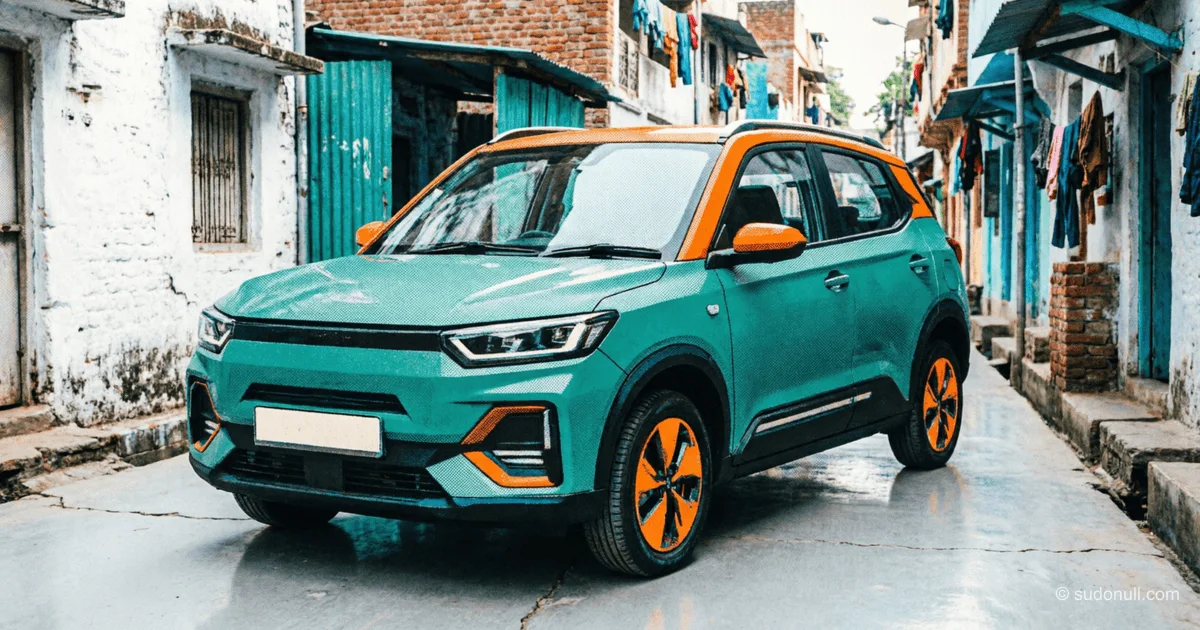
Updated Tata Tiago EV with 360-Degree Cameras and New Design Unveiled
The Indian automaker has revealed the specs of the updated electric vehicle ahead of sales launch on May 28. While the powertrain remains unchanged, the hatchback gets a completely redesigned front end and a surround-view system.
Updated Tata Tiago EV: The 'People's Electric Car' Challenges Luxury
The Gist: What's Really Happening
On May 21, 2026, Tata Motors officially unveiled the updated Tiago EV, along with its gasoline sibling, revealing first details after a series of teasers. Sales are set to begin on May 28. Media outlets are reporting 'new design and 360-degree camera,' but that's just the tip of the iceberg.
Here's what's really happening: Tata isn't just refreshing the looks—it's reshaping the economics of the affordable EV segment, striking back at Mahindra after losing revenue leadership. The key feature of this facelift isn't the new LED headlights or the 10.25-inch screen, but the introduction of a surround-view system and, likely, six airbags.
Why does this matter? Because 360-degree camera technology and an expanded safety package have never been available in a budget hatchback in India before. Tata is effectively offering premium-segment features at a city car price (with an expected increase of $300–500). This is a 'paradigm shift' in positioning.
Timeline and Context
- Fiscal Year 2026 (ended March 31, 2026): Mahindra & Mahindra surged ahead in EV sales revenue (₹15,089 crore vs. Tata's ₹14,995 crore), narrowing the volume gap and eating market share. Tata lost 10.6% market share, though it sold 78,811 units physically.
- April 2026: Tata still leads in volume (8,543 units), but Mahindra is hot on its heels.
- May 20–21, 2026: Tata releases video teasers of the new Tiago and Tiago EV. Key changes include LED lighting, redesigned bumpers, connected taillights (a first for this model), and cameras on the front bumper and side mirrors.
- May 28, 2026: Official sales launch and price announcement.
Key detail: This is the first facelift for the Tiago EV since its launch. It's meant not just to refresh the lineup but to stop customer defection to the Mahindra XUV400 and possibly compete with newcomers like the MG Comet, which are pulling budget buyers.
Who Wins and Who Loses
Winners:
- Tata Motors. A facelift is a cheap way to raise average selling price (ASP) without developing a new platform. By adding a 360-degree camera and 6 airbags, Tata can hike the price by ₹30,000–50,000 (about $350–600) over the old version. This directly improves margins and allows competing with Mahindra on features rather than volume, especially since Mahindra overtook Tata in revenue.
- Buyers in megacities (Delhi, Mumbai, Bangalore). A 360-degree camera in a compact hatchback solves parking problems in crazy traffic and narrow streets. Previously, such features required spending $15,000–20,000 on a higher-class car.
- Camera and ADAS system supplier (likely Bosch or Continental). Tata is the largest player by volume (nearly 39% market share in FY26). A contract to equip a mass-market model with 360-degree cameras means millions of units and a massive order.
Losers:
- Mahindra (short-term). They just declared themselves 'revenue leader,' but Tata fires back immediately: 'You have expensive SUVs; we have a cheap hatchback with features your budget models lack.' Mahindra can't respond in the same price segment because they have no direct Tiago EV competitor in the budget niche.
- MG Comet. It's a direct rival to the Tiago EV (both small, urban). The Comet has quirky design, but the facelifted Tiago EV now looks more modern and offers more tech for comparable money.
What the Media Isn't Saying
Insight #1: This isn't a design update—it's a 'title defense operation' using a zero-sum game strategy.
In the Indian market, where price matters and EVs are still more expensive than gasoline cars, you can retain buyers only two ways: discount or technology. Tata can't keep dumping (margins are already thin in the budget segment), so they chose technology.
For an Indian driver, a 360-degree camera isn't a 'nice bonus'—it's a 'deciding factor' at purchase. Indian cities are among the most congested globally, and parking is stressful. By adding this feature, Tata created an insurmountable gap in consumer appeal versus the Mahindra XUV400 (which starts at a higher price) and base versions of competitors. They're changing the game: now in the sub-$15,000 segment, having a 360-degree camera will become an expected standard, not a luxury.
Insight #2: The powertrain remains unchanged, but that's a feature, not a bug.
No review says this outright: Tata deliberately avoided increasing the battery or power. They kept the old 19.2 kWh and 24 kWh batteries with ranges of 223 km and 293 km, respectively.
Why? Because it's about keeping the price low. Adding 5 kWh to the battery would add $1,000–1,500 to the car's cost, pushing the Tiago EV out of the 'people's EV' category into 'expensive hatchback,' where it would lose to larger models. Tata sacrifices range (less critical for city driving) for affordability and loaded features. This is a deliberate, risky, and brilliant compromise: 293 km ARAI translates to about 220–240 real-world km in the city, enough for a week of commuting.
Insight #3: 6 airbags aren't about safety—they're about exports.
Tata Motors is ramping up export potential. Southeast Asia and Africa demand high safety levels. By making 6 airbags standard (or an option) on the Tiago EV, Tata streamlines production and gains the ability to sell this model in markets with strict safety ratings (e.g., Latin NCAP). This reduces development costs for export versions.
Forecast: Next 30 Days and 90 Days
Next 30 days (June 2026):
- Price shock. Tata will announce prices for the facelifted Tiago EV ranging from ₹850,000 to ₹1,190,000 (about $10,200–$14,300), 5–7% higher than the old version. The old version will be sold with discounts through end of June.
- Volt rush: Tata will launch an ad campaign emphasizing 'SUV technology in a pocket hatchback.' Mahindra will try to respond with discounts on the XUV400.
Next 90 days (August 2026):
- Market share recovery. Tata Motors will reverse its revenue market share decline, clawing back 3–5% from Mahindra by raising the ASP of the updated Tiago EV. Expect an Autocar India article: 'Tiago EV is once again the best-selling EV in India.'
- Launch of 'Tech' trim. Tata will release a special Tiago EV version with an enlarged 30 kWh battery (350 km ARAI range), but only as a top trim at $16,000 to compete with the upper segment and stop customer 'migration' to pricier models.
Main risk: Infrastructure. If India doesn't solve fast-charging issues in residential complexes, even a 360-degree camera won't save the day. The Tiago EV buyer is someone without a home garage (street parking). The 360-degree camera helps park but doesn't help charge. Second risk: cannibalization of gasoline Tiago sales. If the facelift pushes Tiago ICE prices too high, Tata risks losing its traditional 'people's car' buyers.
Conclusion: The updated Tiago EV isn't just a 'new face.' It's a marker of the Indian EV market's maturity. Players are shifting from a 'discount war' to a 'features war.' Tata was the first in the budget segment to understand: customers are willing to pay 10% more if they get a tech experience unavailable in a gasoline car. The 360-degree camera is a symbol. The reality is a shift in EV perception from 'savings' to 'premium accessibility.' And that's a winning strategy.
— Editorial Team










No comments yet.