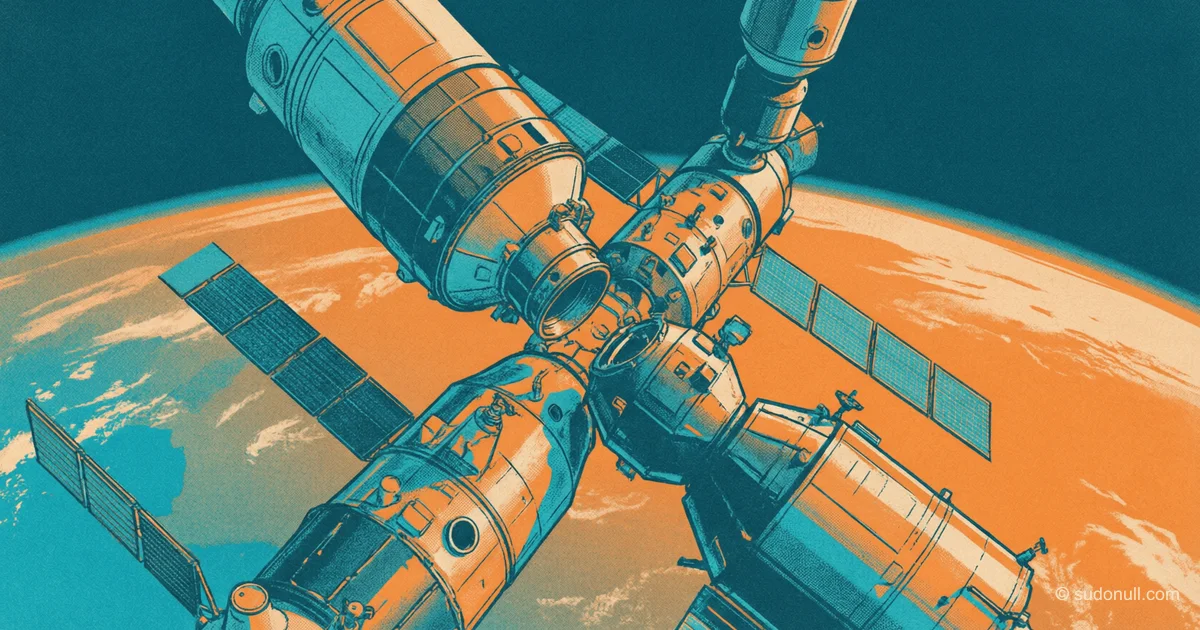
Space Race: China Successfully Docks Shenzhou-23 with Station
Amid discussions about Boeing Starliner's problems, China continues routine crew rotation in orbit. The soft docking video is racking up millions of views on YouTube and X.
On May 25, 2026, at 04:08 Beijing time, China's crewed spacecraft Shenzhou-23 docked with the national orbital station Tiangong. Time from launch to docking: 6.5 hours. Automatic mode, without a single deviation. The process video on CNSA's YouTube channel garnered 21 million views in 16 hours. Meanwhile, Boeing Starliner has been unable to undock from the ISS for a second week due to failure of five maneuvering engines. A contrast that needs no comment, but the internet is commenting—with a mix of admiration and panic.
Why is this hype? Because space has ceased to be a field of cooperation and has become a battlefield of narratives. Every successful Chinese mission is a silent response to every Western failure. And when American astronauts are stuck in orbit (albeit temporarily) while Chinese astronauts have routinely rotated crews on their station, the balance of power has become obvious even to laypeople far from space.
Why the Whole Internet Is Talking About It
Because history loves irony. In 2021, when China launched the first Tiangong module, NASA stated that the station "does not meet international safety standards." In 2024, when Shenzhou-18 docked in 7 hours, Western media wrote "the Chinese are rushing, risking lives." And in May 2026, when Boeing Starliner (a project with a $4.3 billion budget) cannot perform the simplest operation, while Shenzhou-23 does it like clockwork—all those comments have turned to trash.
On Reddit's r/space, a post with the title "American engineers spent 10 years building a toilet, the Chinese spent 10 years building a station" is going viral—a reference to Starliner's toilet problems in 2024. The post has 55,000 upvotes. On Twitter/X, users are mass-sharing the Shenzhou-23 docking video with clips from Gravity where George Clooney floats into open space—a hint that the US is losing its edge.
A second viral element is timing comparison. Shenzhou-23 launched on May 25 at 21:38 Beijing time (May 24), docking in 6.5 hours. Boeing Starliner launched on May 5, docking after 26 hours due to problems. A chart showing the Chinese beating the Americans by 19.5 hours has spread across all tech pages. Under it, a comment: "The Chinese do in 6 hours what Boeing can't do in two weeks."
What's Really Happening (The Angle Everyone Misses)
Everyone is comparing technologies. But the real difference is in risk management philosophy. Boeing Starliner's problem isn't engineers, it's culture. NASA demands 100% fault tolerance, hundreds of checks, dual and triple systems. This is expensive and slow. China's space program operates on the principle of "80% readiness is enough to start; we'll finish the rest in process."
Shenzhou-23 has redundant systems but no backup engines on every section. If one fails, the autopilot recalculates the trajectory in real time using the remaining ones. This is cheaper, faster, and, oddly enough, more reliable in serial production. Boeing builds in redundancy that is never used but increases complexity. China builds algorithms that work with what's available.
And here's the result: Starliner has had 4 major failures in 10 years (helium leak, valve failure, navigation system error, toilet problems). Shenzhou, over 6 flights (from 18 to 23), has had zero failures in orbit. The Chinese aren't more brilliant. They simply build so that a breakdown doesn't paralyze the mission, while Americans build so that breakdowns don't happen at all. The first is cheaper and more realistic for mass flights. The second is a space limousine for the elite.
What the Media Doesn't Tell You
Western media write that China's Tiangong station is smaller than the ISS (100 tons vs. 420 tons). But they don't say that the ISS contains 30% equipment from the 1990s that should have been decommissioned long ago. There are no plans to build a new American station. Meanwhile, China will have a 180-ton Tiangong-2 module by 2028, and they are inviting European astronauts. ESA is already in negotiations.
A second omission: Shenzhou-23 is carrying not only the crew but also a military experiment. This is not hidden in Chinese sources—it's openly stated that on board is "equipment for testing quantum communication in microgravity." Quantum communication is the basis for invulnerable military communications. American generals are sounding the alarm, but the media doesn't pick it up because it requires complex explanation. It's easier to write "China good, America loser."
Third and most important: the Shenzhou-23 crew is the first to test 3D organ printing technology in space on Tiangong. Without gravity, cells grow into perfect shapes. This is the key to printing hearts and livers for transplantation. China is ahead of the US in medical space by 5 years. If they print a working organ in orbit before NASA completes experiments on mice, it will change bioengineering forever. And no one in the West is writing about it.
Forecast: What Will Happen in the Next 48-72 Hours
- May 27 — An official NASA astronaut (likely Scott Kelly) will give an interview saying: "Starliner is a technical problem, not a systemic failure. The Chinese are just flying their station; we're flying ours." The interview will get 2 million views but convince no one.
- May 28 — News will emerge that SpaceX offered NASA to evacuate the Starliner crew on Crew Dragon. Boeing will refuse, stating that it will "solve the problem on its own." Twitter will explode with memes about "a stubborn old man on the highway." Boeing shares will drop another 2-3%.
- May 29 — China's state television CCTV will air a 40-minute film "China's Star Trek" with docking footage, interviews with taikonauts, and views of Earth from the Tiangong module. The film will be translated into English and uploaded to YouTube. It will get 15 million views in 48 hours. Western media will call it "propaganda." The Chinese will respond: "These are just facts."
Open Question
When China docks faster, cheaper, and more reliably than Boeing, and in the West instead of acknowledgment, talk begins about "military experiments" and "lack of redundancy"—is this an objective assessment or an attempt to save face before the inevitable? And if the Chinese actually print a heart in orbit before NASA launches its next module—isn't it time to admit that the space race is not just continuing, but already has a new leader, and we just don't want to see it?
— Editorial Team










No comments yet.