Realme launches budget smartphone 16T 5G in India with 8000 mAh battery
The new device is powered by the MediaTek Dimensity 6300 chipset and runs Android 16. It is designed for long battery life and comes in several colors.
Realme 16T: when a budget phone gets flagship-level armor
The gist: what's really happening
On May 22, 2026, Realme launched the 16T 5G smartphone in India with an 8000 mAh battery and MediaTek Dimensity 6300 chipset. Sales start on May 27 via Flipkart.
Media outlets are writing about a "massive battery," "three days of usage," and "an affordable price starting at 26,999 rupees (around $320) with discounts." All true, but just the tip of the iceberg.
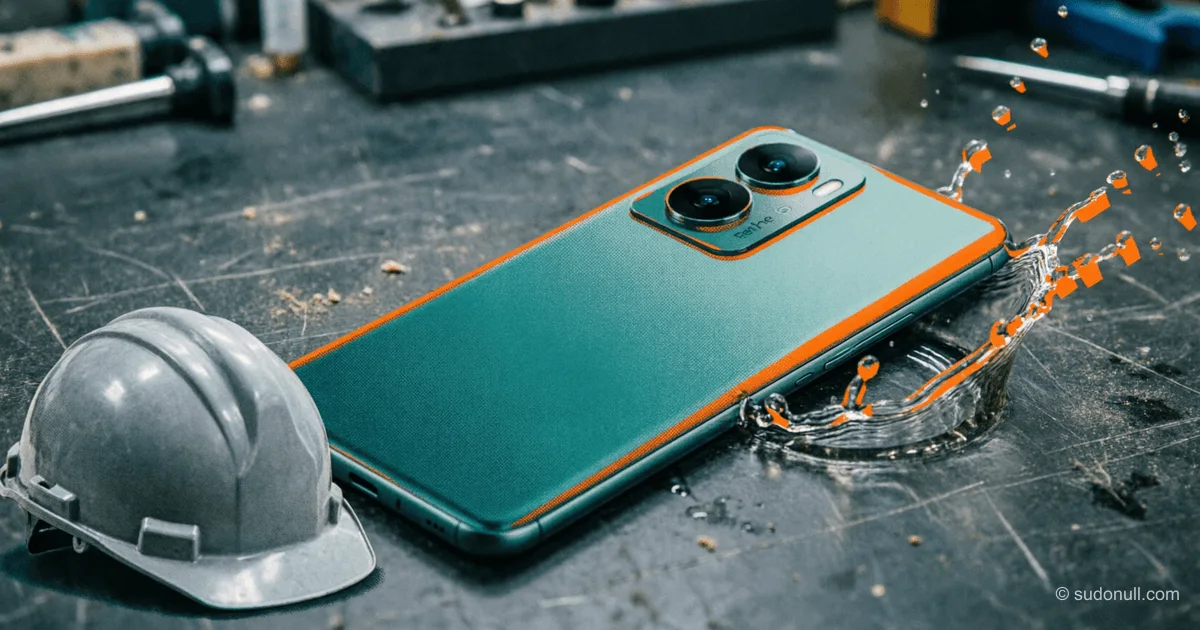
Here's what's really happening: Realme didn't just make a "chunky phone with a big battery." They created a device with IP66, IP68, IP69, and IP69K protection, MIL-STD-810H military certification, and a 7-year battery health warranty. This is the first budget smartphone you can wash under hot running water (IP69), drop from a meter, and not worry.
For $300-350, you get protection that costs 3-4 times more on Samsung and Apple flagships. And that changes the game in the budget phone market.
Timeline and context
- 2022-2024: Realme discontinues the T Series in India due to market saturation.
- May 2026: Announcement of the T Series return with the 16T model. Price starts at 29,999 rupees (around $360).
- May 21-22, 2026: Official launch. Bank discounts bring the effective price down to 26,999 rupees (around $320).
- May 27, 2026: Open sales begin.
Key detail: The device runs Android 16 out of the box. This makes the Realme 16T one of the first budget phones on the new OS, which matters for Indian users who keep their phones for 3-4 years.
Who wins and who loses
Winners:
- Realme. The company has found a niche ignored by competitors: a budget "workhorse" phone for harsh conditions. Zomato and Swiggy delivery drivers, Uber drivers, construction workers, farmers — people who carry their phone in their pocket in heat (+50°C), dust, and rain. They don't need a Snapdragon 8 Elite. They need a phone that won't die in a month. Realme delivers.
- MediaTek. The Dimensity 6300 isn't a flagship chip. But it's stable, doesn't overheat, and sips power. Paired with 8000 mAh, it delivers 34 hours of social media scrolling and 14+ hours of gaming. MediaTek gets a massive order and confirmation that top-tier processors aren't needed for the mass market.
- Budget-conscious Indian users. For $300, they get protection that usually costs $800+. This is democratization of durability features.
- Those tired of power banks. 8000 mAh means two to three days of normal use or one day of very heavy use.
Losers:
- Samsung (M and F series). The Samsung Galaxy M56 and F16 have 6000 mAh batteries and IP67 at best. Realme offers 33% more capacity and full IP69 protection. Samsung will have to either cut prices or increase batteries, which would ruin their slim designs.
- Xiaomi (Redmi Note 15 series). The Redmi Note 15 Pro has 6500 mAh and IP68. Realme beats them on capacity and price. Redmi either catches up with an early Redmi Note 16 or loses ground in India.
- "Premium budget" brands (Nothing Phone 3a, Poco F7). They focus on design and performance. Realme focuses on survivability. For the average Indian, survivability matters more than 120 Hz AMOLED. Nothing and Poco can't match that in the same price segment.
What the media isn't telling you
Insight #1: IP69K isn't marketing; it's a "license to kill" for the rugged phone market.
There's a category of "rugged phones" (Blackview, Doogee, Ulefone) selling for $200-400 with IP68/IP69K and big batteries, but terrible processors and cameras. The Realme 16T with Dimensity 6300 and a 50MP Sony IMX852 destroys them in performance and photo quality. It costs about the same but delivers a proper user experience.
Realme isn't making a "phone for climbers." Realme is making a normal phone that happens to be unkillable. And that kills an entire market segment.
Insight #2: 45W charging is a deliberate choice for longevity.
Realme could have put 67W or even 100W. But they chose 45W. Why?
Because 8000 mAh is a huge capacity. Fast charging heats the battery. Heat kills silicon-carbon cells. Realme promises 7 years of healthy battery life. To achieve that, they sacrificed speed: a full charge from 0 to 100% takes about 90-100 minutes. That's not fast by 2026 standards. But after 3 years, the 16T's battery will last longer than any competitor's that charges in 30 minutes.
Insight #3: The HD+ (720p) display isn't a bug; it's a feature for battery life.
The Realme 16T has an HD+ resolution (729x1570 pixels) on a 6.8-inch screen. Pixel density is about 250 ppi. That's noticeably lower than competitors with Full HD+ (400+ ppi).
But for the Indian mass market, it's acceptable. More importantly, an HD+ screen consumes 30-40% less power than Full HD+. Combined with 8000 mAh, that gives the claimed 34 hours of scrolling. If Realme had used Full HD+, real-world battery life would drop from three days to two. The 16T's audience isn't watching 4K video. They're scrolling Instagram, chatting on WhatsApp, and watching YouTube at 720p on the go. For them, it's enough.
Forecast: next 30 days and 90 days
Next 30 days (June 2026):
- Realme 16T will sell 500,000-700,000 units in the first month — a record for the T Series.
- Reviews will say: "HD+ screen is a disgrace for 2026." But real user reviews on Flipkart will be 4.5+ stars due to battery and protection.
- Samsung will urgently announce the Galaxy M57 with a 7500 mAh battery and IP68 — but only on paper; actual release in September 2026.
Next 90 days (August 2026):
- Realme will release a "Pro" version of the 16T with an AMOLED display and Full HD+, a 7500 mAh battery, and a price of 35,000 rupees (around $420). This will address display criticism.
- Competitors (Xiaomi, Poco) will release "clones" of the 16T with similar 8000 mAh batteries but without IP69K — they can't match the protection at the same budget. Realme retains a unique advantage.
- Custom ROMs for the 16T will appear, trying to "unlock" faster charging. Realme will release an update blocking this due to fire risk.
Main risk for long-term forecast: software updates. Realme promises "6 years of smoothness," but the company doesn't have the best reputation in this area. If the 16T doesn't get Android 18 in two years while competitors (Samsung) do, users may be disappointed.
Second risk: weight and thickness. 224 grams and 8.8 mm is a lot for a budget phone. Some buyers will pass on it for that reason.
Conclusion: The Realme 16T isn't "just another budget phone." It's a redefinition of the "budget phone" category. You no longer have to choose between battery, protection, and price. Realme gives you all three for $300.
This isn't a phone for geeks chasing 144 Hz refresh rates (though it has them) and peak brightness. It's a phone for real people — delivery drivers, drivers, workers, students — who just want their phone to work when they need it. And not break when it drops. And not die when it rains. The Realme 16T is the first mass-market "antifragile" smartphone. And that's far more important than another flagship with a 200MP camera that's afraid of water.
— Editorial Team










No comments yet.