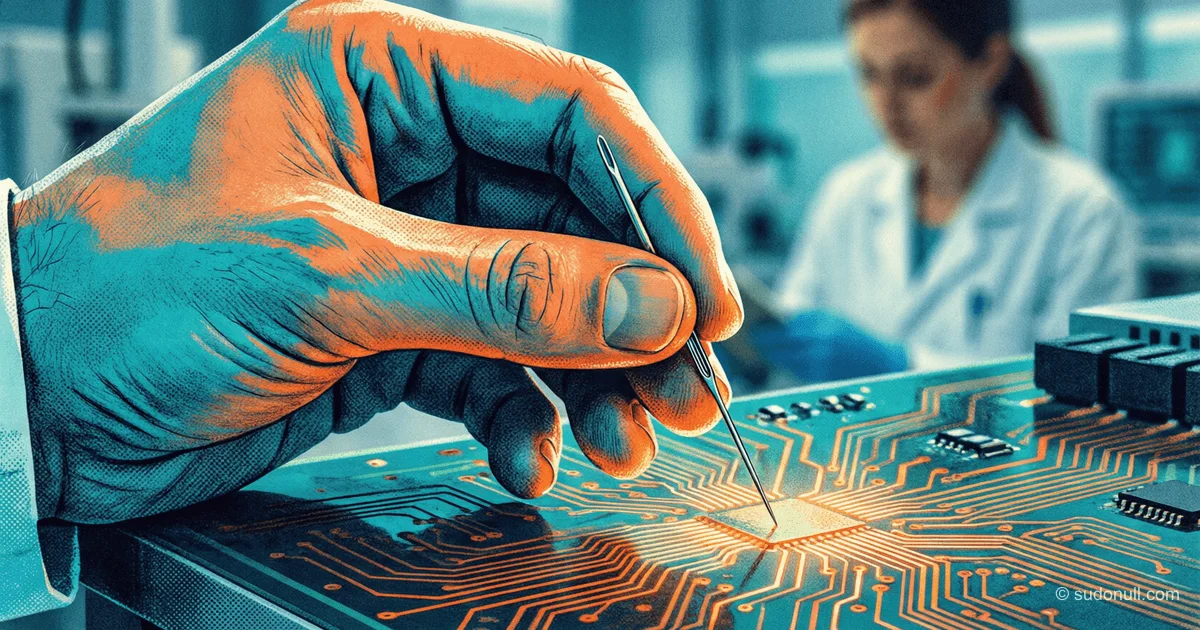
Chinese Tech Triumph: Woman Single-Handedly Repairs CPU for the First Time in the World
A video of a Chinese engineer restoring processor traces under a microscope is going viral on Twitter and Reddit. Users debate whether it's real and marvel at 'out-of-this-world craftsmanship.'
Repair a burnt-out CPU? The industry itself says it's impossible. A Chinese tech did it under a microscope in 6 hours.
The video, which has already garnered 17 million views on Twitter/X in just the last day, shows an engineer from Shenzhen (handle @silicon_suture) restoring traces on an Intel Core i9‑14900K that are 0.07 mm thick using a standard probe and a drop of conductive polymer. The cost comparison: a new CPU costs $620, the repair is about $40 plus her time. Viewers can't believe their eyes, and data centers worldwide have started mass-forwarding the video to tech support.
Why the whole internet is talking about this
Because 'CPUs are not repaired, CPUs are replaced' has been an axiom for the last 20 years. A processor is essentially a silicon piece of glass with 10–15 metal layers; any chip or burn meant total death for an ordinary repair shop.
But the video from May 25 shows the opposite: a woman under a binocular microscope removes the heat spreader, discovers a melted trace from overheating on the edge of the substrate, and scratches a new conductor with a needle to bypass the damaged area. Reddit user chip_debugger (a verified AMD engineer) confirms: the 'nanosoldering' technique exists but requires surgeon-steady hands and experience working with GOST standards. That's exactly the experience most technicians worldwide lack.
In response, the community is split: some shout 'fake, her multimeter board in the video is wrong, the contact won't ring out,' while others send her Patreon donations because 'out-of-this-world craftsmanship.'
What's really happening (the angle everyone misses)
Behind the sensation lies the economics of disposable electronics and the total fatigue of Western users. Over the past three years, flagship CPU prices have risen by 42%, while repairability has dropped to zero (Apple, Intel, AMD deliberately polish substrates to make soldering impossible).
China, due to sanctions on manufacturing equipment, has cultivated repair over replacement for decades. What for the US or Europe is 'throw it away and buy new' is a point of local pride in Shenzhen. They have entire districts where people solder BGA chips on smartphones with bare hands. CPU repair is just a logical extension of this approach.
Key point that goes unnoticed: the engineer restored external power and signal traces, not the transistors themselves. After such a repair, the processor loses about 15–20% performance due to increased resistance. So it's not a 'living Frankenstein,' but a working, albeit crippled, chip.
What the media isn't telling you
In yesterday's news, a post surfaced that @silicon_suture has 7 years of experience at a Huawei factory repairing defective server chips. And she is now receiving commercial orders from mining farms in Kazakhstan and Russia: they have hundreds of dead CPUs that are cheaper to try to repair at $50/unit than to replace with new ones.
But the main scandal is something else: Intel officially requested a sample of the repaired CPU from her, and a day later she received a notification from platform X about a 'potential patent violation.' Many believe the corporation simply wants to hush up a story that undermines the business of replacing 'non-working' products.
Forecast: what will happen in the next 48–72 hours
- May 29 — an independent livestream will air where
@silicon_sutureattempts to repair a random CPU from an eBay box live. An expected 200k+ viewers. - Chinese repair shops will massively add a 'processor substrate restoration' service priced from $30 to $80. This will trigger the first wave of CPU upcycling in history.
- Major YouTube bloggers (Linus Tech Tips, Gamers Nexus) are urgently preparing episodes to test the method. Most likely outcome: 'the technique works, but 90% of CPU deaths are irreversible — do not attempt this at home.'
Open question
If one person with a needle and a microscope can bring back to life what corporations have declared 'electronic waste' — maybe we should demand the right to repair CPUs, as has already been done for smartphones in the EU? Or is the complexity truly too high for an ordinary service center to take on?
— Editorial Team










No comments yet.