CPU rating by CoreMark
While picking up a new desktop, I was faced with the chaos of various estimates of system performance. And it seems like everyone has long known that a bunch of components should be selected according to the “sea convoy” principle - the total speed of the convoy is determined by the slowest ship, which are the exchange rate between the CPU, RAM blocks and the interlayer in the form of chipsets. However, due to very sharp changes on the processor front, everything is not so objective for me, and I associate the largest amount of misunderstanding with processor crystals. On the one hand, the market follows servers, multithreading and an increase in the number of cores, the exchange frequencies between components increase significantly, on the other hand, software is slowly optimized for multiprocessing, with the exception of mathematical and engineering packages that are really capable of loading all of the kernels. Over the past 5 years, the architecture of the desktop desktop processor itself has changed, although the data bus has not overcome 64 bits, the Intell Haswell generation has acquired a high-performance ring bus, after the conveyor and HT I personally consider it a new round of evolution of central microprocessors on the PC platform, which coupled with reorientation Green Technology manufacturers and low consumption should finally lead the market to new highly productive and energy-efficient solutions. I would also like to hear about the latter from Habr users, as among the most knowledgeable audience. which, coupled with the reorientation of manufacturers to Green Technology and low consumption, should finally lead the market to new highly productive and energy-efficient solutions. I would also like to hear about the latter from Habr users, as among the most knowledgeable audience. which, coupled with the reorientation of manufacturers to Green Technology and low consumption, should finally lead the market to new highly productive and energy-efficient solutions. I would also like to hear about the latter from Habr users, as among the most knowledgeable audience.
The following link leading to the page with the rating of processors gives one comment that interests me. Literal quote:
You must admit that the amount of electricity in the world is strictly limited by the number of power plants that are not commissioned very often, the increase in electricity tariffs is observed everywhere, and the volume of microprocessors in the hands of the population and in the ownership of enterprises is growing like an avalanche. Data centers most clearly express the general situation, in which the cost of fixed assets in the form of a server fleet is low compared to the total cost of powering racks and the functioning of cooling systems. This naturally necessitates the conclusion of an adequate rating of processors adjusted for TDP / Mhz for ordinary consumers without the need to climb into each datasheet separately and spend time. Another thing, a secret between us, consumers rarely look at TDP. Only shhh ...
What remains for me, on which processor should I focus? For starters, it would be nice to look at the overall rating of ALL mainstream solutions on the market, or almost all. Let's get started. As is clear from the title, I used the CoreMark base . It is worth registering first, you can go through this procedure while downloading the test sources themselves:
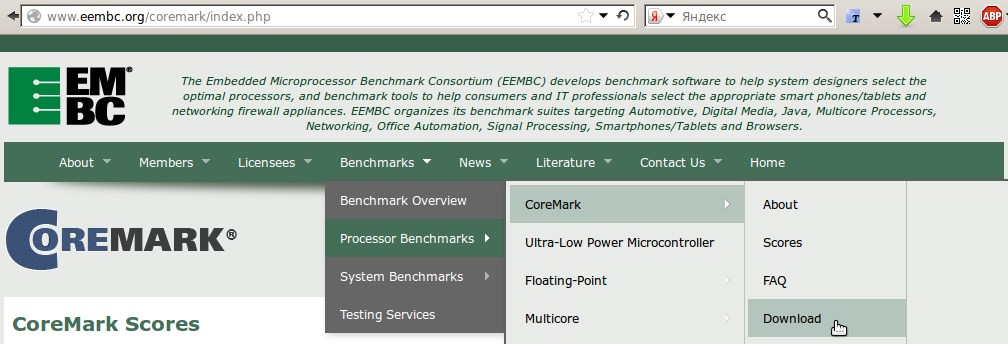
Then, by choosing vendors,
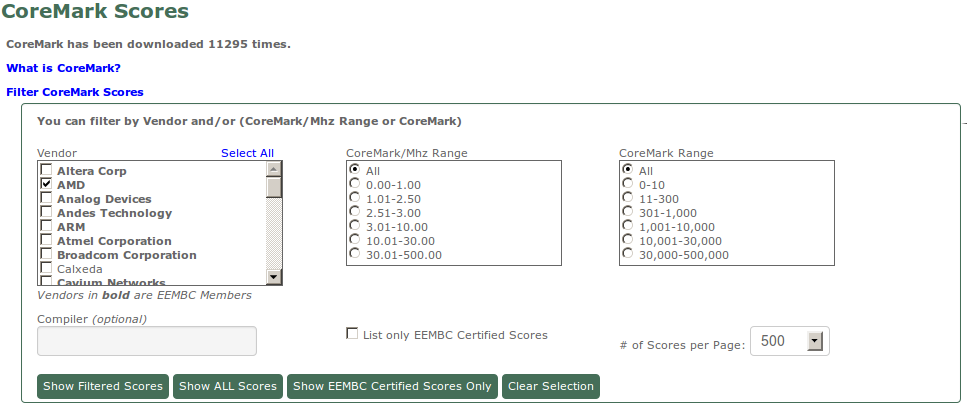
you can see such nice signs (I ask you to pay special attention to the number of threads):
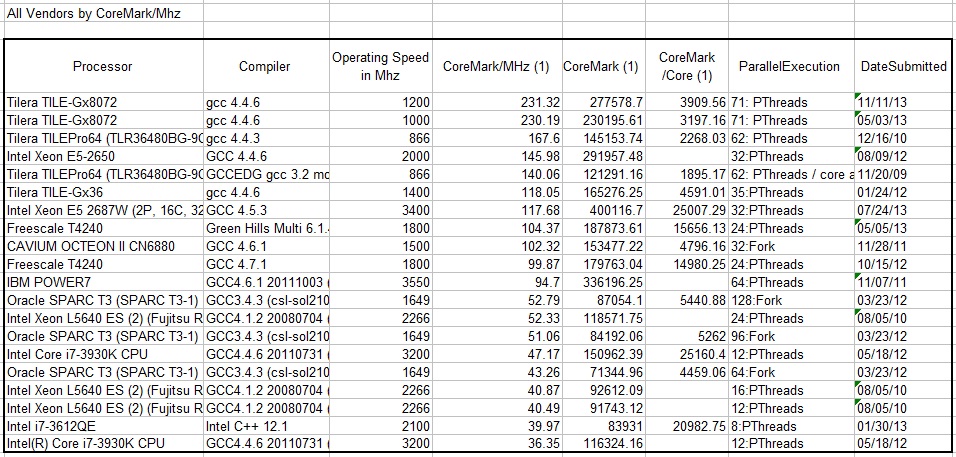
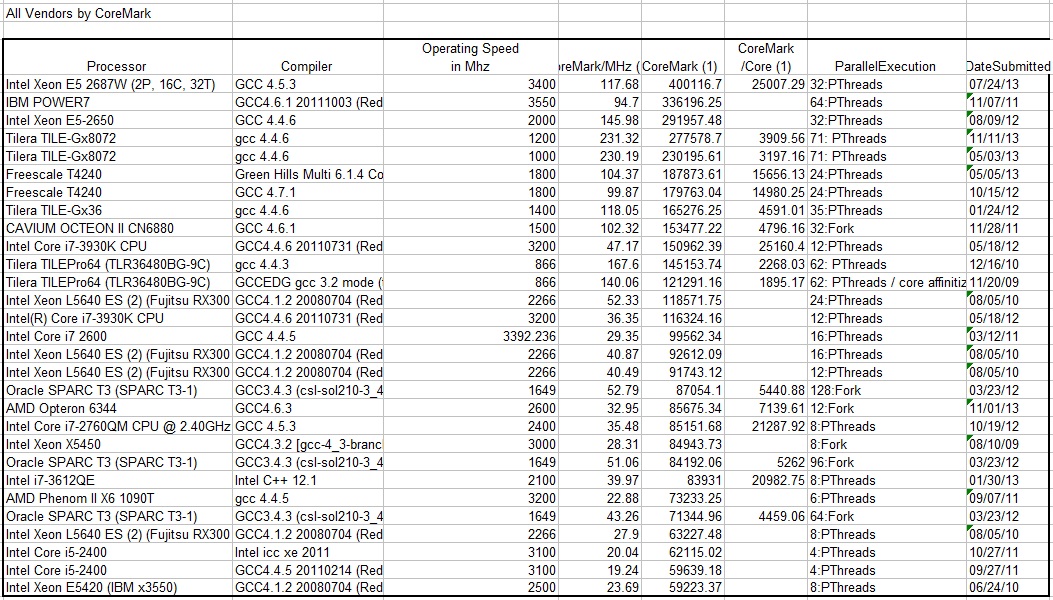
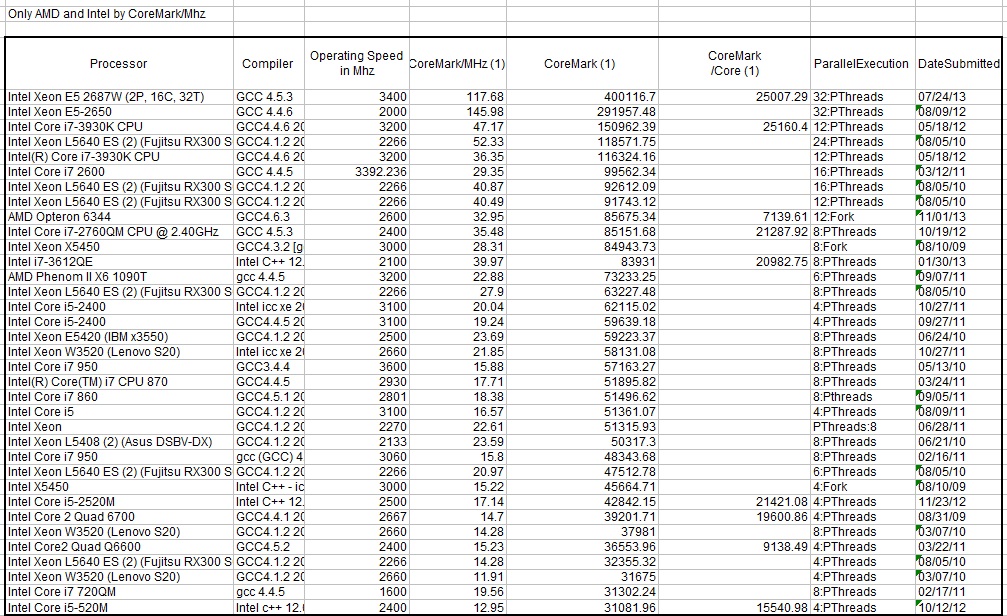
Along the way, I rated Atom N455 by unpacking the sent sources of the coremark_v1.0 test. tgz and typing for 2 threads in the console
Now all I had to do was search for info on the current flagships of desktops:
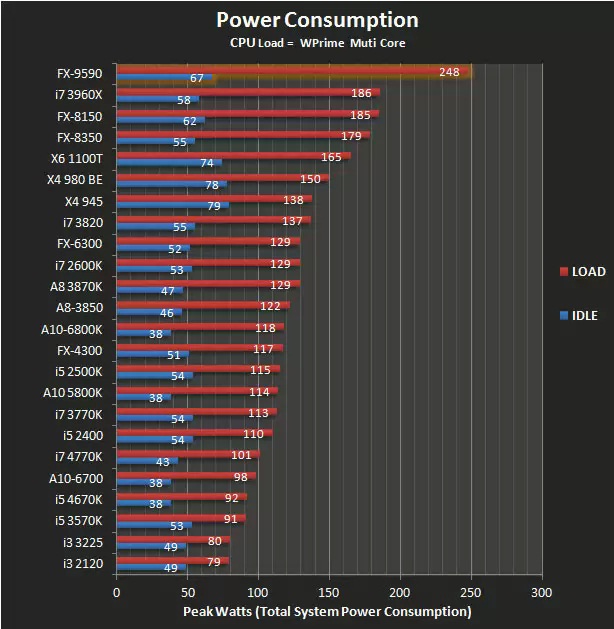
And also take into account TDP:
Results: the current situation with the ratings looks rather one-sided and personally does not suit me at all. Instead of a handful of pages scattered on the Internet, I would like to see the combination in one final table of the total figures of productivity, energy efficiency and specific return on the purchase amount. But while manufacturers and marketers are getting dark, they have to reinvent the wheel. I would very much like to see a different point of view in your comments and still see this table live. Thanks for attention.
The following link leading to the page with the rating of processors gives one comment that interests me. Literal quote:
“There are many tables on the Internet with comparative characteristics of processors. But it’s very hard to find tables comparing architectures. There is such a rarely used parameter DMIPS / MHz. This parameter shows the specific performance per cycle. This parameter allows you to understand whose architecture is the most effective and has the best chance. For example, processors based on ARM cores are compared precisely in specific performance. And in specific performance they are better than Intel processors. This means that if Samsung makes a processor with an ARM core for the next iPhone using the most advanced 22 nm technology, then they will get a processor with characteristics better than the most modern Intel processors. The second important parameter for comparing architectures is DMIPS / Watt performance. Allows you to evaluate the energy consumption of the architecture. The less power the processor requires, the more likely it is to use it in mobile (phones, tablets) or vice versa in super-large systems (supercomputers). It would be very nice if at least one Internet media made an extensive table on the old and new architectures of various (not only Intel, AMD or ARM) processors. ”
You must admit that the amount of electricity in the world is strictly limited by the number of power plants that are not commissioned very often, the increase in electricity tariffs is observed everywhere, and the volume of microprocessors in the hands of the population and in the ownership of enterprises is growing like an avalanche. Data centers most clearly express the general situation, in which the cost of fixed assets in the form of a server fleet is low compared to the total cost of powering racks and the functioning of cooling systems. This naturally necessitates the conclusion of an adequate rating of processors adjusted for TDP / Mhz for ordinary consumers without the need to climb into each datasheet separately and spend time. Another thing, a secret between us, consumers rarely look at TDP. Only shhh ...
What remains for me, on which processor should I focus? For starters, it would be nice to look at the overall rating of ALL mainstream solutions on the market, or almost all. Let's get started. As is clear from the title, I used the CoreMark base . It is worth registering first, you can go through this procedure while downloading the test sources themselves:
Then, by choosing vendors,
you can see such nice signs (I ask you to pay special attention to the number of threads):
Along the way, I rated Atom N455 by unpacking the sent sources of the coremark_v1.0 test. tgz and typing for 2 threads in the console
make PORT_DIR=linux XCFLAGS="-g -DMULTITHREAD=2 -DUSE_FORK=1". The result in 4500 quite accurately fit into the overall picture. Details of the test.Now all I had to do was search for info on the current flagships of desktops:
Powerful processors of 2014 and conditional performance rating (as edited by dxdigitals.info ):
Intel Core i7-4765T 50.4
Intel Core i5-4670K 56.7
Intel Core i5-4670 57.2
Intel Core i7-4770T 59.7
Intel Core i7-3770S 63.1
Intel Core i7-3820 63.8
AMD FX-9370 64.5
Intel Xeon E3-1240 V2 65.4
Intel Core i7-3770 66.2
Intel Core i7-3770K 67.3
Intel Core i7- 4820K 67.4
AMD FX-9590 68.5
Intel Core i7-4771 69.7
Intel Core i7-4770 72.4
Intel Core i7-4770K 72.5
Intel Core i7-3930K 87.5
Intel Core i7-3970X 94, 2
And also take into account TDP:
Results: the current situation with the ratings looks rather one-sided and personally does not suit me at all. Instead of a handful of pages scattered on the Internet, I would like to see the combination in one final table of the total figures of productivity, energy efficiency and specific return on the purchase amount. But while manufacturers and marketers are getting dark, they have to reinvent the wheel. I would very much like to see a different point of view in your comments and still see this table live. Thanks for attention.