May 13, 2014 at 15:52
IPhone spread and diffusion of innovation
- Transfer
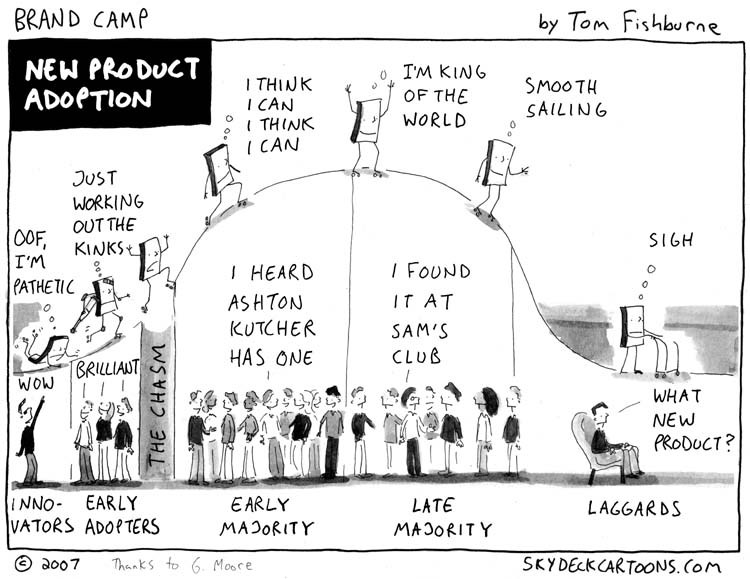
Theoretical and practical research agrees that the spread of innovation is displayed as an S-shaped curve. Indeed, the S-shaped pattern of diffusion of innovations seems to be a basic anthropological phenomenon.
This observation dates back to 1895, when the French sociologist Gabriel Tarde described the process of social change for the first time through the imitative nature of the mechanism of “group thinking” and the S-shaped pattern [1]. In 1983, Everett Rogers developed a more advanced four-step model of the innovative decision-making process, consisting of: (1) knowledge, (2) belief, (3) decision and implementation, and (4) confirmation.
Rogers divided the population of potential followers according to the time period at which they “accept” the innovation and categorized them according to their standard deviation from the “average” moment of adoption. He demonstrated extensive empirical evidence for the assumption that a symmetrical bell-shaped curve represents the distribution of followers over time. The shape of the curve corresponds to the first derivative of the logistic growth and replacement curve, as shown in the figure below:
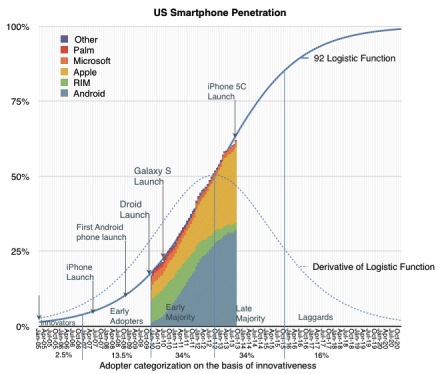
In the graph below, I applied the Rogers followers classification to the data on the “acceptance” of smartphones in the USA. Data collected through September 2013 inclusive.
The fact that the data on smartphones in the US is consistent with theory is amazing, but what conclusions can we draw regarding specific platforms? In the first half of this time period, the market leader changed. The following graphs illustrate this in more detail, showing minor changes in the distribution of market shares.

Please note that, with the exception of the iPhone, each individual platform does not correspond to the logistic (e.g. linear) pattern, even though the whole technology corresponds to it.
And here a serious snag arises: although we can predict how smartphones will be adopted in society, we cannot predict how each particular firm will be perceived by society. This means that the investor cannot confidently make a “bet” on technology [2]. If he "puts" on a particular company, there is a chance that he will lose. Among all platforms, there is usually only one unexpectedly clear leader.
Before we continue to delve into the question of finding winners or predicting the future distribution of market shares between competitors, we must understand the reasons that underlie the pattern of “adoption” of innovation.
Rogers concluded that the basis of the symmetry of the diffusion of innovations is the behavior of individuals in the process of cognition. At first, when a person is faced with a new situation (with something to learn), he makes many mistakes. Their number gradually decreases (in the learning process) over time, because a person receives more and more information that acts as an incentive [ to further cognition - approx. Transl.]. The gain acquired through practical training is proportional to the product of the amount already studied by the amount of remaining information that still needs to be studied.
Arnulf Grübler explains:
This is exactly equivalent to transforming the logistic curve in F (1-F) format. It must be emphasized that these characteristics of the learning process are reflected in real situations related to training and are confirmed by a large number of laboratory and field experiments. Therefore, this adoption of innovation in the social system is equivalent to the process of studying the use of an innovative product by an individual. Thus, the symmetrical pattern of diffusion is the result of how innovation messages are created and disseminated in the process of “social learning”.
So, these researchers consider learning behavior to be the reason for adopting technology. Can a similar statement be applied to individual platforms? Sounds tempting.
The hypothesis is as follows: the followers of innovation not only serve as sources of information about the new technology, but also use various platforms as they appear and update the OS on smartphones. If we perceive the choice of a platform as a learning process, then if one platform has a natural advantage over others, it allows the platform to take a dominant position, as users “learn in the learning process” about this advantage. And vice versa, if no platform has advantages over others, the change of leaders will continue as competitors lose / occupy favorable market positions.
The graph shown above, apparently, indicates that the logistic pattern of the iPhone has characteristics that allow the company to win through the learning pattern. Alternative platforms, in this case, are simply trying to manipulate the current position in search of temporary advantages.
This is a curious hypothesis. To develop it in the future, you need to answer the question of what benefits can be acquired in the learning process. I suspect that they are related to the ability to solve unmet and implicit needs. In other words, the winning product solves a set of tasks such as " jobs to be done ", the occurrence of which is difficult to "calculate" in advance.
Notes:
- The Tarde was probably influenced by the mathematician Pierre Francois Verhulst, who first published materials on the logistic function in 1845.
- Of course, investors often lose their investment when a new technology appears on the horizon. While technology is evolving, individual companies supplying them often fail. Take a look at the history of transport, communications, computing, and energy.
- Quote from The Rise and Fall of Infrastructures, Physica-Verlag 1990