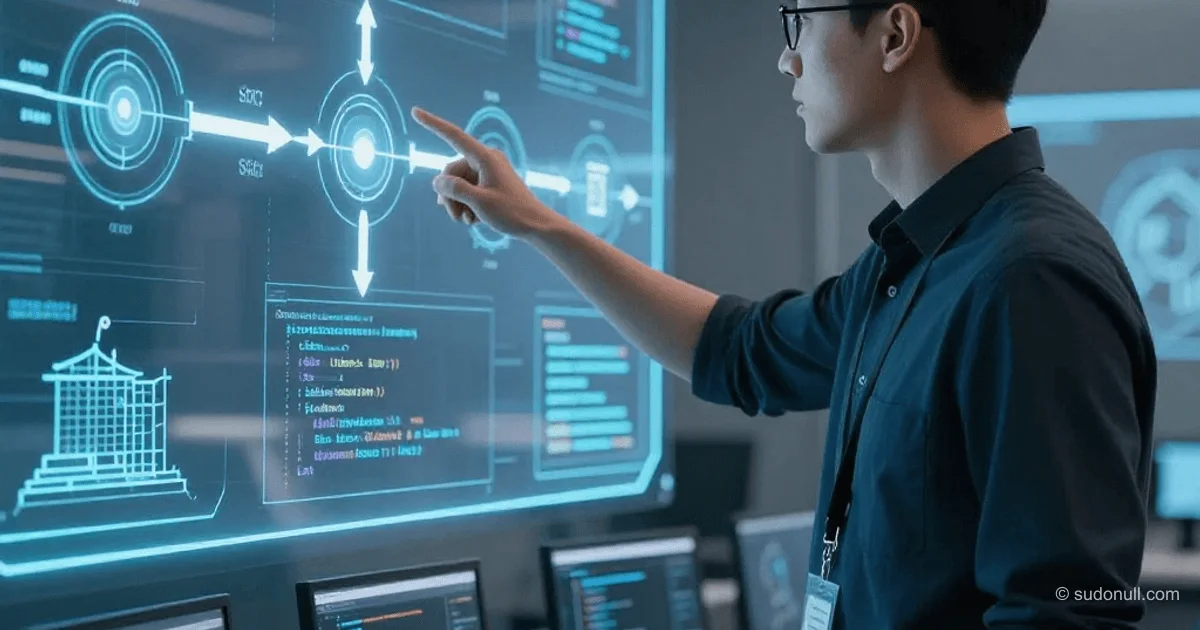
SDLC Is Dead: How AI Agents Have Shrunk the Development Lifecycle into a Tight Loop
AI agents didn’t optimize the SDLC—they eliminated it. The classic software development lifecycle, built on sequential phases, manual handoffs, tickets, and ceremonies, no longer reflects the reality of modern development. Instead, a new paradigm has emerged: a continuous, asynchronous, context-driven loop where humans set the intent, agents generate working code with tests and infrastructure, and observability systems automatically validate, correct, and manage rollouts. This isn’t acceleration—it’s a fundamental shift in the foundation.
Why the SDLC No Longer Exists as a Process
The traditional SDLC (Waterfall, Agile, DevOps) assumed discrete phases: requirements gathering → design → implementation → testing → review → deployment → monitoring. Each phase had its own tools, metrics, roles, and rituals: Jira for tracking, Figma for design, GitHub PRs for reviews, Datadog for alerts. But the key sign of obsolescence isn’t complexity—it’s the need for manual handoffs. When an agent handles the entire stack—from intent to production-ready artifacts—the boundaries between phases physically disappear. There’s no “handoff” from designer to developer because the agent simultaneously interprets UX specs, generates components, and validates them through end-to-end tests. There’s no “waiting for review” because validation is built into the generation process: adversarial agents analyze code for security, performance, and contract compliance before commit. This isn’t “Agile 3.0”—it’s a shift from a process-oriented model to an intent-driven architecture.
How Each SDLC Phase Has Been Shrunk into Context
Requirements gathering is no longer a document; it’s become dynamic context. A PRD is no longer fixed in advance: an engineer describes a task in natural language (“Add OAuth2 support for SSO via Okta, with fallback to local auth and strict token validation”), and the agent generates three implementation options with different trade-offs (stateless vs stateful session store, JWT parsing strategy), with the choice made based on benchmarks and telemetry. Requirements become a byproduct of iteration, not an input condition.
System design is now a real-time dialogue. Agents don’t just implement a ready-made architecture—they propose it. For the request “Need a fault-tolerant event bus for 10K RPS,” an agent can compare Kafka, NATS JetStream, and Materialize, taking into account latency SLAs, cost per million events, and operational complexity, generate a Terraform module, observability configuration, and even a load test script. Architecture ceases to be a static diagram—it becomes an executable, adaptive contract.
Implementation is fully delegated. Modern agents (Cursor, Continue.dev, Tabby) generate not only functions but entire microservices with Swagger documentation, health-check endpoints, middleware chains, and type-safe DTOs. They handle edge cases: for example, when generating an HTTP client for a REST API, the agent automatically adds a retry policy with exponential backoff, circuit breaker, and context cancellation—without explicit instruction in the prompt. Humans focus on validating the intent, rather than writing lines of code.
Testing is integrated at the generation level. The agent creates unit, integration, and end-to-end tests alongside the code, using the same semantics. When generating the function calculateTax(amount, region), it immediately writes tests for boundary values, invalid regions, and currency conversion. TDD isn’t a methodology—it’s the default behavior. QA as a role has disappeared: there’s no “handoff to QA” because validation happens within the loop.
Code review has lost its meaning as a manual process. Reviewing 500 PRs a day by a human is a technical absurdity. Instead, the following are used:
- Adversarial code review: a second agent analyzes the generated code for security vulnerabilities (CWE-79, CWE-89), performance anti-patterns (N+1 queries, unbounded recursion), and compliance with internal RFCs.
- Context-aware linting: rules are embedded in the agent’s LSP server and trigger in real time.
- Human-in-the-loop only for high-impact changes: architectural decisions, changes to core domain logic, or when the agent’s confidence score is below 0.92.
Deployment has become continuous and autonomous. Agents generate not only code but also CI/CD pipelines with feature flags, canary analysis, and automated rollback. Example:
- name: Deploy with traffic shift
  uses: actions/deploy@v3
  with:
    canary-percent: 5
    success-threshold: "latency_p95 < 200ms && error_rate < 0.1%"
    rollback-on-failure: true
Release isn’t an event—it’s a state: code goes live immediately after passing the gate, and enabling functionality is controlled by routing rules (e.g., via Envoy RDS). Agents monitor rollout and adjust traffic in real time.
What Remains: Context and Closed-Loop Feedback
Only two elements of the entire SDLC have survived:
- Context—the sole source of truth. Its quality (specification accuracy, depth of the domain model, relevance of architectural constraints) directly determines the outcome. Context engineering is a new systemic skill: formalizing intentions, managing the history of context changes, versioning business rules.
- Observability—not as a tool for on-call engineers, but as closed-loop feedback for agents. Metrics, logs, and traces must be structured so that the agent can interpret them: for example,
error_rate{service="payment", version="v2.4"}should trigger the agent, which compares v2.4 with v2.3, finds a regression invalidateCardExpiry(), and proposes a hotfix.
What Matters
- The SDLC hasn’t sped up—it’s vanished as a linear process; all that remains is the Intent → Build → Observe loop.
- Code review as a manual PR inspection is luddism; instead, use adversarial agents and human-in-the-loop for high-risk decisions.
- Requirements and architecture are now generated and validated in real time, rather than being locked in documents.
- Deployment and release are decoupled: code is deployed continuously, and enabling functionality is managed by traffic.
- The key skill of the future is context engineering, not knowing Jira or GitFlow.
In a world where agents ship hundreds of changes a day, traditional processes aren’t just slow—they’re a source of errors. Teams that have switched to closed-loop observability systems, where telemetry directly controls agents, gain not just speed but resilience: regressions are fixed faster than people notice them. Others keep tweaking dashboards in Datadog, unaware that the data is already being used by agents for automatic recovery—without their involvement.
— Editorial Team










No comments yet.