
 August 4, 2014 at 09:50
Guilty Control
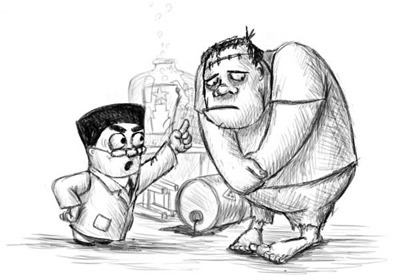
Many years ago, I was appointed responsible for fire safety in one office of an IT company. It looked like this: “Sign here and here, everything, we’ll hang your name on the dashboard, nothing else is needed.” The problem was that I found what such painting really means. And he began to "build" everyone in the office to comply with safety rules. If you have not tried, I inform you - it is often very difficult to do under normal conditions. What is the problem? The fact that most people consider this norm a convention. Everyone breaks, and we will.
Now imagine that you are introducing a rule that cannot be followed. Or that they will not follow, because they are used to doing otherwise. And do not provide tight control over each case. Well, it’s kind of like a forum where you can’t swear by the rules, but the moderator doesn’t give a damn. We don’t need to go far for larger examples, but we won’t talk about this today. Presented?
Do you know what we just did inside the company or department as a result? We have created a situation in which each person is guilty separately, but no one as a whole . And this is a very important and cruel instrument of control.
Why are they doing this?
For example, if you, as a manager, suddenly want to fire someone, you always have a suitable official reason: systematically did not comply with the requirement of the boss. Moreover, even after the dismissal of such a character, no one in the team will comply with the rule. There is the principle of social proof: “Nobody does, and I will not. Why stand out? ” Accordingly, the status quo will remain: each person in the group is so guilty that you can be fired instantly, but at the same time, everyone as a whole is doing everything right.
What does it mean?That you transferred control from the sphere of documented processes to the sphere of personal agreements with everyone. You have simplified the chain of official interaction, in fact, making yourself a tyrant in one single team. Now imagine that you are wrong somewhere. Your colleagues will be afraid to point it out - after all, an instant retaliatory response will be the opening of their guilt (which is by default). That is, everyone walks guilty and hopes that you will not fall out of favor.
What is happening in the team at this time?For starters, a social force appears that keeps new people from changing. The defensive reaction of the system, roughly speaking. As in my example with fire safety - it is unlikely that I alone can change the work of 20 people without the direct support of the director of the company, but in theory, in an ideal model - I had to do just that.
The level of fear is growing. If you are always to blame, then you will react passively to new unfair demands. You are to blame. Hence the decrease in feedback, which, by and large, is already deadly in a changing market.
Then the concept of the appropriateness of following other rules and documents breaks up. If one thing can be broken, then the rest, too. This directly hits first in discipline, and then in diligence. A countermeasure appears very quickly - the tyrant leader must clearly and firmly indicate orders. This leads to further loosening of the processes - only the “completed-made” mechanics remain, which works only in small groups (but tyranny is effective for them).
Total, we have three stages of wrongness:
- Regular work, when everyone acts according to documents and rules. It is expensive in terms of energy costs to comply with everything that is not necessarily vital now.
- Cant, when someone alone is to blame, but at the same time he does not receive social confirmation of his innocence.
- And a mess when everyone is to blame.
In the described situation, we come to a mess. The mess is the most difficult condition. When everyone is guilty, you cannot take and fire everyone at once, and then find new people.
How to decide?
Disassembling a mess is very unpleasant and difficult. This is one of the management tasks that I once did. I will not say what is good, but I did. So, imagine that you are faced with a similar choice, and you have several options:
- Recruit a new team. Everything is simple here: you select up to 10% of sane people from your current team and transfer them to a new one, then gradually ensure the transfer of functions. This is a cool plan if you have unlimited resources. In reality, they are not.
- Slowly pull the system into order through the introduction of new rules and constant monitoring (I did just that). A normal plan that will meet serious resistance: roughly speaking, the most lazy employees will undermine discipline and create friction. Situations like “yes, you cannot directly follow the rules, we are all human beings” will begin. In this case, the military are moving to the barracks position and resolutely “building” it.
- Take advantage of the factor of social evidence and use the power of control through guilt against the very system of such control. This is a very elegant method. To do this, you need to remove everyone from guilt in one operation, guaranteeing them that past sins will not be counted. But at the same time, one cannot simply declare an amnesty - because without a specific negative example there will be no motivation not to do it again as before. The mechanics are very cynical, but effective. It is necessary to find one guilty and explain that it is he who is to blame for the current situation. No matter what his contribution to the state of things in fact. And punish. This is an example of wartime, when execution is supposed to be executed for the retreat of a detachment, but you cannot deprive yourself of fighters. The commander finds one "traitor" - and denotes his guilt. If this is not done, the unit will retreat again,
Where does this state come from? A mess can appear either as a result of the actions of a weak leader who is not being listened to by their own people, or as a result of a deliberate imposition of a control strategy through guilt.