What tests showed the new flash-storage EMC XtremIO

This is what the transport box that came to us looked like. The piece of iron costs according to the price as 3-4 apartments in Moscow.
In early March, we conducted an open test drive of the new flash storage from EMC - EMC XtremIO. The system is considered one of the fastest in the world of storage. Feature - inline deduplication on board. Iron is expensive, but as one of our customers said: "Nifiga myself, I will save $ 3 million a year only on licenses." Because the array can be reduced from 128 cores to 64, and licenses are often counted precisely by the cores. And yet, the system will be especially interesting for those who work with virtual environments, who are looking for a way to reduce the response time of storage systems and who have performance problems.
The following tests were included in the menu: IOPS 100% read, random 4k; IOPS 50% read 50% write, random 4k; IOPS 100% write, random 4k. Conducted using an IOmeter. We also tried the system in combat mode, watched its reaction to component failures (pulled the disk “live” under high load, rebooted the controller, turned off the power on one of the inputs, turned off the UPS) and peak load.
In general, there was something to see. Details below.
Flash vs HDD
XtremIO takes up 10 times less space in the data center than solutions on conventional disks, which saves space in the server room and power. It is generally appropriate to compare flash with similar solutions on disks. An ordinary cabinet with disks will give about 50 thousand IOPS, if you consider that an average of 250 disks will fit in a cabinet, and each one will give out 200 IOPS (although this is with a large margin). And these IOPSs will be with a delay level of 3-9 milliseconds. The XtremIO cabinet will issue up to 1 million IOPS if necessary, and most importantly, the delays will be less than 1 ms, which is very important for target applications.
Tests
Read tests were carried out on disks with created partitions and a file system, in the write tests we tried to test on raw devices without partitions, where the result is close to the line, apparently, the FS driver introduces such an uneven result. Tested on the latest Iometer with the template Full random 4K Read, Full random 4K Write, Full random 4K Write 50%. The vendor said respectively 250k IOPS, 100-150k IOPS depending on the uniqueness of the data, and 150k IOPS with a read / write ratio of 50/50, below I will show how much the array fit into the declared parameters.
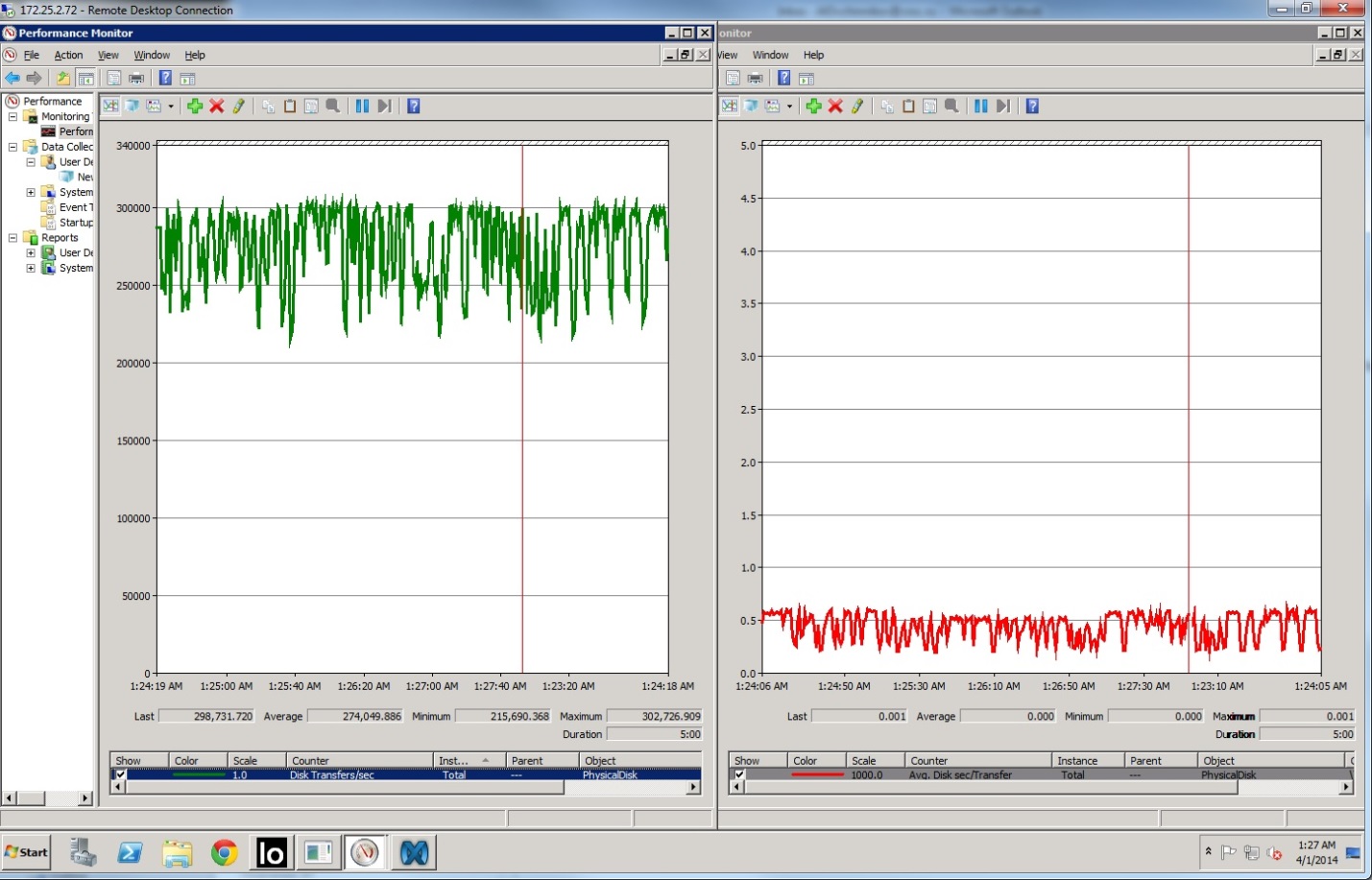
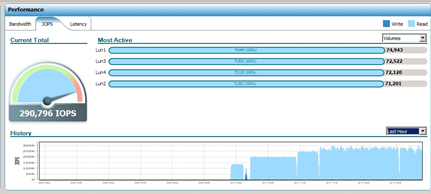
As the results I quote the instantaneous value on the array and more detailed measurements on the host from which the testing was conducted. For host schedules, green is IOPS, red is delay.
Reading
With reading, the result was very encouraging, we easily reached the stated indicators and even exceeded them.
Record
With the recording, it turned out as follows:
We didn’t get the declared characteristics on the sub-millisecond delays, here we reached the limit:

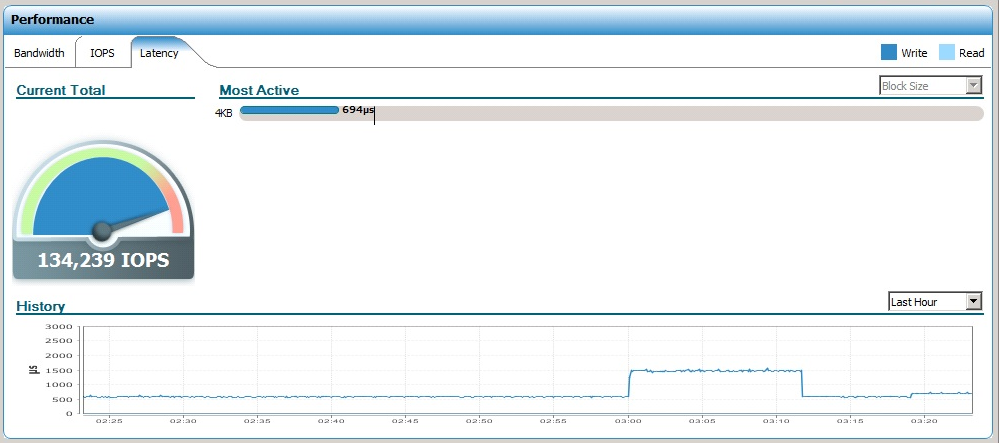
Nevertheless, it was quite easy to get the maximum, if you did not look at the delay:
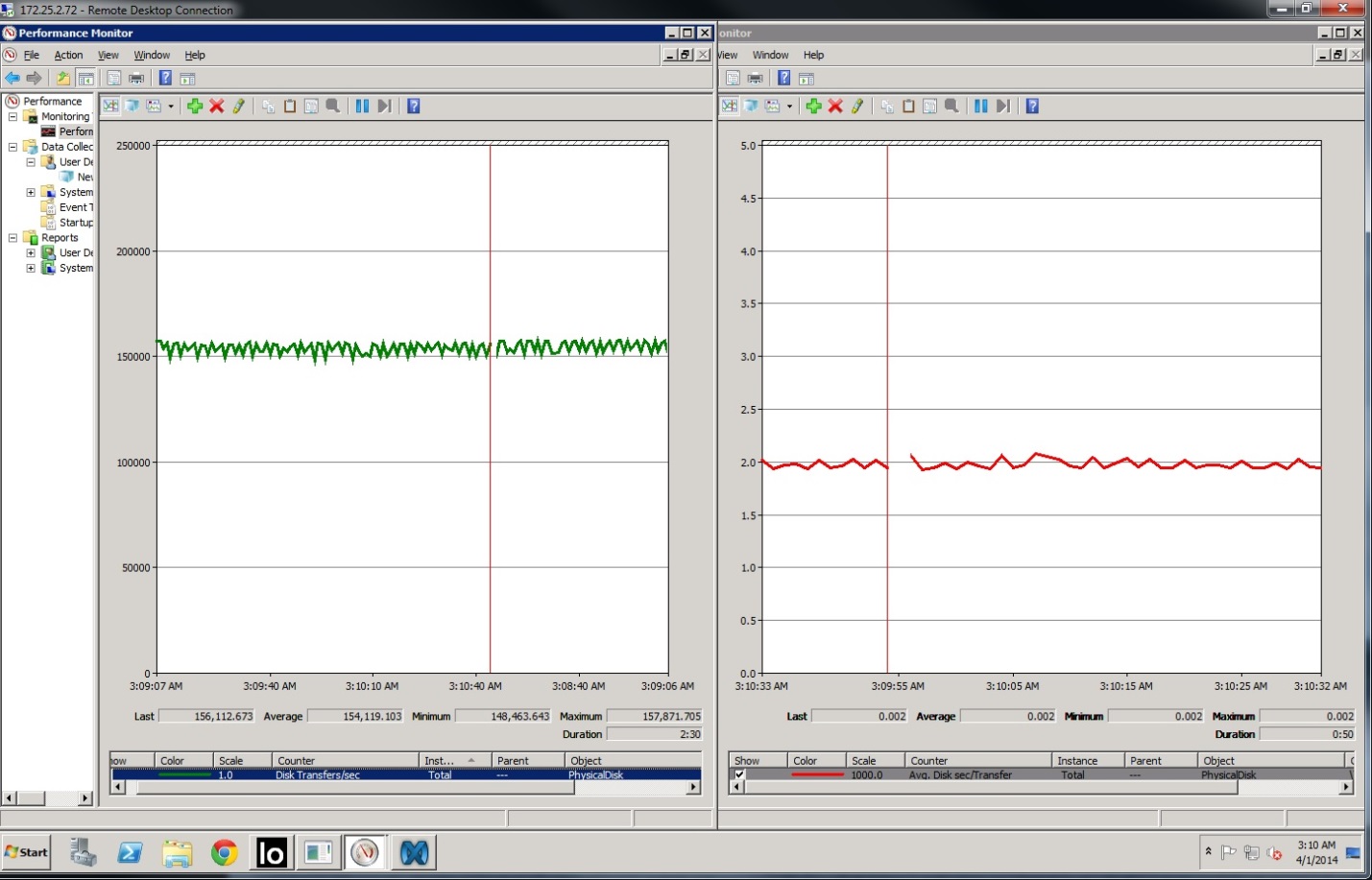
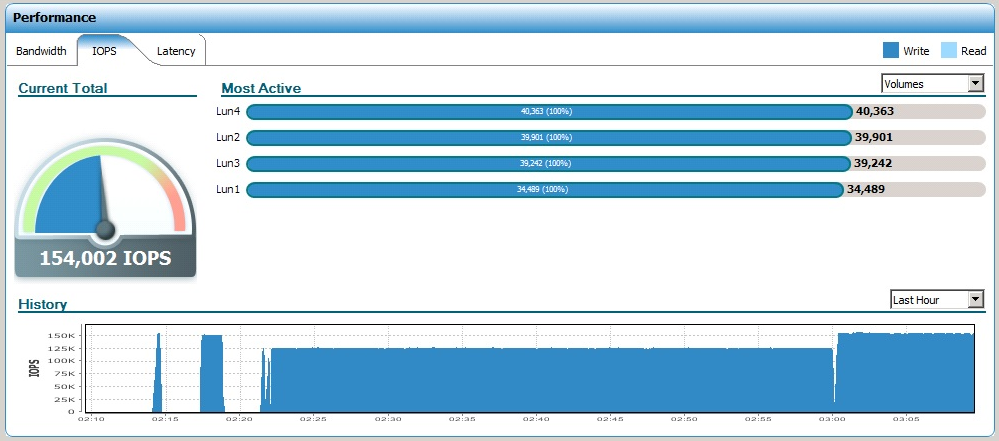
Only the delay on the array, of course, grew above 1 ms .
Read / write
Here we didn’t have enough of 5 dozen IOPS to achieve the declared values:
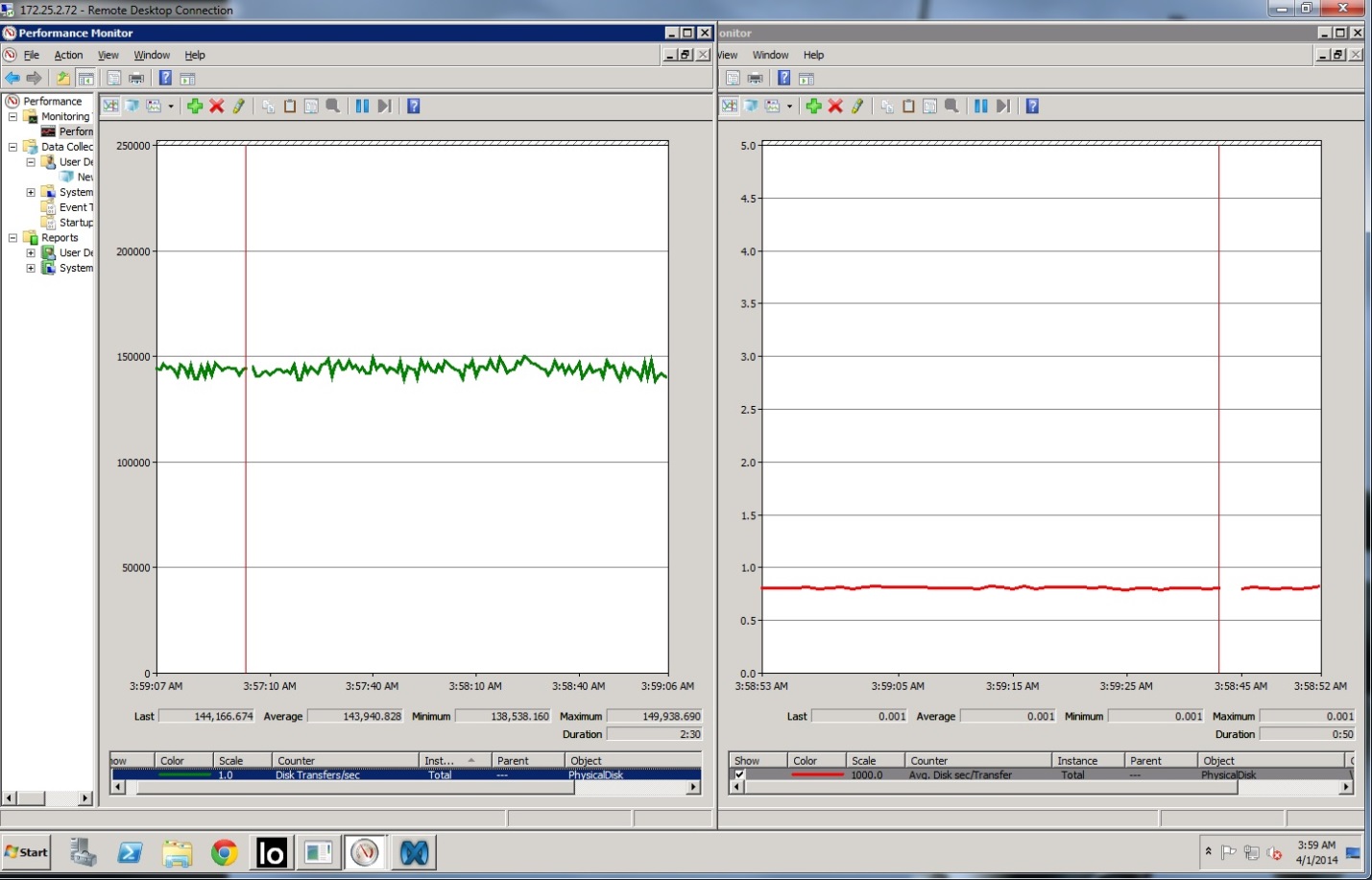
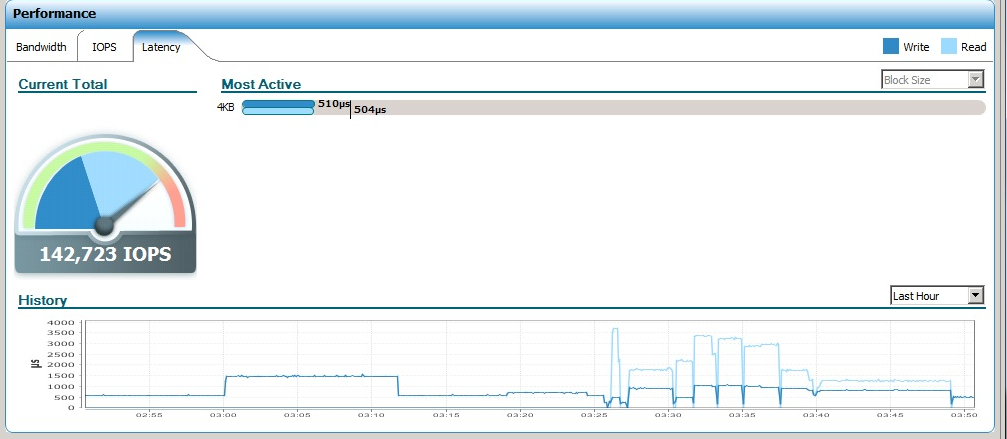
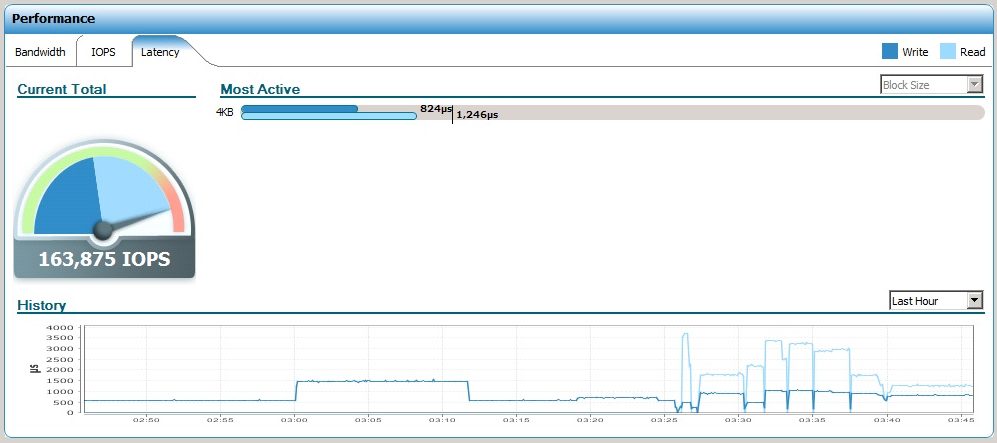
Of course, for the sake of interest, we tried to finish off these IOPS, but the delay inevitably crawled up and went out for a millisecond, and, funny enough, it was the reading delay:

General sensations from the array
In general, from the point of view of the administrator, the system is very convenient and pleasant to manage, the configuration is minimal and does not require serious configuration planning. In fact, the only thing you should not forget about is connecting the host to both controllers (this is often forgotten). At the same time, despite the small number of parameters, the interface is very informative and visual, a couple of minutes will be enough for a more or less experienced administrator to figure it out.
From the point of view of a service engineer, the array is quite large in comparison with analogues. In my opinion, the sharpening of the array under VDI is very clearly visible, and the storage of "hot" data for the databases of the financial, insurance, scientific and energy sectors, the ability to deduplicate data as much as possible is very critical for the solution.
From what else I liked - most of the components of the array are very convenient to change, with analogues it is usually more complicated.
In general, until recently, no one even thought about deduplication on the fly for flash storage because of possible delays.EMC not only thought, but was also able to introduce enterprise-level storage systems where this technology has become key. Such deduplication allows you to not write data to disk if they already exist somewhere. That is, the write operation, in fact, is carried out in the cache, providing even better response time. Now EMC is the only one that does inline deduplication inside storage. Others do this either as a separate piece of hardware or not on the fly, which, in particular, allows you to get rid of crutches in the form of deduplication of the RAM cache (it is simply not needed: the data is already processed there). The new duplicate block is immediately replaced by a link, wherever it is inside the system - both in the cache and on the SSD. At the same time, the system does not try to store data in the cache, but immediately writes it to the SSD - this required the developer to review the architecture, but gave a gain in performance. All this in a complex for solutions like VDI can reduce the number of records on the disks themselves to 30 or more times.
Price
Every time I show this or a similar box, many questions arise for the price. I will answer the basic ones. First, how much it costs: the price on the price list is 28 million rubles, but in fact it always differs down (and significantly) due to the large number of programs and special conditions of the vendor. That is why prices for such solutions are usually not announced, but indicated in the commercial proposal for a specific implementation. If you work with highly loaded applications, then you fully understand that it is justified: it is a very fast storage system in itself (it removes “bottlenecks”, for example, in banks, insurance and mobile operators), plus “confinement” for virtual environments. If you count on many practical highload-solutions, operation is much cheaper than disk (specifics are interesting - write, I will send an offer) And, finally, this storage comes with support. The basic implies, in addition to software and consultations, the replacement of any nodes within 1 business day, and the extended one means a maximum of 4 hours.
I invite to the test
The system with the photo above is now with us, and is used for tests and demos. If you want to test it for your tasks (in particular, according to your program) - write to me at [email protected].