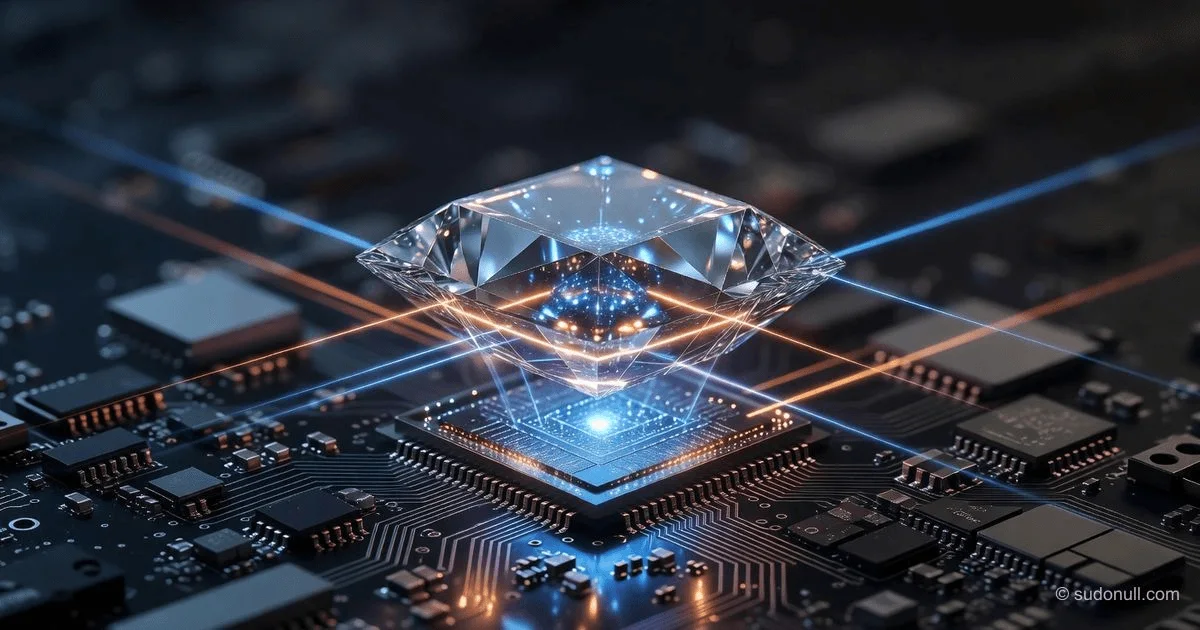
Technion Scientists Create First Room-Temperature Quantum Chip on Diamond
Researchers at the Technion Israel Institute of Technology have developed a diamond-based quantum processor that operates without cryogenic cooling.
Diamond Revolution: Why the Technion Chip Is Not a Quantum Breakthrough, but the End of the Airship Era
[The Gist]: What's Really Happening
When Israeli researchers from Technion announce a diamond-based quantum chip operating at room temperature, most media outlets write "revolution cancels cooling." But an insider sees something fundamentally different: it's not about replacing the superconducting chips from Google or IBM, but about making quantum computing a practical tool rather than a lab attraction. This is a shift from the era of "quantum supremacy" (who has more qubits) to the era of "quantum applicability" (who can solve a real chemical problem at an affordable price).
Pay attention to the material—diamond with NV centers (nitrogen-vacancy centers). This is not just an "expensive stone." It's a physical platform that allows qubits to remain coherent at 300 Kelvin (room temperature). Unlike superconducting qubits that require cryostats costing millions of dollars and consuming megawatts of power, the diamond chip can operate in the field, on a desk, next to a regular computer. But this convenience comes at a cost: the coherence time of such qubits has historically been much shorter, and scaling is more difficult. It is here that Technion appears to have made a leap hidden from the general public.
The essence is that Technion has created not a "large" quantum computer, but a "specialized" quantum processor. Most likely, it's a prototype optimized for specific tasks, such as simulating spin systems or biomolecules. The real breakthrough here is abandoning the qubit race for the sake of stability and low cost of ownership. It's like comparing a Cray supercomputer from the last century to a modern GPU. A GPU is slower in general theory, but it wins the market because it does specific things (graphics, neural networks) quickly and cheaply.
Timeline and Context
Although the news has exploded across feeds, research on diamond NV centers has been ongoing for over two decades. However, the key problem has always been uniformity. Creating one NV center in a crystal lattice is not difficult, but making a hundred or a thousand identical qubits that can be individually addressed by laser without interfering with neighbors is a true technological nightmare. Typically, due to crystal defects, "noise" kills quantum entanglement in fractions of a microsecond.
There have been loud claims before. For example, in 2023, several labs reported breakthroughs in scaling diamond chips. But they hit a wall with the complexity of readout. Technion likely solved the problem with a new optical readout scheme or by introducing silicon impurities into the diamond lattice (SiV centers), which are more stable but harder to fabricate. The media often confuses NV centers with SiV centers, even though the energy difference is huge.
The current context is also important because 2026 is a year of "cooling" in the quantum computing market overall. Investors have become disillusioned with superconducting systems from Google and IBM, which cost billions but have yet to deliver commercial returns beyond trendy articles. Against this backdrop, any news about "room temperature" generates hype among venture capitalists looking for a way out of the dead end. Technion hit the window perfectly: when skepticism toward old technologies peaked.
Who Wins and Who Loses
Winners include first and foremost the defense and aerospace sectors. The ability to have a quantum chip operating on a satellite without tons of liquid helium is a game-changer. It will enable quantum gyroscopes of incredible precision or communication systems that cannot be hacked. The Israeli defense corporation Rafael, closely tied to Technion, has certainly already assessed the possibility of integrating such chips into drones.
Winners also include the chemical and pharmaceutical industries. To model a caffeine molecule or a new catalyst, you don't need a million qubits for $100 million. You need 30-50 stable qubits that can be quickly reprogrammed. If Technion can offer a "quantum chip for the lab" for $50,000-100,000, it will kill the market for classical supercomputers in materials science. Companies like Roche or Merck will be first in line to buy.
Losers include IBM and Google Quantum AI. They have spent decades convincing the market that the path to a quantum computer lies through freezer-sized rooms consuming electricity like a small town. If the diamond alternative proves scalable, investments in superconducting systems could sharply depreciate. While their machines solve abstract random circuit tasks, the diamond chip could solve a specific commercial problem as early as tomorrow.
Losers also include ion trap startups like IonQ and Honeywell. They too tried to avoid cryogenics, but ion traps require complex vacuum systems and lasers and are highly sensitive to vibrations. The diamond chip is solid-state microelectronics; it can be integrated with conventional control chips on the same board. Ion traps will remain in ultra-sensitive metrology labs, but they will lose the mass application market to diamonds.
What the Media Leaves Out
The least obvious insight concerns spectroscopy and the "readout" problem. The media writes about "room temperature operation" but remains silent about the fact that initializing and reading the state of an NV center still requires a powerful green laser (wavelength 532 nm). In a lab, this is not a problem, but for a pocket device, it's already challenging. The laser consumes watts of power and requires cooling (not cryogenic, but active). So "room temperature" in the headline refers only to the chip, not to the entire support system.
The second omission concerns clock speed. Superconducting qubits switch in nanoseconds. Diamond NV centers switch in microseconds—a thousand times slower. If you try to run Shor's algorithm to break RSA, the diamond chip will take 1000 times longer than a superconducting one with the same number of qubits. But for quantum simulation tasks, where long-term coherence (microseconds vs. nanoseconds) matters, the diamond chip may actually be better.
And the third, most hidden point: the cost of the diamond substrate. Synthetic diamond is not sand. High-purity isotopically enriched diamond (usually carbon-12) for quantum applications costs a fortune. A 4-inch wafer can cost thousands of dollars. Technion likely used a tiny chip (millimeters), which is acceptable for a lab, but for mass production of thousands of chips per wafer, huge investments in CVD reactors (chemical vapor deposition) will be required. The technology exists, but scaling the economy will be very painful.
Forecast: Next 30 Days and 90 Days
Next 30 days (June 2026). We will see a wave of debunking articles from US competitors. Physicists from MIT or Stanford will criticize the coherence time and claim that "diamond qubits are still noisy." Technion will respond by releasing a preprint with detailed data (likely on arXiv). Negotiations over potential technology licensing will begin. Stocks of companies related to cryogenics (Bluefors, Oxford Instruments) may dip slightly on speculative fear.
Next 90 days (August-September 2026). This is the most interesting period. Currently, Technion is a research group. Within 90 days, they will either announce the creation of a spin-off (startup) backed by venture capital from Silicon Valley or the Israeli Yozma fund, or transfer the technology to a large corporation (possibly Intel or TSMC, which have long been eyeing diamonds as the future of heat sinks and quantum electronics). If a startup is formed, its seed round valuation could reach $50-100 million based solely on this prototype—the market has long been hungry for "live" quantum technologies, not slides.
By September, we should also expect a demonstration of a specific computational result. Currently, a chip has been shown. In three months, they will likely show how this chip calculated the energy spectrum of a simple molecule, such as hydrogen or helium, with accuracy unattainable by classical computers. Once this is demonstrated, IBM will either have to urgently announce its own roadmap for diamond technology or admit that they missed a technological transition.
Bottom line: Don't expect a diamond laptop in a year. But the fact that Technion has buried the mainstream "the bigger the freezer, the cooler" is a fact. Now the game will be played by different rules: not watts and Kelvins, but integration with silicon and the cost per logical qubit. And here Israel made a big bet, and it seems to have paid off. Diamonds are becoming a girl's best friend, but also an engineer's.
— Editorial Team








No comments yet.