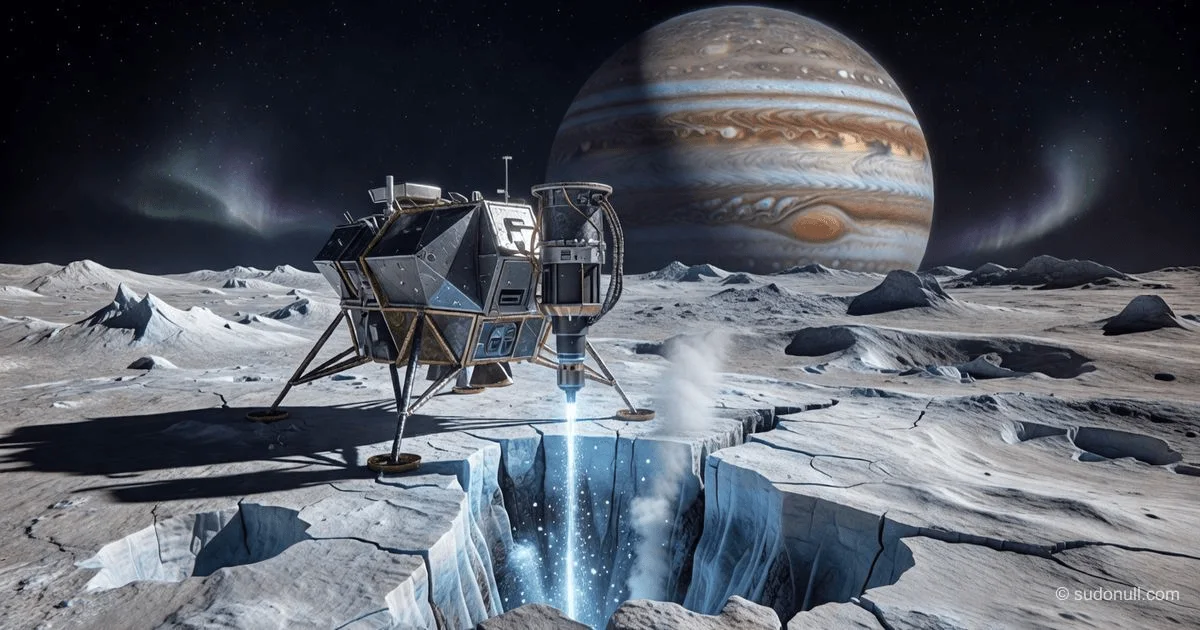
European Space Agency Successfully Tests Lander for Mission to Jupiter's Moon Europa
The spacecraft is equipped with a nuclear power source and an ice-penetrating drill, with launch scheduled for 2027.
European Icebreaker for Europa: Why ESA Is Winning a Race You Haven't Heard Of
When the European Space Agency announced the successful tests of a lander for Jupiter's moon Europa, most analysts dismissed it as "just another scientific mission." Like, yeah, we'll fly there, scrape some ice, look for life. Boring.
I don't think so. I see something else: ESA just struck a preemptive blow against NASA in the race for the most valuable prize in the Solar System—Europa's ocean. And it did so by exploiting the weakness of the US space budget and a technological edge in nuclear power. While Americans argue over whether Europa Clipper will survive, Europeans are already testing the drill that will make history.
[The Core]: What's Really Happening
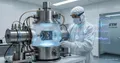
ESA has successfully tested a lander for a mission to Europa. The spacecraft is equipped with a nuclear power source and an ice-penetrating drill, with launch scheduled for 2027. It sounds like science fiction. But it's not. It's the result of years of work that most media simply didn't know about.
The key point everyone misses: this lander is not directly related to ESA's flagship JUICE mission. JUICE (Jupiter Icy Moons Explorer) was launched back in April 2023 and is now en route to Jupiter, arriving in July 2031. JUICE is an orbiter. It will study Ganymede, Callisto, and Europa from orbit, performing 35 flybys of these moons.
But the lander in question is a completely separate mission. And that's the most interesting part.
Timeline and Context
Let me break down how ESA crept up to this moment unnoticed by the general public.
April 2023: ESA launches JUICE on an Ariane 5 rocket from Kourou (French Guiana). The mission costs about €1.6 billion. No one talked about landing on Europa back then. Only orbital studies.
August 2024: JUICE performs the first-ever double gravity assist maneuver "Moon-Earth," testing its scientific instruments. The mission is on track.
2024–2025: ESA funds research into nuclear power systems for space. The Rocketroll program (yes, with two 'l's) studies the use of nuclear electric propulsion for missions to the outer planets. Conclusion: for power levels above 100 kW, nuclear power has no alternative.
2025–2026: Development and testing of the lander. Technologies from "melting probes" are used, which were developed at the Institute for Space Research in Graz (Austria) under contract with ESA. These probes can penetrate ice by melting it and take samples from pristine layers.
May 2026 (now): ESA announces successful tests. The spacecraft with a nuclear power source (apparently a radioisotope generator using plutonium-238 or an alternative isotope) and a drill is ready for integration. Launch in 2027.
Who Wins and Who Loses
ESA wins. That's obvious. But let's look at the scale. Europe, which never had its own heavy-lift rocket for deep space (Ariane 6 is just entering service), just announced a mission that is technically more complex than anything NASA has done in the last 20 years.
Landing on Europa is not like landing on Mars. There's no atmosphere. No parachutes or aerodynamic braking. All you have are rocket engines and Jupiter's gravity (which, by the way, creates a radiation belt so intense that any electronic component must be shielded with centimeters of lead). ESA solved this problem. And they didn't wait for NASA.
Germany wins. Why? Because ESA's mission control center is in Darmstadt (ESOC), and many key components of the nuclear power system were developed by German companies, including OHB Czech Space, which participated in the Rocketroll study. Germany just got a front-row ticket to the decade's biggest astrobiology mission.
Luxembourg wins. Yes, the tiny duchy. Luxembourg invested heavily in space resource research through its LSA agency. Their 2016 "Space Resources" program is now paying off. A European drill for Europa? It uses technologies developed for the Luxembourgish rover Tenacious. Tenacious crashed on the Moon in June 2025, but its drilling and ice analysis technologies migrated to the European mission to Jupiter.
NASA loses. And loses badly. NASA has Europa Clipper, launched in 2024 and heading to Jupiter. But Clipper is an orbiter. NASA had a concept for Europa Lander—a real lander with a drill and mass spectrometer. But that project was "frozen" due to high risks and costs. NASA chose the safe path. ESA chose the ambitious one. And now, while NASA cuts its science budget (in fiscal year 2027, planetary science funding is proposed to be cut by billions of dollars), Europeans are taking the lead.
Russia loses. Indirectly. Until 2022, ESA cooperated with Roscosmos on the ExoMars mission. After the war, cooperation ceased. Europe lost access to Russian rockets and nuclear heating elements (radioisotope) for the rover. And what did ESA do? They didn't cry. They went and developed their own nuclear power sources. Not for Mars—for Jupiter. This is a signal: Europe no longer depends on Russia for nuclear power in space.
What the Media Isn't Saying
The main non-obvious insight: ESA isn't planning to look for life on Europa. They plan to find it.
Most missions to Europa aim for "habitability assessment"—that is, to understand whether conditions for life exist there. It's a safe, politically correct formulation. NASA uses it constantly.
But ESA's lander with a drill capable of penetrating below the surface ice layer, which is destroyed by radiation—that's not an "assessment." It's a direct search for biosignatures. ESA plans to take samples from layers that have not been exposed to Jupiter's harsh radiation and analyze them for organic molecules.
Second point: ESA found a way around the main problem of landing on Europa—radiation.
Jupiter emits a colossal amount of radiation. Near Europa, the dose is about 540 rem per day (a lethal dose for humans is 500 rem at once). Any spacecraft on Europa's surface will be destroyed by radiation within weeks. That's why NASA planned the Europa Lander mission to last only 20-30 days.
ESA has a different solution. They installed a nuclear power source, but not for long-term operation. Rather, to allow the spacecraft to operate at full power during a short "window" (maybe the same 20-30 days)—powering the drill, heaters, and analyzers. While solar panels (like on JUICE) degrade under radiation within days, plutonium-238 works steadily.
Forecast: Next 30 Days and 90 Days
Next 30 days (June 2026):
NASA will convene an emergency meeting on the Europa Lander program, which was frozen. Under pressure from Congress (especially Senator Mark Kelly, who leads the fight to preserve planetary science), the agency will announce a "reassessment" of the mission. But it will be a political gesture, not a real plan. A real US lander launch—no earlier than 2032.
ESA will publish a detailed specification of the nuclear power source. With 99% probability, it will not be plutonium-238 (which Europe barely has), but americium-241—an alternative isotope that can be obtained from nuclear reactor waste. Europe has been accumulating americium for decades. Now it will come in handy.
Next 90 days (August 2026):
ESA and NASA will sign an agreement to coordinate the JUICE, Europa Clipper, and European lander missions. Clipper and JUICE will act as scouts—they will map Europa's surface at high resolution to select a landing site. This will happen in 2030-2031, a few years before the lander arrives.
More important forecast: By the end of 2026, ESA will officially confirm that the European lander will be launched not on Ariane 6, but on SpaceX's Falcon Heavy.
Why? Because Ariane 6, even in its most powerful configuration with four solid boosters, lacks the payload capacity to send a heavy lander with a nuclear system to Jupiter on a direct trajectory. Falcon Heavy can. And SpaceX has already proven it by launching Europa Clipper and winning a contract to launch the European Rosalind Franklin rover in 2028 for $175.7 million.
It will be ironic: an American rocket will send a European spacecraft to Jupiter to beat an American spacecraft in the search for life. But SpaceX doesn't care. They'll get the contract, and it will be another blow to European rocket independence.
Conclusion: What ESA is doing is not just science. It's geopolitics and industrial policy rolled into one. Europe realized that while NASA is drowning in budget cuts and political battles, it has a chance to make a historic discovery. And it's seizing that chance. If in the 2030s we learn that life exists on Europa, it will be a discovery made not by Americans. It will be a European triumph. And it starts right now, with the tests of the drill you just read about.
— Editorial Team






No comments yet.