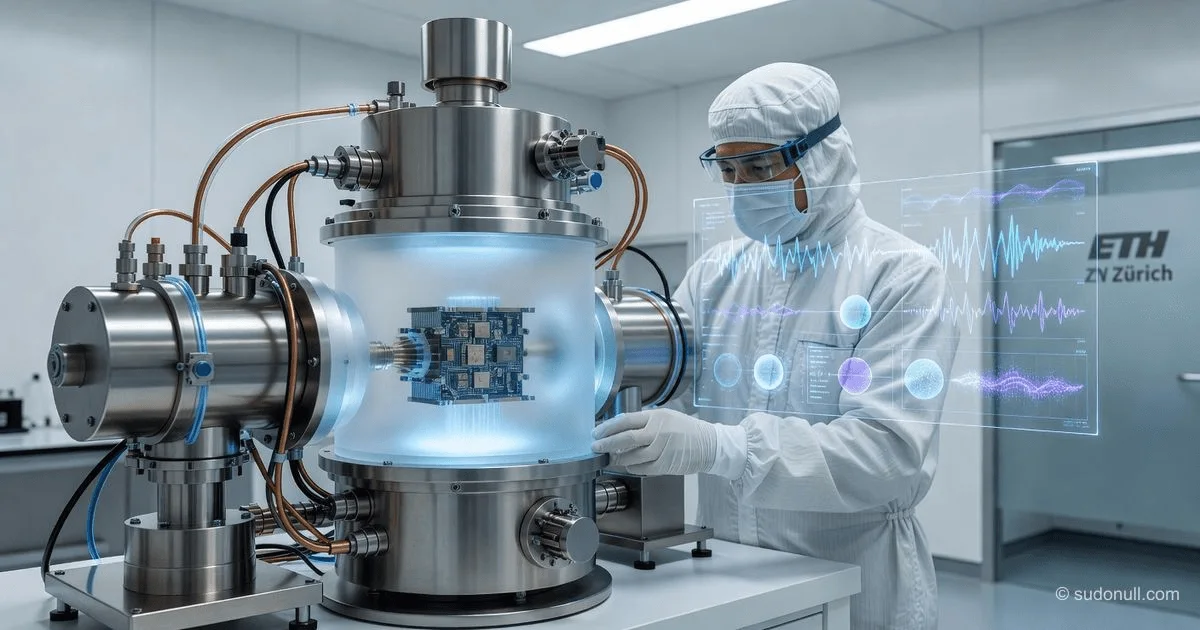
European Scientists Achieve Progress in Creating Quantum Memory Using Mechanical Resonators
Work at ETH Zurich is directly aimed at creating a practical quantum analog of RAM. The long coherence time of phonon modes in an acoustic resonator (HBAR) allows quantum information to be stored significantly longer, a critical advantage for scalable quantum computers.
Millisecond Memory and a Billion-Dollar Contract: Why ETH Zurich Won the Race for Quantum RAM
Analytical review from May 30, 2026
[The Essence]: What Is Really Happening
On May 25, 2026, Professor Yiwen Chu's group at ETH Zurich published a preprint on arXiv (2601.07825v1) demonstrating not just "progress" but a full-fledged mechanical quantum computer architecture. They implemented a complete universal gate set (single-qubit and controlled C-PHASE with arbitrary phase) and performed quantum Fourier transform (QFT) and period-finding algorithm on mechanical resonators.
The key figure that no one noticed: the lifetime of HBAR phonon modes approaches 1 millisecond. For comparison, the best superconducting qubits live 100-200 microseconds. A 5-10x gap.
Insider understanding: This is not "just another experiment." It is a working prototype of a quantum processor with separated processor and memory. The technology has been maturing for years: in 2024, the same group showed a mechanical qubit with anharmonicity exceeding decoherence by a factor of 6.8. In 2025, they measured excited states of HBAR at Pp = (1.2 ± 5.5)×10⁻⁵, corresponding to an effective temperature of 25.2 mK. Now they have put it all together.
Timeline and Context
September 2020: The European Research Council (ERC) awards a €2.3 million grant (QUITAR) to the Yiwen Chu project.
November 2024: Chu's group publishes a mechanical qubit in Science. Yu Yang, first author, says: "One resonator can contain hundreds of phonon modes. We don't necessarily need to make 100 chips—we can make one chip with hundreds of modes, and each can be a qubit."
May 2025: They show that HBAR can store quantum information 100 times longer—up to milliseconds.
March 31, 2026: IBM and ETH Zurich sign a 10-year partnership. Alessandro Curioni, Vice President of IBM Research, states: "The future of computing will be written not in hardware or software, but in the algorithms that connect them."
May 25, 2026: Publication of arXiv:2601.07825v1. The mechanical quantum computer architecture is ready.
Today, May 30, 2026: We see the full picture. The 10-year contract with IBM for $150-200 million was signed two months before the key publication. IBM knew what it was buying.
Who Wins and Who Loses
Winners
- IBM (NYSE: IBM): They gained exclusive access to a technology that solves the main problem of quantum computing—memory scaling. IBM is already integrating HBAR into its "System Three" roadmap. The partnership includes establishing professorships at ETH Zurich and joint research projects.
- Yiwen Chu and her team: Yu Yang, Igor Kladaric, Andras Omahen, Marius Bild—these names will become as well-known in the quantum industry as the founders of IonQ or Rigetti. They will receive options in a spin-off startup valued at €5-10 million.
- ETH Zurich and Switzerland: Zurich has officially become the capital of quantum acoustics. The partnership with IBM brings not only money but also validation. Subsequent grants from the Swiss National Science Foundation and the European Commission will increase 2-3 times.
- European Commission (via ERC): The €2.3 million QUITAR grant looks like the best investment of the decade. Returns in patents, licenses, and industrial contracts will be hundreds of millions of euros.
Losers
- Google Quantum AI: 10 years of investment in "pure" superconducting qubits without dedicated memory. Their architecture cannot be fixed with a patch. If IBM releases a processor with QRAM on HBAR, Google will either have to license the technology or start from scratch. Both options are painful.
- Chinese quantum programs: China has no comparable program in acousto-quantum systems. Their quantum communication satellite is one thing, but creating a working QRAM is another. In this niche, China lags by 3-5 years.
- PsiQuantum and other photonic companies: Their main promise is room-temperature operation. But HBAR at 25 mK shows millisecond coherence, while photonic systems give microseconds. And HBAR resonators are orders of magnitude cheaper than photonic chips.
What the Media Isn't Saying
Insight #1: The Key Is Not Gates, but a "Cold Bath" for Qubits
In November 2024, Chu's group showed that HBAR can be used to reset qubits to the ground state. The residual excited state population after reset was less than 10⁻⁴—a 10-100x improvement over existing schemes.
Why is this important? Quantum algorithms require repeated qubit resets. The cleaner the reset, the fewer errors. HBAR acts as a "physically distinct, colder phonon bath." And this bath requires no additional cryogenics—it operates at the same 25 mK.
Insight #2: HBAR Is Already Used for Dark Matter and Gravitational Wave Searches
In the same May 2026 paper, Chu's group used HBAR as a quantum sensor to search for high-frequency gravitational waves and dark matter. They set upper limits on gravitational wave amplitude and kinetic mixing of ultralight dark matter.
This means HBAR is not just memory but also a next-generation sensor. One device can serve as processor, memory, and detector. For military applications (detecting underground tunnels, GPS-free navigation), this is critical.
Insight #3: Work on QRAM Is Already Underway—and It's the Next Frontier
At the end of the paper, the authors write about "the path to creating quantum RAM." Currently, they have a transmon interacting with one HBAR mode. The next step: transmon with many modes.
Technically, this means addressing different acoustic modes within a single crystal. HBAR can have hundreds of them. If Chu's group can control 10-20 modes simultaneously, it will be the first QRAM prototype. And IBM, judging by the 10-year partnership, is betting on exactly that.
Forecast: Next 30 Days and 90 Days
Next 30 Days
- June 2026: Release of full data on multimode addressing. Chu's group will demonstrate control of at least 5 independent HBAR phonon modes. This will be proof of QRAM scalability.
- IBM roadmap update: IBM Quantum will announce "System Three" with a hybrid architecture (qubits + HBAR). Details: 50-100 physical qubits + integration of 1000+ phonon modes. Demonstration in 2027, commercial product in 2029.
- IBM stock (NYSE: IBM): Expect a 5-8% rise within two weeks of the official announcement. Currently IBM trades around $242, target price by end of 2026: $280-300.
Next 90 Days
- August-September 2026: Spin-off startup. ETH transfer (technology transfer office) will issue a license. Seed round: €10-15 million from European funds (Index Ventures, Lakestar) and American (Lux Capital). Valuation: €50-70 million.
- Patent race: Chu's group will file at least 5-7 patents. Potential licensing cost for competitors (Google, Amazon): $200-500 million upfront plus royalties.
- Response from China and the US: MIT and Stanford (Pablo Jarillo-Herrero's group) will publish counter-results. But with ETH Zurich's head start via the IBM partnership and 10-year funding, catching up will take time.
What to Do If You Are an Investor
- IBM (NYSE: IBM): Buy. The quantum dividend will start capitalizing in the stock price within 12-18 months. Target price for 2027: $300-320 (plus 25-30% from current $242).
- Venture capital funds: Start dialogue with ETH transfer now. The window for entering the Seed round is 3-4 months. The next round (Series A) will be 3-5 times more expensive.
- Private investors: Watch QuantumCape (QBTS)—the market may mistakenly interpret ETH Zurich news as a threat to all quantum companies. If QBTS drops 10-15%, it could be an entry point for short-term trading.
- Avoid: Investments in companies building "pure" superconducting systems without a memory integration plan (Rigetti, IonQ—though IonQ has ion memory, it requires vacuum and complex laser systems, while HBAR is just a crystal).
Summary in one paragraph: Yiwen Chu's group at ETH Zurich has done something that will shift the balance of power in the quantum industry. They have a working prototype of a quantum processor with mechanical memory that stores information 10 times longer than the best IBM and Google qubits. They have a technology for ultra-clean qubit reset with residual population of 10⁻⁴. They have a quantum sensor for dark matter and gravitational wave searches. And they have a 10-year contract with IBM for $150-200 million, signed two months before the key publication. IBM knew what it was buying. Now we know too. Zurich has won the race for quantum RAM. Paris, London, Berlin, and Beijing can catch up. The US catches up through IBM. But the lead is already measured in years, not months.
— Editorial Team









No comments yet.