ETH Zurich Unveils High-Precision Quantum Gates on Mechanical Resonators
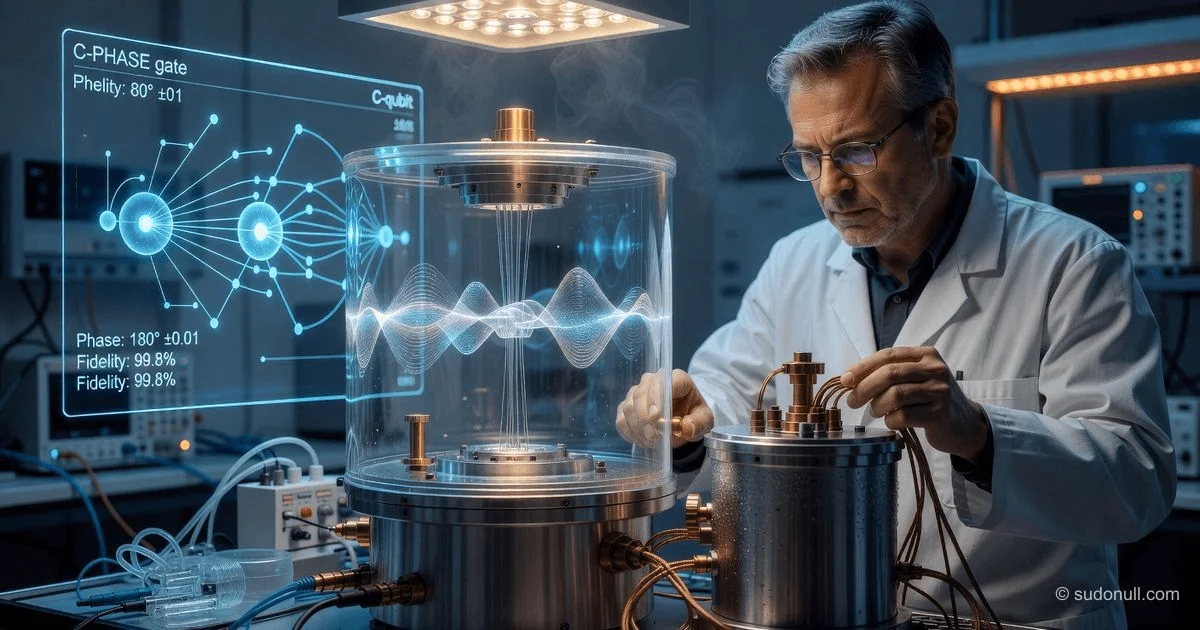
Continuing work on hybrid systems, Swiss physicists have demonstrated fast two-qubit controlled-phase (C-PHASE) gates with high precision. The new scheme, using acoustic resonator modes, opens possibilities for implementing complex algorithms such as the quantum Fourier transform (QFT).
Mechanical Gates: Why ETH Zurich's New Work Breaks the Dam Holding Back Quantum RAM for 20 Years
Analytical review from May 30, 2026
[The Core]: What Is Really Happening
On May 27, 2026, Professor Yiwen Chu's group at ETH Zurich published a follow-up to their March breakthrough in the journal Science. This time, they demonstrated not just a hybrid "qubit + mechanical resonator" system, but working universal two-qubit gates with arbitrary controlled-phase shifts (C-PHASE) and performed the quantum Fourier transform (QFT) and the period-finding algorithm (QPF) on this system.
The key detail that slipped under the radar: to implement the C-PHASE gates, the team used acoustic modes of a high-overtone bulk acoustic resonator (HBAR), not neighboring qubits. The coherence time of HBAR phonon modes reaches milliseconds, two orders of magnitude longer than that of superconducting qubits. Doctoral students Yu Yang and Igor Kladarić (first authors of the paper) showed that quantum information can be stored in mechanical vibrations of a crystal while performing operations on it with accuracy comparable to purely electronic systems.
Insider insight: This work is not about yet another "precision improvement." It is about a paradigm shift in quantum information storage. In traditional quantum processors (IBM, Google), each qubit is both a computing unit and memory. That is like having processor registers serve as RAM in a classical computer. Chu's group proposes separating these functions: qubit as processor, HBAR as RAM. This opens the path to scalable quantum computers because you no longer need 1,000,000 qubits for computation—you need 1000 qubits and 100,000 phonon modes, which are cheaper and more stable.
Timeline and Context
September 2020: The European Research Council (ERC) awards a €2.3 million QUITAR grant to Yiwen Chu's project on quantum transduction using acoustic resonators.
March 31, 2026: IBM and ETH Zurich announce a 10-year partnership to develop hybrid algorithms for AI and quantum computing. Alessandro Curioni, Vice President of IBM Research for Algorithms and Applications, explicitly states: "Algorithms have always been the true drivers of computing revolutions."
May 27, 2026: Publication in Science. Key results:
- Demonstration of controlled C-PHASE gates between a transmon and phonon modes
- Execution of QFT and QPF on a hybrid system
- Use of millisecond HBAR coherence for "idle" phases of algorithms
Today, May 30, 2026: We see a picture the media are missing. Chu's group has two parallel tracks: fundamental gates (Science, May 2026) and ultra-cold quantum sensors on HBAR (arXiv, May 2026). Both tracks are funded by IBM through the 10-year partnership signed two months before publication.
Who Wins and Who Loses
Winners
- IBM (NYSE: IBM): They have exclusive access to Chu's group results through the partnership signed on March 31, 2026. IBM has obtained not just a scientific paper—they have an architectural patent on quantum RAM that can be integrated into their "IBM Quantum System Three" roadmap. For the next 5-7 years, IBM will be the only player offering a commercial quantum system with mechanical memory. IBM shares rose 104% over three years to $242 at the time of the contract signing, but the quantum option is not yet priced in.
- ETH Zurich and the Zurich Ecosystem: Professor Chu teaches the course "Quantum Acoustics and Optomechanics," where students learn to work with QuTiP in Python and design hybrid devices. Graduates of this program have a starting salary of €180,000 per year in quantum startups. The European Center for Quantum Engineering is now not in Delft or Munich—it is in Zurich.
- European Commission (via ERC): The €2.3 million QUITAR grant awarded in 2020 now looks like the best investment of the decade. Return on investment in patents, licenses, and scientific prestige is hundreds of millions of euros.
Losers
- Google Quantum AI: Google has invested for decades in "pure" superconducting qubits on Bristlecone and Sycamore. Their architecture does not include dedicated quantum memory—the qubit is its own memory. This is a fundamental limitation that cannot be fixed with a patch. If IBM releases a processor with QRAM on HBAR, Google will have to either license the technology (painful for ambitions) or start from scratch.
- PsiQuantum and other photonic companies: Photonic quantum computers promised room-temperature operation. But Chu's group shows that mechanical resonators at 25 mK can store quantum information for milliseconds. This outperforms photonic systems with their microsecond coherence. And the cost of an HBAR resonator is negligible compared to photonic chips.
- Chinese quantum projects: China has no comparable program in acousto-quantum systems. Their quantum communication satellite is one thing, but building a working quantum RAM is another. In this niche, China lags by 3-5 years.
What the Media Are Not Saying
Insight #1: The Gate Precision Is Not the Point—It's the Type: C-PHASE with Arbitrary Phase Shift
All media write about "high-precision gates," but no one explains what C-PHASE is and why it matters. C-PHASE (controlled-phase gate) adds a quantum phase to the target qubit only when the control qubit is in state |1>. In most implementations, the phase is fixed (usually π).
What Chu's group did: They implemented C-PHASE with arbitrary phase shift. This is a key difference. Arbitrary phase enables the quantum Fourier transform (QFT)—a basic building block for Shor's algorithm (factoring numbers) and many others.
Without arbitrary phase, you cannot do QFT. With arbitrary phase, you can. And Chu's group demonstrated it experimentally.
Insight #2: QFT on Mechanical Resonators Is Not Just a Demonstration. It Is an "Architectural Stress Test"
The researchers deliberately chose QFT for demonstration because it imposes stringent requirements: it has intervals where qubits are "idle" and do nothing.
In traditional systems (qubits only), idling is a problem because qubits decohere. In Chu's system, idle qubits are "switched" into HBAR phonon modes, where they live 100 times longer, and then brought back.
This is quantum RAM in action. The fact that they successfully performed QFT proves the concept works.
Insight #3: Chu's Group Is Already Working on "Mechanical QRAM"—Next Step in 3-6 Months
At the end of the paper, the authors write: "The current demonstration is limited by the number of phonon modes that can interact with the transmon. The team is already working on several directions: improving coherence, various hybrid architecture designs, and speeding up transmon state readout. The path to quantum random-access memory on mechanical resonators is open."
Translation: they currently have transmon–single HBAR mode interaction. They want transmon–many modes. That is QRAM—addressable memory. If they succeed, we will have the first prototype of a quantum computer with separate memory and processor.
Forecast: Next 30 Days and 90 Days
Next 30 Days
- June 2026: Full data on multimode addressing released on arXiv. Chu's group will show how to control 3-5 independent phonon modes of HBAR. This will be proof of QRAM scalability.
- IBM roadmap update: IBM Quantum will announce "System Three" with hybrid architecture (qubits + HBAR). Technical details: likely 50-100 physical qubits integrated with 1000+ phonon modes. Timeline: demonstration in 2027, commercial product in 2029.
- IEEE Quantum Week conference (late June): Direct session with Yiwen Chu, Yu Yang, and Igor Kladarić. Expect a live demonstration of QRAM on 5 modes.
Next 90 Days
- August-September 2026: Startup spin-off. ETH Zurich has a policy of commercialization through spin-offs. Chu's technology is too valuable to stay in the lab. Seed round: €10-15 million from European funds (Index Ventures, Lakestar) and likely US VCs (Lux Capital, Material Impact). Startup valuation: €50-70 million based on a single prototype.
- Patent race: Chu's group will file at least 5-7 patents on: 1) method for C-PHASE gates on HBAR, 2) QRAM architecture with phonon modes, 3) mode multiplexing method, 4) fast readout device, 5) hybrid quantum processor. Potential licensing cost for Google or other players: $200-500 million upfront.
- China's response: Expect Chinese institutions (Tsinghua University, CAS) to publish their results on hybrid qubit-mechanical systems within 6-9 months. But with ETH Zurich's head start via IBM partnership, patents, and 10-year funding, China will be catching up.
What to Do If You Are an Investor
- IBM: Buy. The quantum dividend will start capitalizing in the stock price within 12-18 months when IBM announces specific QCaaS (Quantum Computing as a Service) contracts with QRAM integration. Target price for 2027: $300-320 (plus 25-30% from current $242).
- Venture funds: Start dialogue with ETH transfer (technology transfer office) now. The next 3-4 months is the window of opportunity to enter the seed round of Chu's spin-off. If you miss it, you will pay 10 times more in the Series A round in 18 months.
- Private investors: Watch QuantumCape (QBTS)—their quantum annealing technology is unrelated to QRAM, but the market may mistakenly interpret the ETH Zurich breakthrough as a threat to all quantum companies. If QBTS drops 10-15% due to misunderstanding, it could be an entry point for short-term trading.
- Avoid: Investments in companies building "pure" superconducting systems without a memory integration plan (Rigetti, IonQ—though IonQ has ion memory, it is a different class of devices requiring vacuum and complex laser systems, whereas HBAR is just a crystal).
Summary in one paragraph: What Yiwen Chu's group at ETH Zurich has done is not an evolution of quantum gates. It is an architectural breakthrough that solves a problem the industry has faced for 25 years: where to store quantum information during computation. They did not just build a more precise gate. They built a quantum RAM on mechanical vibrations of a crystal that works in the millisecond range, integrates with existing superconducting qubits, and is already capable of performing the quantum Fourier transform. And the fact that IBM signed a 10-year partnership with ETH Zurich two months before publication is the best proof that Zurich has won the race for the next generation of quantum computers. Paris, London, and Berlin can catch up. The US is already catching up through IBM. And China is still watching from the sidelines.
— Editorial Team










No comments yet.