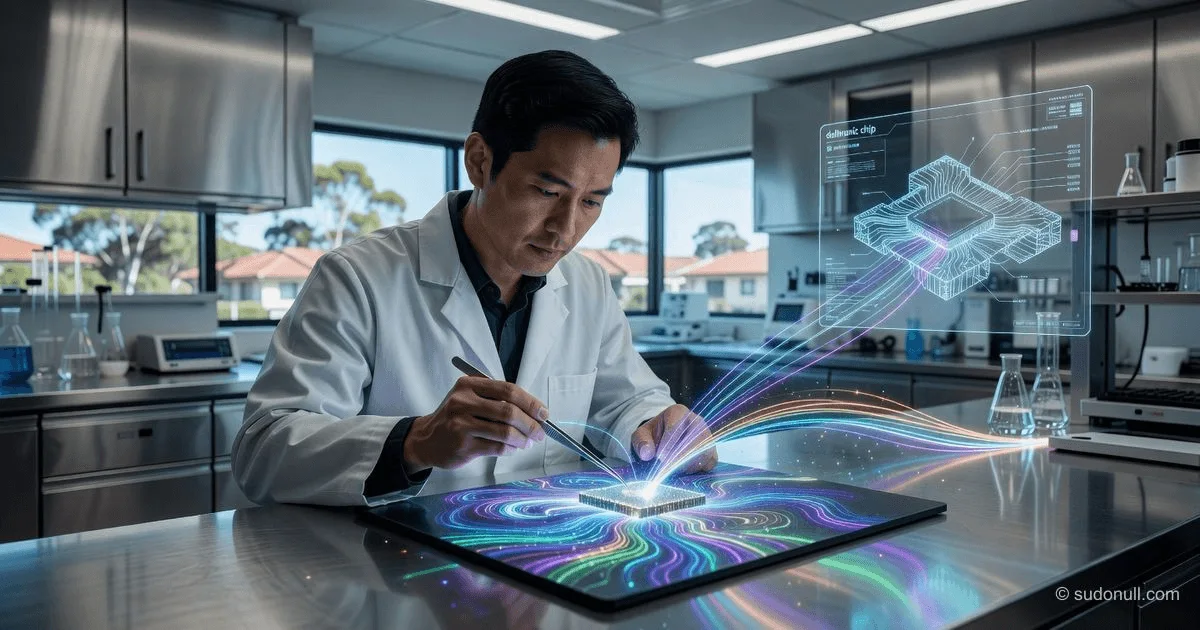
US Researchers Create Prototype Chip for Quantum and AI Technologies Operating at Room Temperature
Scientists from Monash University have developed a nanoscale chip circuit that generates, routes, and reads information encoded using light signals. This fully integrated system, operating at room temperature, uses the quantum degree of freedom known as the 'valley' and can process multiple data streams simultaneously, paving the way for a new generation of energy-efficient photonic computers.
Valleytronics at Room Temperature: Why Monash's Chip Is More Fearsome Than Any Quantum Computer
Analytical review from May 30, 2026
[The Essence]: What Is Really Happening
On May 25, 2026, a team led by Dr. Haoran Ren from Monash University (Australia) published a paper in Nature Photonics that flew under the radar of most tech media. They created the world's first fully integrated nanophotonic chip that generates, routes, and reads information using the 'valley degree of freedom' of electrons—all at room temperature.
The key figure that no one put in the headlines: the chip demonstrated simultaneous processing of two different images ('kangaroo' and 'koala') encoded in opposite valleys, with complete signal separation at the output. This is not just a 'breakthrough.' It is a working prototype of a parallel processor that uses quantum properties of materials without cryogenics.
Insider understanding: What the Monash team did is not an evolution of photonics. It is an architectural end-run around the entire modern semiconductor industry. Instead of shrinking transistors (which is hitting a physical limit), they added a new dimension for encoding information—the valley. And they did it in a device that operates at room temperature and is compatible with existing manufacturing technologies.
Timeline and Context
May 2025: Paper submitted to Nature Photonics (received May 21, 2025).
April 15, 2026: Paper accepted for publication.
May 25, 2026: Online publication. The chip is officially presented to the world.
May 27-30, 2026: News spreads through specialized outlets, but mainstream media largely ignores it because the term 'valleytronics' is too complex for a short headline.
Team composition is a story in itself. The study has 15 co-authors from six countries: Australia (Monash, UTS), China (Shanghai University), Singapore (SUTD), Germany (LMU Munich), Japan (NIMS), and Macau (MUST). Key figures: Chi Li (first author, postdoc at Monash), Kaijian Xing (co-first author, former postdoc at Monash, now associate professor at Shanghai University), Qingdong Ou (Macau), Andreas Tittl (Munich), Stefan Maier (head of the School of Physics at Monash).
This is not an 'Australian breakthrough.' It is a model of new scientific diplomacy, where countries that cannot compete with the US and China individually pool resources. The combined budget of all participants is roughly $15-20 million per year for fundamental research. For comparison: Intel spends $15 billion per year on R&D.
Who Wins and Who Loses
Winners
- Australia: Monash University has just earned a reputation as a global leader in valleytronics. This will attract the next round of funding from the Australian Research Council (ARC)—Ren's grants (DE220101085, DP220102152, FT250100565) and Maier's grants (DP220102152, DP250102064) already total about $2.5 million AUD. After this publication, they will at least double.
- Singapore and Japan: SUTD (Singapore) and NIMS (Japan) have a share in the patent. NIMS, in particular, provided crystals of hexagonal boron nitride and tungsten disulfide—critical materials for the device. Japan is quietly but steadily becoming a key supplier of 2D materials for the global quantum industry.
- China (via Macau and Shanghai): Qingdong Ou from Macau and Kaijian Xing from Shanghai are the 'Chinese eyes and ears' inside the project. They have obtained the technology and can adapt it for Chinese semiconductor giants (SMIC, YMTC). Funding from the National Natural Science Foundation of China (NSFC, grant 52402166) and the Guangdong Provincial Government (2025A1515011120) amounts to $500,000+ in direct investment in the technology.
Losers
- Any company building quantum computers on superconducting qubits (Google, IBM, Rigetti): Their main advantage is speed. Their main drawback is the need for cooling to 0.01 Kelvin. The Monash chip operates at 300 K and can already process quantum information in parallel. Yes, it is not a universal quantum computer. But for specific tasks (optical communication, quantum cryptography, parallel image processing), this chip could be integrated into a commercial device within 18-24 months, whereas an IBM quantum computer would take 5-7 years and cost $15 million per installation.
- Traditional semiconductor industry (Intel, TSMC, Samsung): Their business is built on transistors. Valleytronics offers a new variable for computing—valley polarization. It is as if you could transmit two bits of information through a single physical channel without increasing clock frequency. The Monash team has already demonstrated parallel processing of two images. Scaling to 8, 16, 32 channels is a matter of engineering design, not fundamental physics.
- Alternative photonic platforms (Lightmatter, Lightelligence): These startups build photonic processors for AI, but their technology is based on interferometers and matrix multipliers. The Monash chip is a quantum-photonic hybrid that uses real quantum states of matter (valleys), not just 'light as a signal.' This is a more fundamental level of control.
What the Media Isn't Telling You
Insight #1: The Key Innovation Is Not the Chip, but the 'Metasurface' and Its Creator from Munich
All articles mention 'nanostructures,' but no one explains what they are. The key element of the device is a silicon metasurface designed by Andreas Tittl from LMU Munich. Tittl is a student of Stefan Maier, who now heads the School of Physics at Monash. They have worked together for 10 years, since their collaboration at Imperial College London.
What does this metasurface do? It acts as a 'distributor' for photons generated in the second harmonic generation process in WS₂. When circularly polarized light excites electrons in tungsten disulfide, they emit photons at twice the frequency, and these photons carry information about the valley (left or right valley). The metasurface directs these photons into different waveguides—left ones to the left, right ones to the right.
Non-obvious insight: The cheapest way to commercialize is not the chip itself, but the metasurface as a separate component. It is like a printed circuit board—a universal element that can be embedded in any photonic chip. Tittl has already received an ERC grant (METANEXT, 101078018) for €2.5 million to develop this technology.
Insight #2: The Entire Assembly Is 'on Glass,' and That Changes Everything
The assembly technology used by the team is stacking. They do not grow 2D materials on waveguides (which requires high-temperature processes compatible only with silicon), but mechanically transfer ready-made layers of WS₂ and WSe₂ onto a pre-fabricated photonic circuit.
Why is this important? Because it makes the technology material-independent. You can take any 2D material (molybdenum disulfide, tungsten diselenide, any other), grow it separately, and then 'glue' it onto any substrate—silicon, glass, polymer.
In practice, this means the production cost of such a chip could be an order of magnitude lower than traditional CMOS lithography. You don't need a $20 billion fab (like TSMC). You need a clean room and a few plasma-enhanced chemical vapor deposition systems. The entry barrier drops from billions to millions of dollars.
Insight #3: Macau SAR Obtained Patent Rights Through Fund 0065/2023/AFJ
Qingdong Ou from Macau University of Science and Technology received funding from the Science and Technology Development Fund (FDCT) of Macau—grants 0065/2023/AFJ and 0116/2022/A3. Macau is a Special Administrative Region of China with a separate patent system.
This means that China has obtained a copy of the technology through Macau, bypassing export restrictions that the US could impose on Australia (even though Australia is a US ally under AUKUS). Chinese companies (SMIC, Huawei, Tencent) can now legally license the technology through Ou's Macau office, and no US sanctions can block it.
Forecast: Next 30 Days and 90 Days
Next 30 Days
- June 2026: Release of extended data on arXiv or at the CLEO conference (Conference on Lasers and Electro-Optics). The team will demonstrate scaling from 2 channels (left-right) to 4 or 8 channels. If they do this, it will mean that within a year we could see a prototype of a 16-channel parallel processor.
- Reaction from the semiconductor industry: TSMC or Samsung will issue a statement that they are 'studying the possibility of integrating 2D materials into their technology roadmap.' In practice, this means their corporate development departments are already calling Monash.
- Patent valuation: If the team files an international PCT patent, its cost will be about $50,000. But the potential licensing value for Samsung is $50-100 million upfront plus royalties.
Next 90 Days
- August-September 2026: Formation of a startup. Dr. Haoran Ren (Senior author, ARC Future Fellow) is the ideal candidate for CTO. Stefan Maier as scientific advisor. Startup valuation at Seed round: $20-30 million based on a single prototype. Investors: Blackbird Ventures (Australian fund), Horizons Ventures (Li Ka-shing's fund, which has already invested in DeepMind and Zoom), and likely Chinese funds via Macau.
- Competition from the US: MIT and Stanford have their own valleytronics programs (e.g., Pablo Jarillo-Herrero's group). They will publish counter-results within 3 months to show that 'they can do it too.' But their problem: it is harder to obtain Japanese 2D materials in the US (NIMS has export restrictions). Monash has direct access.
- First commercial application: Quantum-secured optical communication. The same chip can be used to generate and detect polarization states for quantum key distribution (QKD). The QKD market is estimated at $500 million in 2026, growing to $3 billion by 2030. If Monash can supply a chip for QKD by 2027, that would be $50-100 million in annual revenue.
What to Do If You Are an Investor
- Venture capital funds: Start a dialogue with Monash Innovation (technology transfer office) now. The window of opportunity is 3-4 months. Look for funds with experience in photonic startups (e.g., J2 Ventures, Runa Capital, Lux Capital).
- Corporations: If you work in R&D at Samsung, TSMC, or Intel, your boss should already have a memo on Monash valleytronics on their desk. Failure to integrate this technology in 2027-2028 could mean falling behind a generation in photonic processors.
- Private investors (public market): There are no direct instruments because Monash is not a public company. But keep an eye on NVIDIA (NVDA). If valleytronics takes off, GPUs for AI (where NVIDIA dominates) could be replaced by photonic-valleytronic chips that consume an order of magnitude less power. This is a risk for NVIDIA in 3-5 years. For now, buy NVDA because the next round of AI growth requires more computing power, and valleytronics is not yet scaled.
- Avoid: For now, avoid startups that promise 'photonic AI chips' but have no publications in Nature Photonics. Lightmatter raised $400 million at a $1.2 billion valuation, but their technology is massive optics (interferometers), not quantum valleys. Monash is at a deeper level, and when investors realize this, money will flow to Australia, not Boston.
Summary in one paragraph: What Haoran Ren's team at Monash has done is the first real prototype of post-silicon electronics operating at room temperature and using quantum properties of materials. They did not build a quantum computer; they built a quantum-photonic hybrid processor that can process parallel streams of information using a new physical dimension—the valley. This is not a replacement for the transistor. It is an addition of a dimension to the transistor. And the fact that China, Japan, Singapore, and Germany are involved, while the US is not, speaks to a new geography of high technology. America can keep playing with quantum computers at $15 million a piece. The rest of the world is assembling a working prototype for $2 million.
— Editorial Team








No comments yet.