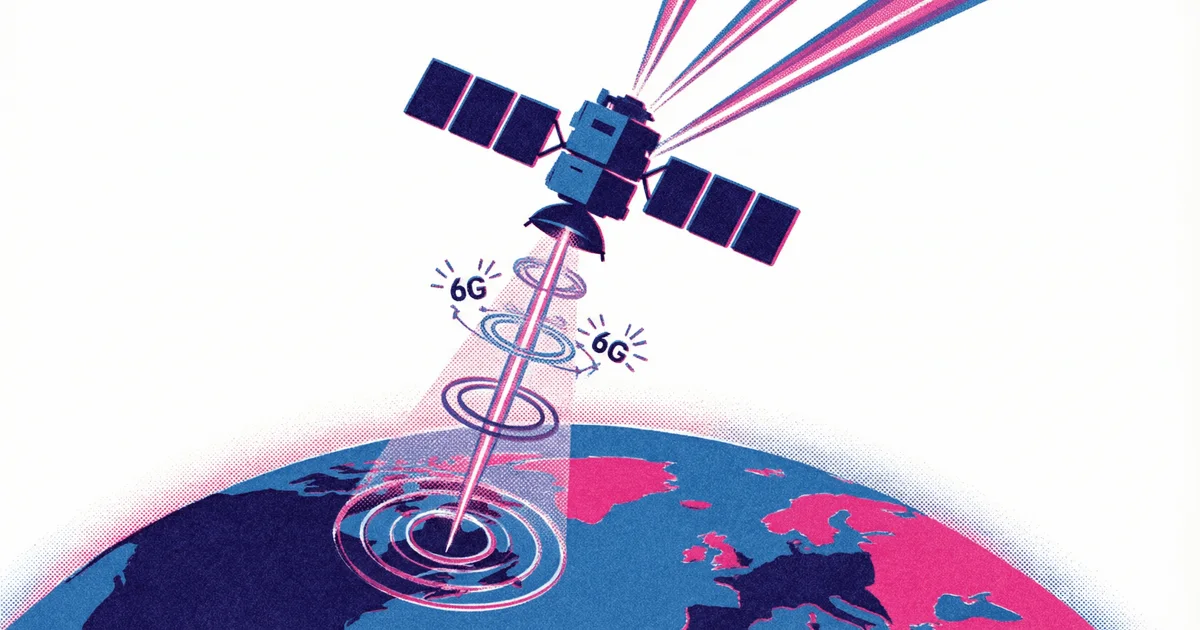
China Launches Satellite for Quantum Communication and 6G Tests
A carrier rocket successfully lifted off from the Xichang Space Center carrying the "Technological Experimental Communication Satellite-24." The spacecraft is designed to test high-speed data transmission technologies as part of the development program for quantum internet and sixth-generation communication.
Analytical Note: Insider Perspective on the Launch of the "Technological Experimental Communication Satellite-24"
Status: Strategic memorandum for venture capital funds and defense analysts.
Author: Consultant on space security and telecom infrastructure.
Subject: Quantum satellite "Tianjin-24" — a new level of 6G and quantum internet.
[The Gist]: What's Really Happening
Official version: China launched experimental communication satellite No. 24 to test multi-band high-speed data transmission as part of developing quantum internet and 6G communication.
Reality:
"Satellite No. 24" is a public mask for the launch of third-generation quantum repeaters. Officially called TJSW-24 (Tongxin Jishu Shiyan Weixing — Experimental Communication Satellite), but within the industry it has already been dubbed "Jiao-Tong" ("Bridge"). Its mission is to connect disparate terrestrial quantum networks (Beijing-Shanghai) with the orbital constellation "Thousand Sails" and the state network Guowang (13,000 satellites).
The whole world is now trying to build a Post-Quantum Internet. China has already built its skeleton. While Starlink solves the problem of "just giving internet to a village in Honduras," the Chinese are solving the problem of "how to make this internet unhackable even by a quantum computer." The launch on May 27, 2026, is not a test of a new antenna. It is the integration of Quantum Key Distribution (QKD) into a commercial low-orbit constellation.
The main non-obvious insight: China is abandoning heavy quantum satellites in favor of mass-produced micro-satellites. Previously, they had "Mo-Tzu" weighing 600 kg — that was a laboratory. Now, thanks to micro-miniaturization technologies (optics on a chip), they are placing a quantum generator on a satellite weighing 50-100 kg. Satellite No. 24 is the first in a series of "commercial" (conditionally) quantum devices that can be stamped out by the hundreds at a factory in Shanghai. The launch took place from the Wenchang Space Launch Site (on the water, Hainan) using a Long March 7A rocket, indicating mass deployment to orbit.
Timeline and Context
Why May 27, 2026 is a paradigm-shifting date:
- 2023-2024 (Old School): The "Jinan-1" (23 kg) was in orbit — the first micro-satellite for QKD, but it was experimental and had a short lifespan.
- March 2025 (Proof of Concept): China conducted the "Beijing — Johannesburg" experiment (12,900 km). This proved that keys could be transmitted over intercontinental distances via micro-satellites. The world was amazed but said, "This is a lab experiment; mass production is far off."
- January 2026 (Economic Basis): Details of the "Thousand Sails" project became known: $943 million USD for 15,000 satellites. The contract includes a "classified" clause for integrating QKD modules.
- May 2026 (Today): Launch No. 24. This is the first spacecraft created not by the Chinese Academy of Sciences (CAS), but by the 8th Research Institute of CASC Corporation (mass production plant). This marks a transition from "one-off" scientific satellites to "assembly-line" combat units.
Key context: 2026 has been declared in China as the year of the start of the "Great Quantum Construction." The budget for space quantum communication in the 15th Five-Year Plan (2026-2030) is set at $12 billion USD. This satellite is the first tranche.
Who Wins and Who Loses
Winners:
- Chinese telecom operators (China Mobile, China Telecom): They gain infrastructure for "quantum roaming." They are already testing "5G + quantum satellite" for encrypting state secret calls. By year-end, they will offer a "quantum SIM card" service for diplomats and corporations at $500 per month.
- Russia (Roscosmos / "Bureau 1440"): Now we have a ready-made technology track to copy. We are not reinventing the wheel. We look at the "Long March 7A" and realize we need similarly cheap launch vehicles and micro-satellites. The "Sphere" project could be reformatted for quantum protection.
- Optical component manufacturers (Lumentum, II-VI): Demand for chips for laser inter-satellite links and single-photon detectors will skyrocket. "Tianjin-24" is equipped with a system that allows two satellites in vacuum to exchange quantum states without losing them to the atmosphere. This costs millions of dollars per component.
Losers:
- Starlink (SpaceX): Elon Musk dominates in volume. But his network is not protected against quantum hacking. The Pentagon has long said Starlink is "convenient but dangerous." Now the Chinese are offering the market a "secure Starlink." European banks and logistics companies will think twice: use the American civilian network or the Chinese quantum-safe one?
- European IRIS² project: The EU is just ramping up allocation of €6 billion EUR for its satellite constellation. It will be ready by 2028-2030, and quantum protection is not yet included (only in plans). China already has a flying prototype in 2026. Europe has hopelessly missed the "quantum internet" train. Their fate is to buy services from China or the US.
- Classical crypto vendors (RSA Security, Entrust): Their product (mathematics-based cryptography) is dying. Satellite No. 24 renders their main argument ("long keys"/RSA-2048) useless at the physical level. Investments in "post-quantum cryptography" (mathematics-based algorithms) may turn out to be wasted money if physical quantum communication becomes cheap.
What the Media Doesn't Tell
Main non-obvious insight:
The launch took place at 00:16 local time. Why at night? Not just because of orbital mechanics. It was done deliberately so that SpaceX's drone could not capture the spacecraft up close during deployment.
US spy satellites (and Starlink with cameras) fly over Wenchang during the day. A night launch is classic camouflage. Moreover, many Russian and Western bloggers wrote that this is just "another telecom satellite." They did not pay attention to the designation "TJSW." The TJSW series (starting with TJSW-1) has always involved military or dual-use technologies. Previous TJSW satellites tested missile warning. This one is a weapon of future warfare: quantum communication.
- Link to 6G: 6G is not just about speed. It's about Integrated Sensing and Communication (ISAC) and "free" access to terahertz spectrum. But the most important thing in 6G is Native Security. The Chinese are embedding a quantum chip directly into the 6G architecture. Satellite No. 24 tests how fast a photon can be "caught" by a moving train or airplane. If this works, then in 2030, Chinese 6G will be fundamentally unhackable.
- "Dark" Tests: According to leaked (but unconfirmed) forum data, TJSW-24 carries a prototype of "entanglement switching." This allows switching an "entangled" pair of photons between different ground subscribers in microseconds. It's analogous to a switch in Ethernet, but for quantum. Without this, the quantum internet is just a set of point-to-point connections. With it, a full-fledged network.
Forecast: Next 30 Days and 90 Days
30 days (end of June 2026):
- Data publication: The Chinese will release in open access (likely in Optica or Nature Photonics) the first results of speed tests. The figure will be around 10-15 kbit/s key generation (10 times faster than "Jinan-1"). This is enough for encrypting voice calls and launch commands, but not for YouTube.
- Pentagon reaction: A report will be released in the US calling TJSW-24 a "direct threat to national security" as it enables invulnerable command transmission for the nuclear shield ("Doomsday" system). Lockheed Martin shares will rise 2-3% on fears.
90 days (August 2026):
- Launch of second spacecraft (No. 25): Before haters can cool down, China will launch another (likely from Taiyuan or Jiuquan). They will ramp up the orbital constellation at a pace of 1 satellite every 1-2 months. By September, they will have 3 operational quantum satellites in orbit.
- Battle for standards: China will submit an application to the ITU (International Telecommunication Union) to establish its quantum routing scheme (CIQSNet) as the global standard for 6G. The US and EU will try to block it, but China, having a working prototype in orbit, will say, "Who has real technology? Show us." This will cause a diplomatic scandal on the sidelines of the UN General Assembly.
- Russian response: Roscosmos will announce the creation of a "Quantum Communication Center" based on the Skif satellites (Sphere project). In reality, this will involve purchasing Chinese components or scientific-technical cooperation with TUSUR, but the PR flag will be raised. Investments in the project will amount to about $300 million USD, 40 times less than China's, but at least something.
Summary: China is no longer catching up. It is dictating the rules. TJSW-24 is not a scientific experiment. It is the first brick in the wall of the "Unhackable Internet." While we argue about Starlink's speed, China is building a security architecture that no algorithms can break. And we (Russia, Europe, the world) will either connect to this Chinese quantum internet on its terms, or be left with outdated, vulnerable communications. The date May 27, 2026, is the day the transition from the digital world to the quantum world began.
— Editorial Team









No comments yet.