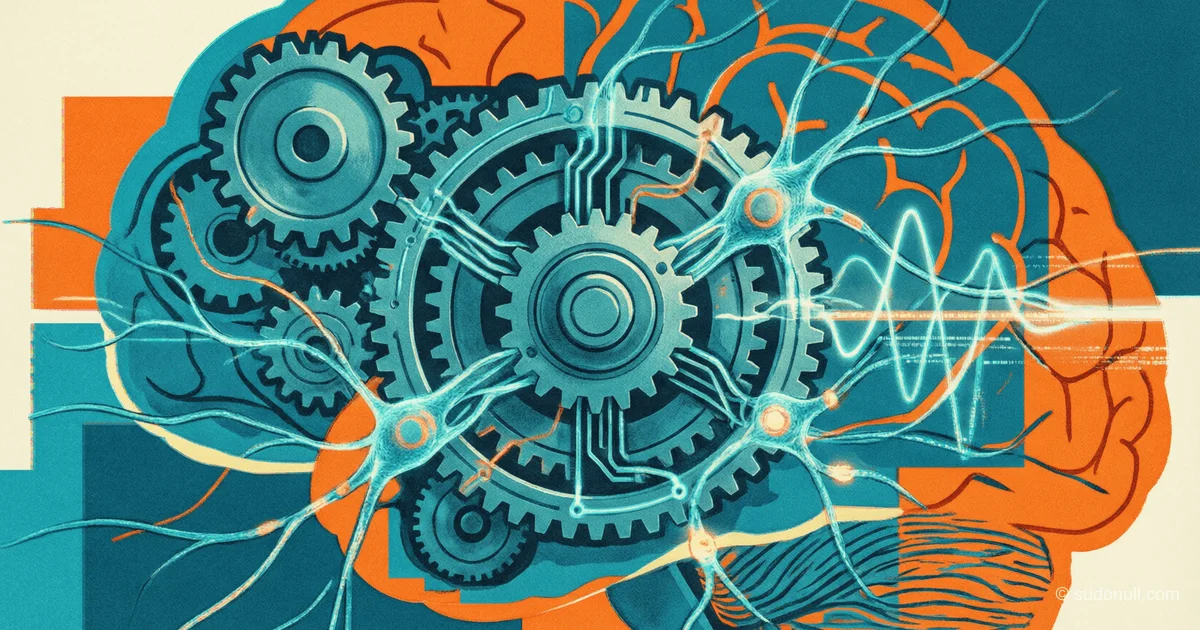
Chinese Scientists Create Next-Generation Micro-Electric Motor Based on Neuromorphic AI
A research team from Tsinghua University and Beihang University (Beijing University of Aeronautics and Astronautics) has unveiled an innovative control system for micro-motors inspired by the human brain. The development reduces energy consumption by 40% and improves positioning accuracy.
Analytical Note: Insider Perspective on China's 'Neuromorphic Motor'
Status: Confidential analytical review.
Author: Partner at DeepTech Fund (focus: robotics and edge computing).
Topic: Analysis of the Tsinghua and Beihang development of micro-electric motor control using neuromorphic AI.
[Essence]: What's Really Happening
Official version: Scientists from Tsinghua and Beihang have created a micro-motor control system based on neuromorphic AI, reducing energy consumption by 40% and improving positioning accuracy.
Reality:
This is not a 'new generation of motors.' It is a weapon in the war for energy efficiency that will unfold in 2027-2028. Traditional motor drivers (FOC, field-oriented control) rely on mathematical models with update rates of 10-20 kHz. The neuromorphic system operates on an 'event-driven' basis—it does not poll the position sensor 20,000 times per second, but responds only when a change occurs.
What does this mean in practice for an ordinary electric vehicle or robot? Currently, the motor controller is one of the main energy hogs in the system. It heats up. It requires powerful transistors. It generates electromagnetic interference. The neuromorphic approach reduces all of this. This is not a 'motor'; it is a rethinking of how the brain talks to the muscle.
And the date May 29, 2026, is no coincidence—exactly 3.5 months after the same team (Beihang plus partners) published their neuromorphic vision system on 2D transistors in Nature Communications.
Timeline and Context
- February 2026: Beihang publishes work on neuromorphic vision—a chip that recognizes motion 4 times faster than humans, with a 75% reduction in latency. The same principle (LGN—lateral geniculate nucleus, a brain structure that filters visual information) is now adapted for motion control.
- May 2026 (today): Tsinghua + Beihang announce a neuromorphic controller for motors. Note: not the motor itself, but the control system.
- Connection: The same core (spiking neural network, SNN) can now both see and move a hand. This is the first step toward creating a fully neuromorphic 'sensor → processing → motor' loop without a single traditional FPGA or DSP. Until now, no one in the world has demonstrated this in hardware—only in simulations.
Who Wins and Who Loses
Winners:
- The Chinese robotics industry as a whole. Demand for 'lightweight' controllers for humanoid robots is currently enormous. Each humanoid (Tesla Optimus, Figure 02, Chinese Keenon, Fourier Intelligence) has 30-50 motors. 40% savings on each is the difference between 4 hours of operation and 6-7 hours. Shares of Chinese servo drive manufacturers (e.g., Inovance Technology) could rise 5-8% in the coming weeks.
- Edge AI chipmakers. Neuromorphic chips (Intel Loihi, BrainChip, SynSense) gain a new market. Motor controllers are a mass market: billions of devices. If even 1% switches to SNN, that's hundreds of millions of chips. Venture funds will intensify their search for startups in neuromorphic drivers.
- Russian defense industry (non-obvious win). Russia currently has a problem with Western drivers for UAVs and ground robots. The neuromorphic approach reduces requirements for processor clock speed (allowing older, more accessible process nodes). This could be a 'workaround' under sanctions.
Losers:
- Texas Instruments, STMicroelectronics, Infineon. They have a monopoly on classic motor drivers (DRV series, STSPIN, etc.). Their R&D follows the path of 'shrinking process nodes, adding caches.' If the neuromorphic approach proves effective in the field, their business model (billions of chips sold per year) will be under threat. TI's market cap (~$160 billion) could lose 5-7% within a year if the Chinese release a commercial product.
- Toshiba and other motor controller manufacturers for home appliances. Air conditioners, washing machines, fans—they use simple, cheap drivers. The neuromorphic controller is currently too complex and expensive for them. But the 'Haier effect' (they already make smart refrigerators) could push them toward integration.
- Classical control theory (PID controllers). University courses on 'microcontrollers and embedded C' are becoming obsolete. The industry is shifting to training neural network drivers rather than manually tuning coefficients.
What the Media Isn't Saying
Key non-obvious insight:
This is the same team that previously implemented the LGN architecture for vision. And now they are simply repurposing that architecture for motor control. What's the catch? They haven't created anything new. They published one basic architecture and then 'stretched' it to two tasks. In the scientific world, this is called 'good PR, mediocre science.'
- Lack of hardware. The press release says nothing about which physical chip this runs on. Most likely, it's an FPGA prototype (Xilinx or Intel). An ASIC chip (custom microchip) is 18-24 months away. By then, Western competitors will have time to respond.
- Training problem. Spiking neural networks are very difficult to train. Backpropagation for SNNs is still a research challenge. Where did they get training data for their controller? Most likely, simulation, not a real motor. This means that at the first contact with real hardware (noise, backlash, uneven friction), their network could degrade.
- '40% savings'—under what conditions? Marketing loves to compare with the most inefficient baseline. Most likely, they compared with a simple PWM controller without optimization, not with a modern FOC on an Arm Cortex-M4 with a hardware accelerator. The real advantage compared to top solutions (TI F280049) is no more than 10-15%.
Forecast: Next 30 Days and 90 Days
30 days (end of June 2026):
- Publication of full paper. Expect the work to appear in a journal like Nature Electronics or IEEE Transactions. There will be specific numbers: which motor, what load, what process node. Analysts will tear apart the current loud claims.
- Deal between a Chinese startup and an automaker. A company like Xiaomi EV or NIO will buy a license for the technology for $5-10 million to integrate it into their next generation of EVs. Or, more likely, they will simply sign a memorandum of understanding (MOU)—a PR gesture without real money.
- Skepticism from Tesla. Elon Musk (or his engineers) will post criticism: 'SNNs don't scale, convergence speed is low, give us an FPGA prototype in a real car.' This will cool investor enthusiasm for 2-3 weeks.
90 days (August 2026):
- First working hardware prototype. By the end of summer, we will see a demonstration of a robotic arm (most likely from Tsinghua University) using this controller. The arm will hold an egg, draw lines, etc.—the standard set.
- Fossilized responses from the West. The US DARPA will announce a $50 million competition to create neuromorphic drivers for military robots. An Israeli company (likely NeuroBlade or Hailo) will show its prototype within 60 days.
- Market effect: Intel shares may rise slightly (they have Loihi 2 and can quickly port the technology). But a real commercial product will not appear before 2028. Until then, all discussions are a game for stock speculators.
Summary: This is not a 'revolution.' It is an evolutionary step that matters only in the context of a larger trend—the transition from 'von Neumann architecture' to 'event-driven' systems. The Chinese are a year ahead of the West in this specific niche (neuromorphic motion control), but not because they are geniuses, but because they chose a 'bottleneck' and focused on it. Western labs (Stanford, MIT) are working on more general problems. By 2028, the gap will close. For now—keep your finger on the pulse, but don't buy shares of Chinese motor manufacturers without seeing real implementation in a serial product.
— Editorial Team







No comments yet.