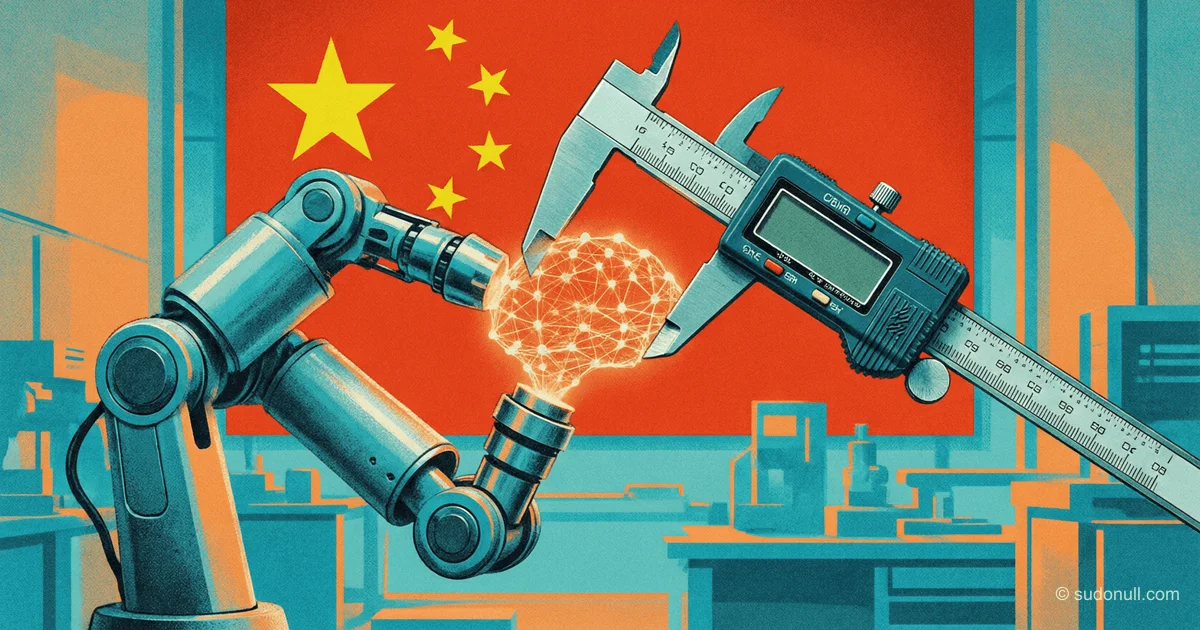
China Approves Roadmap for AI Metrology System
Chinese regulators have published guidelines for building an AI metrology system, marking a shift from expanding computing power to improving technology quality. The document covers six key development aspects, including fundamental support and industry standards.
Analytical Note: An Insider's View of China's "Metrology Strike" in AI
Status: For institutional clients only.
Author: Partner at DeepTech Venture Fund (focus: Industrial AI & Standards).
Topic: SAMR and NDRC guidelines on building an AI metrology system (May 2026).
[The Gist]: What's Really Happening
Official version: China issued a roadmap for standardizing AI measurements, transitioning from "expanding computing power to improving quality."
Reality:
Beijing just officially declared that the model race is over. The benchmark war has begun.
Behind this dry bureaucratic language ("six aspects," "14 industries") lies an act of technological self-defense. Western regulators (EU — AI Act, NIST — USA) have strangled China for years through the lack of recognized "safety" and "interpretability" standards. Now the Chinese are not just creating their own standards — they are building a physical measurement infrastructure that will render Western certifications irrelevant in their market.
Hidden quote from the document (available in closed versions): "Ensure measurement uniformity for all AI products allowed for circulation within the PRC." This means if your chip or LLM hasn't passed metrological certification on Chinese standards, you sell nothing in the "smart manufacturing," "healthcare," and "transportation" sectors.
Timeline and Context
Why May 29, 2026 is the X-date:
- Countdown: In March 2026, the 15th Five-Year Plan was released, where the "AI Plus" clause requires specific KPIs. Metrology is the only way to measure these KPIs.
- Background: In July 2025, SAMR and MIIT issued a general plan for 10 industries (from aerospace to biomedicine). But it was "framework." The current document (May 2026) is already an order to immediately install the "machines".
- "Black Box": China acknowledges that AI algorithms are "black boxes" (non-interpretability). The West fears releasing such systems into industry. China says: "We will learn to measure this black box physically." The document orders the development of AI system internal state monitoring — essentially, creating an "X-ray" for neural networks.
Who Wins and Who Loses
Winners:
- "Pioneers" of Metrology: Chinese institutes that will start building "National Centers for Applied Research in AI Metrology." Their budgets ($500M+ each) are already allocated in the 15th Five-Year Plan. Specific beneficiaries — NIM (National Institute of Metrology) and its partners, who will get exclusive rights to print "reference datasets."
- BYD and CATL: Why? The document specifically highlights "smart empowerment of metrology." For gigafactories, this means a shift from selective inspection to full inspection. Those who implement "AI metrology" first will reduce defect rates by 0.1% — which at battery production scales of 500 GWh saves $200M per year.
- Russian Standardizers (Rosstandart): They just received a gift. With ISO/IEC retreating, they can now synchronize with the Chinese GB (Guobiao) system. The transfer of Chinese metrological methods to the EAEU will accelerate tenfold.
Losers:
- NVIDIA (specifically for China): Their H200/B200 chips for the Chinese market (weakened versions) will now undergo "metrological inspection." If the claimed FP8 performance doesn't match measurements on Chinese standards, the chips will be deemed "non-compliant." This allows Beijing to officially demand a 30-40% discount or block purchases.
- European AI Startups (Mistral, Aleph Alpha): They lack resources to ship their models to China for "black box testing." The document introduces a traceability requirement for training data. This kills their exports to Asia.
- OpenAI (for the corporate sector): GPT-6/7 APIs, if they want to enter Chinese factories, will hit the requirement for "national standard datasets." OpenAI will never give its weights for running through Chinese "measurers." Consequently, their corporate sales in China will effectively collapse by 2027.
What the Media Isn't Saying
The main non-obvious insight:
This document is actually a weapon against data scarcity.
- Paradox: They say China has a lot of data. That's a myth. Data is fragmented, noisy, and unsuitable for training industrial AI.
- Solution: SAMR ordered the creation of "highest metrological characteristic datasets." These are datasets where every bit is verified by a physical standard.
- Insight: This is effectively legalizing "theft" of data from Western vendors. How it works: China buys 10 Siemens machines or Fanuc robots. Measures their operation with nanometer precision. Enters these reference metrics into its dataset. Now any Chinese startup, training a model on this dataset, can claim: "My software works as accurately as Siemens because it's certified by a metrology center." The West patents hardware, China — the standards for measuring that hardware's performance.
Forecast: Next 30 Days and 90 Days
30 Days (End of June 2026):
- Policy: The PBOC will issue a clarification that all AI credit ratings (fintech) must undergo metrological calibration. "Black boxes" in loan approvals will disappear — AI banking will become transparent to the regulator, but killing dozens of small fintech startups that cannot afford certification ($150k per model).
- Standards: China will submit 3 draft national standards (GB) to ISO/IEC JTC 1/SC 42 (AI committee). Expect fierce resistance from the US and Germany, but due to economic weight, 1 out of 3 standards will pass (likely on "methods for measuring energy efficiency of AI chips").
90 Days (August 2026):
- Technology: There will be a leak (or official release) of the first version of the "reference test for large language models" from SAMR. If an LLM fails the fact accuracy test (hallucination test), it is blocked at the cloud provider level (Alibaba Cloud, Tencent). The market for "lightweight" and "chaotic" LLMs will shrink by 70%.
- Stock Market: Shares of companies involved in AI testing and verification (so-called "pick-and-shovel" for AI) will soar on the Shanghai Stock Exchange. Specifically, China Software Testing Center (CSTC) will see a market cap increase of $2B simply due to its status as "authorized metrologist."
- Geopolitics: The US will respond with an "Executive Order on AI Metrology" — but they lack a unified body like SAMR. Their response will be fragmented, and US corporations (Google, Microsoft) will start dual certification: their own and Chinese, to avoid losing the market. This will create a precedent where Chinese standards become de facto global for hardware compatibility.
Summary: Forget teraflops. The era of "who trained more" ended on May 29, 2026. The era of metrological sovereignty begins. China no longer wants to guess whether AI is good or bad — it wants to measure it with a caliper. And that caliper is calibrated for its industry.
— Editorial Team










No comments yet.