Lunar Fire: Why the Moon's Gravity Is More Dangerous Than Weightlessness
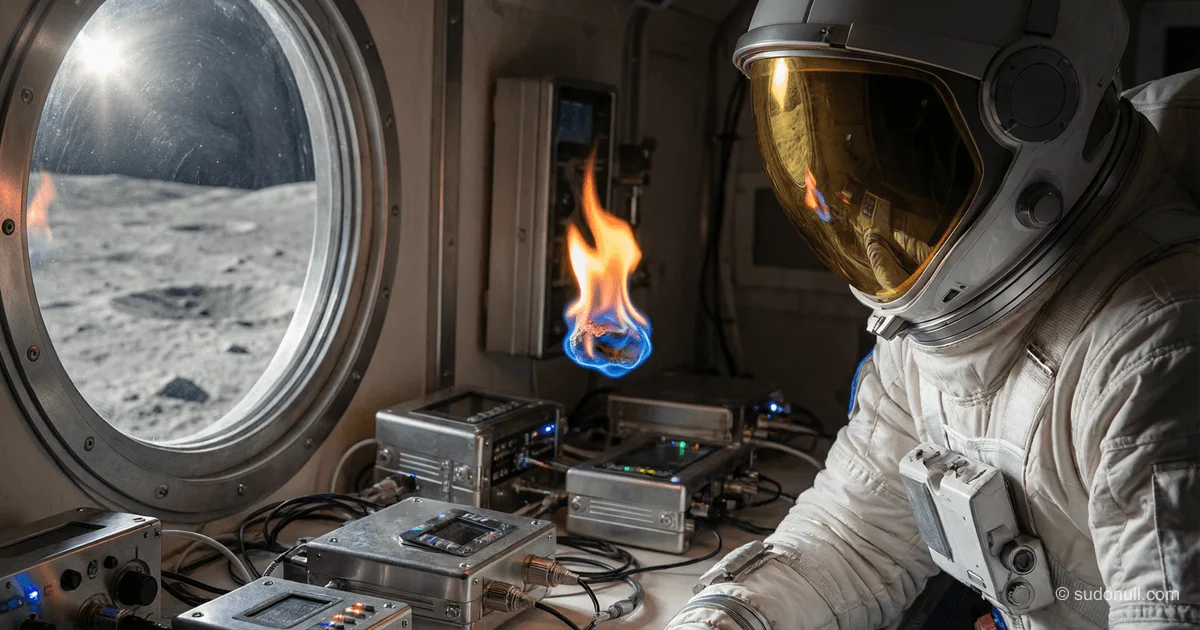
NASA is preparing a unique experiment that will, for the first time, show how fire spreads under lunar gravity. The results of the FM2 mission will influence the design of all elements of the Artemis program—from spacesuits to habitation modules.
Fire in Space: Known Risks
Fires aboard spacecraft pose one of the most serious threats to the crew. On Earth, flames are shaped by gravity: hot air rises, providing a steady supply of oxygen. In microgravity, such as on the ISS, this mechanism breaks down—flames become spherical, less turbulent, but can burn longer and at lower temperatures.
Lunar gravity (about 1/6 of Earth's) occupies an intermediate position. Until now, there has been no precise data on fire behavior under these conditions. Engineers have relied on computer models and extrapolation of results obtained on Earth and in weightlessness.
Mission FM2: What Is Planned
The Flammability of Materials on the Moon (FM2) experiment will be the first direct observation of combustion under lunar gravity. The launch is scheduled for late 2026. As part of the mission, four solid fuel samples will be placed aboard a lander. Scientists plan to record flame parameters—spread rate, temperature, shape, and heat release—over an extended period.
The data obtained will help refine safety standards for future lunar bases. Currently, NASA uses the NASA-STD-6001B standard to assess material flammability, but it was developed primarily for weightlessness and Earth gravity conditions.
Why Lunar Gravity May Be More Dangerous
Preliminary calculations show that under partial gravity, flame spread rate may be higher than in weightlessness. This is because convective flows, though weakened, still occur, but their intensity is insufficient to quickly dissipate heat. As a result, fire can spread faster across the material surface.
Researchers note that in certain combustion regimes, lunar gravity can create conditions where flames become more aggressive than previously assumed. This calls into question the suitability of many materials certified for the ISS for lunar missions.
What Matters:
- Fires on the Moon may spread faster than in weightlessness.
- Existing safety standards do not account for lunar gravity.
- The FM2 experiment will be the first direct measurement of combustion parameters under 1/6 g.
- Results will influence the design of spacesuits, habitation modules, and equipment.
- Full-scale qualification tests on the Moon will only be possible after a permanent base is established.
Impact on the Artemis Program
The FM2 mission is synchronized with key milestones of NASA's lunar program. After the successful Artemis II, the agency is preparing for Artemis III, IV, and V. Each subsequent mission involves longer surface stays and more complex operations. Without accurate data on fire behavior, crew safety cannot be guaranteed.
In the long term, NASA plans to conduct material tests directly on the Moon. However, as the report's authors acknowledge, this will only become possible after permanent infrastructure is deployed.
Context: Combustion Under Partial Gravity
Studying combustion under reduced gravity is important not only for space programs. It helps to better understand fundamental heat and mass transfer processes and may find applications in terrestrial technologies—for example, in designing fire suppression systems for high-rise buildings or mines.
Nevertheless, the primary driver of research remains spaceflight safety. Each new experiment brings humanity closer to confidently exploring the Moon and other planets.
— Editorial Team









No comments yet.