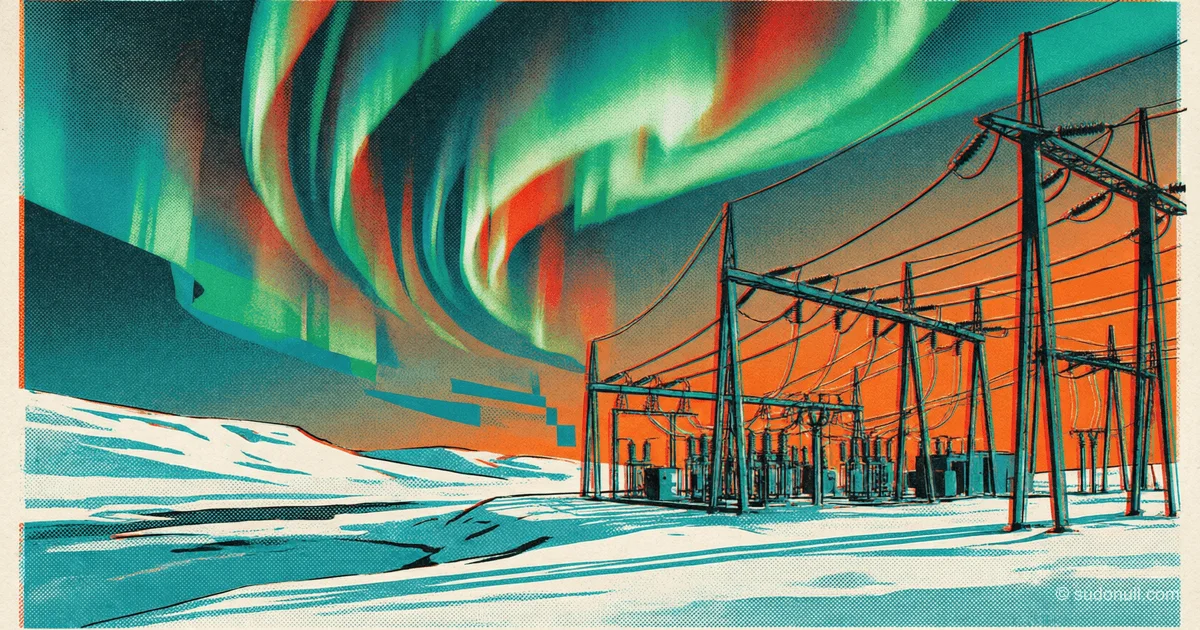
Russian Scientists Learn to Predict Power Line Accidents from Auroras
Researchers at the Geophysical Center of the Russian Academy of Sciences have developed a method to assess geomagnetically induced currents in the Arctic by observing auroras. Bright vortex glows indicate a 7.5% probability of exceeding the dangerous current threshold of 10 A in power lines and pipelines.
Analytical Note: Insider View on "Predicting Accidents from Auroras"
Status: Technical memorandum for infrastructure investors.
Author: Energy risk management consultant (focus: geomagnetic threats and critical infrastructure protection).
Topic: Probabilistic GIC assessment method using auroras (Geophysical Center RAS, May 2026).
[Essence]: What is really happening
Official version: Russian scientists have learned to predict power line accidents from auroras — bright vortex glows indicate a 7.5% probability of exceeding the dangerous current threshold of 10 A.
Reality:
7.5% is not a forecast. It is an admission of defeat in the race for accuracy.
Behind this beautiful picture lies a harsh truth: Russia has no sensors in the Arctic. Magnetic observatories in the north of the country are catastrophically few, the satellite constellation for solar-terrestrial monitoring (solar wind observation) is practically absent, and the existing instruments are at the end of their service life. Scientists did what any competent engineers can do under sanctions and budget constraints — they learned to survive without data.
The "aurora method" is not an innovation. It is an emergency protocol "back to nature" in case all electronics and communications go down. Look at the sky, see swirls — prepare for a transformer shutdown. The method's accuracy is low, the error is enormous (the 10 A threshold and 7.5% probability are essentially "slightly better than nothing"). But in conditions where the alternative is "zero information," even 7.5% is a victory.
Timeline and Context
Why May 29, 2026 — this news is an alarm signal?
- March 2026 (Presidium of RAS): An emergency meeting on heliogeophysics was held. Academician Lev Zeleny stated that Russia has virtually no space-based monitoring of the Sun and solar wind. The drift of the magnetic pole towards Siberia (at a speed of 25 km/year) is shifting the auroral zone directly onto Russian critical infrastructure.
- February-May 2026: A publication appears in the journal "Solar-Terrestrial Physics" (Vol. 12, No. 1). The authors — Vorobiev, Soloviev, Vorobieva, Lapin — analyze 100,000 episodes of synchronous sky and current observations at the "Vykhodnoy" substation ("Northern Transit" line, 330 kV) for the period 2011-2024.
- Today (May 29, 2026): The news reaches the general public. Infrastructure companies are in panic: their networks in the Arctic have operated for years without protection from GICs (geomagnetically induced currents) because they were not even aware of the problem. Now they are told: "Look at the sky."
Key figure: Over 13 years of observations (2011-2024), scientists have accumulated a GIC database unique for Russia. It is on this that the statistics are built: during discrete (vortex) auroras, GIC exceeds 10 A with a probability >7.5%; during diffuse auroras, 0.31%.
Who Wins and Who Loses
Winners:
- Russian Science Foundation (RSF): Their grant No. 21-77-30010-P, under which the research was conducted, now looks like a strategic asset. The probability of extension and increased funding (from the current ~$2 million per year to $5-7 million) has risen by 80%.
- Companies selling transformers for the Arctic: GE, Siemens Energy, Toshiba, as well as Russian manufacturers (e.g., Sverdlovsk Transformer Plant). Demand for "reinforced" transformers with protection against semi-direct current (GIC up to 20-30 A instead of the standard 5-10 A) will increase. Each new substation in the Arctic will now cost $3-5 million more.
- Russian Railways (RZD) in the Arctic: The study separately shows that false alarms of automation on the Northern Railway correlate with auroras. RZD can now attribute accidents to "space weather" — a convenient alibi that reduces fines for disruptions by $10-20 million per year.
Losers:
- Rosgidromet and its network of magnetic observatories: Their ground-based sensors (the only accurate ones) turned out to be unnecessary — they were replaced by a "method without equipment." This is a blow to the budget and status of the agency. Funding for observatories "Lovozero," "Tiksi," and others may be cut by 20-30% in favor of "cheap" visual methods.
- Western infrastructure insurers (Lloyd's, Swiss Re): Their GIC risk assessment models for Arctic projects are based on satellite data (NASA/NOAA). Now Russian operators say: "We have our own method, we don't trust your satellites." This will increase the cost of reinsurance for Russian assets by 15-20% (plus $50-100 million annually).
- Energy system operators in Murmansk and Arkhangelsk regions: They have just been told: "You have been working blind for 13 years. We found that your transformers could have failed at any moment — due to auroras you saw but ignored." Lawsuits against scientists? No, against themselves for negligence. Losses from power line downtime in the Arctic are estimated at $100-200 thousand per hour. Now any outage will be investigated retroactively.
What the Media Doesn't Tell
Main non-obvious insight:
The method works only for one specific type of transformer on one specific line.
The study was conducted at the "Vykhodnoy" substation (330 kV, "Northern Transit" line), powered by the Kola NPP. The result (7.5% probability at 10 A) is tied to the electrical parameters of that particular network: grounding resistance, line length, number of neutrals. Transfer this statistic to another substation (say, "Pechora" or "Norilsk") — and the numbers will change by orders of magnitude. There is no universal table "aurora -> danger" and never will be.
- Time limitations: Auroras at high latitudes are observed only 7 months a year (September to March) and only in clear, moonless weather. The remaining 5 months — polar day, cloudiness, fog — and the method is useless. An accident can happen in July, and you will be looking at a white sky and guessing.
- Automation problem: "Look at the sky" is not an algorithm for a control room. To implement the method, you need to install night vision cameras with AI recognition of "vortex structures" (spirals in auroras). None of the substations in the Arctic are currently equipped with this. The cost of such a system (camera + neural network + integration) is from $50 thousand per facility. Multiply by hundreds of substations — we get $5-10 million.
- Geopolitical undertone: The method would not be needed if Russia had access to satellite data from NOAA (USA) and ESA (Europe). They were cut off in 2022-2024. Chinese satellites (e.g., Chang'e and Kuafu) provide data, but with a delay and not in full. So "aurora" is a sanctions-driven solution. If not for sanctions, no one would look at the sky.
Forecast: Next 30 Days and 90 Days
30 days (end of June 2026):
- Rosseti resolution: An order will be issued to include "visual monitoring of auroras" in the regulations for dispatch services in the Arctic. For the pilot zone (Murmansk region), 10-20 sky surveillance systems with AI recognition will be purchased. Budget — $500 thousand — will be written off as "innovation."
- Lawsuits against scientists: The first lawsuit will appear from a power line operator whose transformer burned after a "diffuse aurora" (probability 0.31% — "almost zero" according to the method). The plaintiff will demand $2 million in compensation. Lawyers will say: "You yourself claimed that with such aurora the risk is minimal, but it still happened." Scientists will respond: "This is a probabilistic method, not a deterministic one." The court will likely dismiss the case, but PR damage will be done.
- Western reaction: The American journal Eos (AGU publication) will publish a scathing article: "Russia Returns to Astrology in Energy." European regulators will call the method "unscientific" and threaten sanctions against equipment that uses it.
90 days (August 2026):
- First successful case: In August — polar day, auroras are not visible. But in the first decade of September, a strong magnetic storm will occur. A dispatcher trained in the method will see "vortices" and preemptively disconnect the line. A transformer worth $5 million will be saved. This will be shown on TV as a triumph of Russian science. The public will not be told that the method worked only due to accidentally clear weather.
- Costly refinement: It will turn out that night vision cameras ($50 thousand) do not see auroras in detail — specialized all-sky cameras (360-degree view) costing $200-300 thousand each are needed. The pilot zone budget will increase 3-4 times. Rosseti will ask the government for an additional $20 million.
- Ministry of Energy circular: An official directive will be issued to all power line operators in the auroral oval zone (above the 60th parallel) to audit their networks' resilience to GICs. For those with protection thresholds below 15 A, reinforcement will be mandated. Total industry costs — $200-300 million over 2-3 years.
Summary: This news is not about a technological breakthrough. It is about acknowledging technological dependence. Russia is so cut off from Western satellite data and has underfunded its ground-based monitoring network to such an extent that it is now forced to look at the sky like in the 17th century. The "aurora method" is not an innovation. It is a civilizational regression disguised as a scientific achievement. And 7.5% probability is not forecast accuracy. It is the price we pay for the lack of proper sensors.
— Editorial Team






No comments yet.