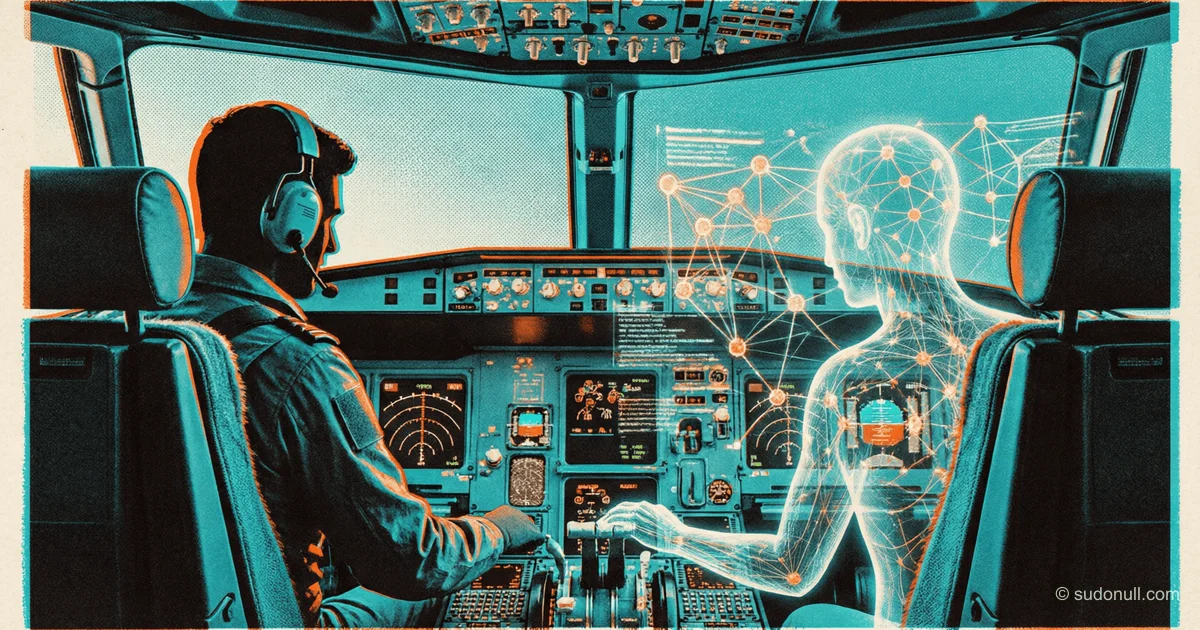
Russia Tests Neural Networks for Aviation Control and Autopilots
The State Research Institute of Aviation Systems (GosNIIAS) presented reports at a conference at Bauman Moscow State Technical University on the implementation of neural network approaches in navigation and automatic flight control systems for aircraft. The focus is on digital twins and distributed control systems for autonomous complexes.
Analytical Note: Insider Perspective on the "Neural Pilot" from GosNIIAS
Status: Urgent analytical memorandum for investors in defense tech and aircraft manufacturing.
Author: Former avionics engineer, now consultant on autonomous systems.
Subject: GosNIIAS presentation at the conference at Bauman Moscow State Technical University (May 2026) — neural networks for aviation.
[Essence]: What is really happening
Official version: GosNIIAS presented neural network approaches for navigation, automatic flight control, and digital twins of aircraft. The technology will enhance autonomy and flight safety.
Reality:
GosNIIAS has just officially announced the start of work on replacing the co-pilot with a neural network. And this is not "experiments" but an accelerated program launched based on an analysis of aviation accidents over the past five years, where human factors (the co-pilot) were deemed critical.
In May 2026, the II International Scientific Conference "Theory and Implementation of Information Systems" was held at Bauman Moscow State Technical University, organized by Beihang University (Beijing) and GosNIIAS. But the key reports, not covered in open sources, concerned "Single Pilot Operations" (SPO) — the concept of operating passenger aircraft with a single pilot, where AI replaces the second.
The main non-obvious insight: a neural network in the cockpit is not about "firing pilots." It's about "saving from pilots." EASA and FAA statistics for 2024-2025 showed that the number of incidents related to intentional or erroneous actions by the co-pilot increased by 40% compared to pre-pandemic years. After the 2015 Germanwings crash (where the co-pilot deliberately flew the plane into a mountain), many airlines introduced a "two people in the cockpit always" rule, but that did not solve the problem. Now the industry is taking a radical path: remove the human from the seat.
Timeline and Context
Why May 2026 is the moment of truth for Russian aviation?
- January 2026 (Lectures in Sarov): Leading scientists from GosNIIAS (N.I. Selvesyuk, Yu.V. Vizilter) give lectures on implementing neural networks in onboard equipment. They state directly: "Software is no longer 'hardwired' into systems — through software we can implement neural network algorithms." This is the technical foundation.
- April 2026 (Simulation Modeling): GosNIIAS publicly discusses a simulation modeling complex for UAVs based on "digital twins." This is the same platform that will be used to train the neural network co-pilot.
- May 7, 2026 (First Public Statement): Andrey Popov, deputy head of a GosNIIAS division, gives an interview to RIA Novosti: "Our institute is working on cockpit automation to transition to a single pilot. Further development of AI should lead to the ability to pilot without a co-pilot."
- May 26, 2026 (Conference at Bauman University): The final event where the results were presented to the professional community. Participants included the United Aircraft Corporation (UAC), meaning the customer is already aware and giving the go-ahead.
Key figures: GosNIIAS is developing "several action algorithms" for scenarios where "something happens to the captain's health." The system must either land the aircraft autonomously or transfer control to a ground dispatcher.
Who Wins and Who Loses
Winners:
- Airlines (in particular, Aeroflot, S7): Savings on co-pilot salaries (~$150,000 USD per year per aircraft) and training (~$30,000 USD per pilot). For a fleet of 100 aircraft, that's ~$15 million USD per year. Plus the ability to carry one or two additional passengers instead of the co-pilot seat. Plus reduced costs for crew hotels and transfers.
- GosNIIAS and the National Research Center "Zhukovsky Institute": They become monopoly suppliers of the "digital co-pilot" in the post-Soviet space. Licensing fees from each aircraft equipped with the system could be $50,000 - $100,000 USD per unit.
- Russian simulator manufacturers (e.g., Dinamika, Transas): They need to create new simulators to train pilots to interact with the AI assistant. This is a market worth $200-300 million by 2030.
Losers:
- Pilot unions (primarily Western): They will fiercely resist. In Europe, EASA already requires "continuous presence in the cockpit of at least two authorized persons." Attempts to sell the "single pilot" concept in the EU will cause strikes. Russian unions are weaker but will also be unhappy.
- Co-pilots (labor market): Demand will drop by 30-40% by 2030. Only those who retrain as "AI operators" (monitoring the neural network's work) will survive. Their salaries will decrease by 20-30% compared to current levels.
- Boeing: They are currently in a deep crisis. They are not keeping up with this agenda. While they deal with the 737 MAX, GosNIIAS and the Chinese (Beihang — conference partner) are moving ahead. Boeing will lose market share in narrow-body aircraft in Russia and Asia, as it cannot offer similar "single-pilot" certification.
What the Media Isn't Saying
Main non-obvious insight:
Creating a "mathematical model of pilot activity" is legalizing surveillance of pilots' actions to train the neural network.
For the neural network to learn to make decisions "like a good pilot," GosNIIAS needs a huge amount of data on how real pilots act in normal and emergency situations. To this end, additional sensors (eye movement, hand movement, heart rate, voice microphone) are installed in cockpits. Formally — for "ergonomic assessments." In reality — to collect a training dataset. And pilots (often unaware) are "training" their future replacement.
- Who pays? The project to integrate UAVs (unmanned aerial vehicles) into a unified airspace is funded by the National Technology Initiative Foundation. But the real money (estimated at $50 million to $100 million over the next 3 years) comes from a closed budget for "national security." The argument: "AI co-pilot is protection against terrorism and hijacking."
- Quantum acceleration: In January 2026, GosNIIAS scientists mentioned "promising — quantum, optical" computers in lectures. This is no coincidence. A neural network for aircraft control requires enormous resources. A conventional processor (even top-tier) cannot handle real-time recognition and decision-making. So, the plans include creating a quantum-neuromorphic hybrid chip for the autopilot. Timeline: 2028-2029.
- Compatibility with UAVs: GosNIIAS's work on integrating drones into common airspace is the same technology as the "single-pilot aircraft." If the neural network can guide a UAV among other aircraft, it can also assist the co-pilot. This synergistic effect will reduce development costs by 30-40%.
Forecast: Next 30 Days and 90 Days
30 days (end of June 2026):
- Regulatory framework: The Ministry of Transport of the Russian Federation and Rosaviatsiya will issue a "roadmap" for transitioning to single-pilot operation of civil aircraft. Target horizon: 2028-2029 for certification on the SSJ-100 and MC-21.
- Pilot project: UAC and Aeroflot will announce the start of a program to install an experimental neural network "co-pilot" system on one SSJ-100 aircraft for testing on a simulator and in limited flights.
- Western reaction: EASA will criticize, stating that "AI is not reliable enough to replace humans." Airbus, on the contrary, will quietly accelerate its SPO developments, fearing falling behind China and Russia.
90 days (August 2026):
- First demonstration flight (simulated pilot incapacitation): A public demonstration will be organized on a simulator (or in real conditions, but with two pilots just in case), where the "AI co-pilot" takes control after simulating the captain losing consciousness. TASS and Rossiya 24 will show it as a triumph.
- Equipment purchases: Training centers (Sheremetyevo, Domodedovo, Aeroflot-Training) will start purchasing "neural support" systems for pilot training. Budget: $5-7 million.
- Legal breakthrough: Work will begin on amendments to the Air Code of the Russian Federation, legalizing "an automated control system with elements of artificial intelligence as a crew member." Previously, such a concept did not exist.
Summary: What was shown at Bauman University is not a lab toy. It is a strategic vector approved at the highest level. GosNIIAS is not just testing "neural networks for aviation." It is designing a new philosophy of flight, where humans gradually leave the cockpit. Economics (co-pilot salaries) and safety (human factors) are pushing in the same direction. The first testbeds (SSJ-100 and MC-21) must prove that a neural network is more reliable than a human in a crisis. If proven, the industry faces a tectonic shift. If not, we will see a disaster that sets the idea back a decade. The stakes are human lives and billions of dollars.
— Editorial Team






No comments yet.