Chinese Scientists Achieve Breakthrough in Solid-State Batteries with 3-Minute Charging
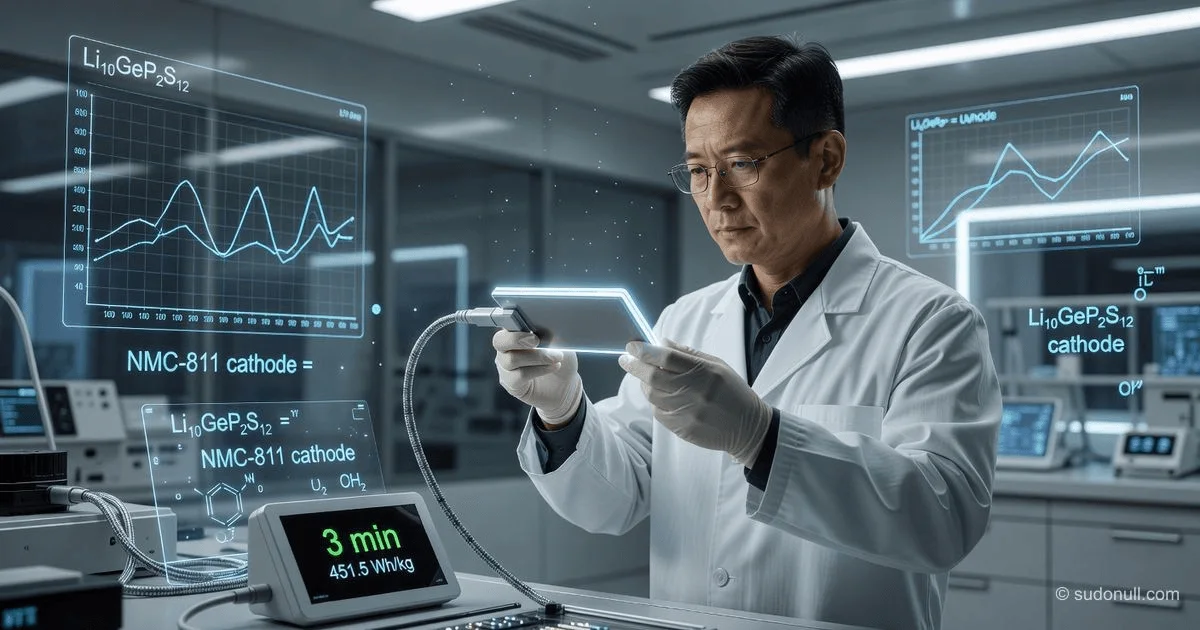
Researchers from the Chinese Academy of Sciences have developed a solid-state lithium-metal battery with a record energy density of 451.5 Wh/kg. Thanks to a new 'compatible plasticization' technology, the battery retains 81.9% capacity after 700 cycles and supports ultra-fast charging that could potentially reduce EV charging time to three minutes.
Chinese Solid-State Battery in 3 Minutes: Why 451.5 Wh/kg Won't Disrupt the Market in 2026
Analytical Review as of May 30, 2026
[The Gist]: What's Really Happening
On May 27, 2026, researchers from the Chinese Academy of Sciences published results in the Journal of the American Chemical Society that should have shaken the EV industry. A solid-state lithium-metal battery with an energy density of 451.5 Wh/kg, supporting 700 cycles with 81.9% capacity retention, and—most importantly—ultra-fast charging equivalent to 3 minutes (at a 20C rate).
But here's what didn't make the headlines: the charging test was conducted under specific laboratory conditions with a thin lithium-metal anode at an N/P ratio of 1.1. That's not the mode your next EV will operate in.
Insider insight: We're not looking at a finished product, but at a proof of concept for a specific chemistry—a PVDF-based polymer electrolyte with a sulfolane plasticizer. This solves the problem of traditional plasticizers (poor compatibility, side reactions), not a ready-made battery that CATL or BYD will put on the assembly line tomorrow. But the market narrative is already set: 'China has overtaken everyone.'
Timeline and Context
2024-2025: The Chinese Academy of Sciences conducts fundamental research on polymer electrolytes. The problem: PVDF electrolytes with conventional plasticizers are unstable.
February 2026: CATL announces plans for pilot production of solid-state batteries with a density of 450-500 Wh/kg in 2026 and integration into vehicles in 2027. BYD announces similar goals. The market expects: Chinese solid-state batteries are about to arrive.
May 20-27, 2026: The Academy of Sciences publishes the study. The new 'compatible plasticization' strategy solves the stability issue of PVDF electrolytes. Successful testing of a pouch cell with a density of 451.5 Wh/kg. It passes the nail penetration test.
May 30, 2026: We see the picture that mainstream media haven't pieced together. We have three parallel tracks:
- A fundamental breakthrough in PVDF electrolyte chemistry (Academy of Sciences, May 2026)
- Industrial plans by CATL and BYD for pilot production of solid-state batteries (announced in February 2026, target 2026-2027)
- Expert doubts about mass adoption timelines—Wang Fang and other analysts cite 2030 as a realistic horizon for full-scale production
Who Wins and Who Loses
Winners
- CATL (market share 39.2% in 2025, market leader): The company already has 'condensed' (hybrid) batteries with a density of around 500 Wh/kg at the scaling stage. The Academy of Sciences study gives them additional tools for sulfide solid-state batteries, which CATL plans to pilot in 2026. Direct win: their R&D department gets a validated method for improving polymer electrolytes that can be licensed or adapted.
- BYD (20.5% market share): BYD is building a 20 GWh oxide line in Chongqing. Their goal is 400 Wh/kg and 10,000 cycles. The Academy's development shows that competitors can achieve 451 Wh/kg, but BYD is betting on durability, not just density.
- The entire Chinese battery alliance (CALB, Gotion, Ganfeng Lithium): This breakthrough is not isolated. It fits into China's state strategy to dominate next-generation batteries. Western automakers (Stellantis signed a €1.17 billion deal with Dongfeng, Volkswagen partners with Xpeng) will now be even more eager to access Chinese technology because they have no alternatives of this scale.
Losers
- European and American solid-state battery startups (QuantumScape, Solid Power, Factorial): The investment community will now ask: 'Why is your product worth $5 billion in market cap (QuantumScape trades around $6-7) if the Chinese are already showing 451 Wh/kg in a prototype, and CATL plans a pilot this year?' Even if the Chinese prototype is far from mass production, perception of the market is shifting. QuantumScape previously promised a 2025 launch—they've already pushed back targets, and now competition has only intensified.
- LFP battery manufacturers (their Chinese counterparts): Paradox. LFP dominates the market today due to low cost and safety. But any mention of solid-state batteries with densities >450 Wh/kg risks cannibalizing their own market. CATL, as a leader in both LFP and solid-state development, is playing ahead, but uncertainty for investors in the LFP chain is growing.
- Traditional (liquid) electrolyte manufacturers: If solid-state batteries actually hit the market by 2027-2028, demand for liquid electrolytes in the EV sector will start declining sooner than expected.
What the Media Aren't Saying
Insight #1: 700 cycles is poor for an EV, even if it sounds like an achievement
450 Wh/kg at 700 cycles to 80% capacity—let's do the math. If an EV with such a battery travels 800 km per charge, 700 cycles equals 560,000 km. Sounds okay? The problem is that real-world operation includes fast charging, deep discharges, and temperature fluctuations. Laboratory 700 cycles under controlled conditions could turn into 300-400 cycles in the real world. For commercial transport (taxis, trucks), this is critical.
BYD is not accidentally targeting 10,000 cycles for its solid-state batteries. They understand that density without durability is marketing, not a product. The Academy of Sciences achieved excellent density, but compared to BYD's durability, there's a 14-fold gap.
Insight #2: '3-minute charging' at a 20C rate, but where is the infrastructure for 20C?
A 3-minute charge corresponds to a 20C current. What does that mean for infrastructure? A 100 kWh battery at 20C requires a charging station power of 2 MW. For comparison, modern Tesla Supercharger V4s deliver up to 350 kW. That's a 5-6 times increase in power. No existing charging network in the world is ready for such loads.
China is building an ultra-fast charging network, but BYD recently announced 5-minute charging—and that's already at the edge of feasibility. 3 minutes at 20C is a lab record, not a roadmap for 2027.
Insight #3: CATL and BYD have already obtained this patent or a variant earlier
CATL announced in February 2026 'condensed' batteries with a density of 500 Wh/kg at the scaling stage. That's a hybrid technology, not purely solid-state. The Academy of Sciences is fundamental research. But CATL has likely already filed patents for similar solutions with sulfolane or other plasticizers.
The bottom line: Chinese corporations and academic institutions operate as a unified system. CATL funds research groups at the Academy of Sciences. Patent strategy is coordinated. In the West, this is called a 'conflict of interest.' In China, it's a 'national strategy.' The difference is that the Academy's results can be integrated into CATL's industrial process within 6-12 months, not 3-5 years as in the US or Europe.
Forecast: Next 30 Days and 90 Days
Next 30 Days
- June 2026: Expect official statements from CATL and BYD on progress in solid-state batteries. CATL may announce that its sulfide pilot line is already producing cells with densities >450 Wh/kg. BYD may emphasize cycle life to differentiate.
- Battery Conference in Shenzhen (mid-June): Direct discussion between representatives of CATL, BYD, and Western startups. The Chinese side will showcase prototypes and test data. QuantumScape and Solid Power will try to explain why their approaches are better. The market will compare not technologies, but timelines.
- CATL stock (300750.SZ): It has already risen on the news, but upside is limited. CATL is valued at $140-150 billion, and solid-state news is already priced in. Watch for announcements of specific contracts with BMW or Mercedes—if they confirm using CATL solid-state batteries in 2028-2029 model years, the stock could gain +10-15%.
Next 90 Days
- August-September 2026: A more detailed publication from the Academy of Sciences with full safety data at various temperatures. Solid-state batteries are known for issues at low temperatures. If the PVDF electrolyte with sulfolane works at -20°C, that would be a real breakthrough.
- CATL roadmap update: Expect the company to officially announce moving the start of mass production of solid-state batteries from 2030 to 2028-2029. The Academy of Sciences has just given them additional arguments for investors to accelerate equipment investment.
- Reaction from Western automakers: Volkswagen (through its partnership with Xpeng) and Stellantis (through Dongfeng) may announce new investments in Chinese solid-state startups to keep up. GM and Ford, which lack such access to the Chinese supply chain, will be in a vulnerable position.
What to Do If You're an Investor
- CATL (Chinese market, if you have access): Hold. The Chinese battery sector will receive government support to accelerate solid-state technology. CATL is the main beneficiary. But be prepared for volatility: any delay in commercialization will be punished by the market.
- QuantumScape (QS): Sell or short. Their advantage was in the ceramic separator and high cycle life. But if the Chinese solve the cycle life issue (or at least approach 1,000 cycles) at densities above 450 Wh/kg, QS loses its uniqueness. They have $1 billion in cash, but time is running out.
- NVIDIA (NVDA) and the charging infrastructure market: A paradoxical win. If solid-state batteries truly enable 3-5 minute charging, a radical upgrade of grids and charging stations will be required. This means orders for power electronics using NVIDIA chips (Orin, Thor for charging management) and microcontrollers from Infineon/Texas Instruments.
Summary in one paragraph: The Chinese Academy of Sciences has shown an impressive lab prototype with record density and ultra-fast charging. But the gap between the lab and CATL's factory is still measured in years, not months. The reality: LFP batteries will remain the dominant solution until 2028-2029, the first solid-state vehicles will appear in 2027 as pilot projects, and only by 2030 will the technology become scalable. However, the strategic signal has been sent: China is winning the solid-state battery race not through a single breakthrough, but through coordination of the entire ecosystem—from fundamental science to industrial giants. And the West is losing not in one experiment, but in a systemic race.
— Editorial Team









No comments yet.