UC Riverside Scientists Gain Control Over Quantum Wave Functions in Ultrathin Materials
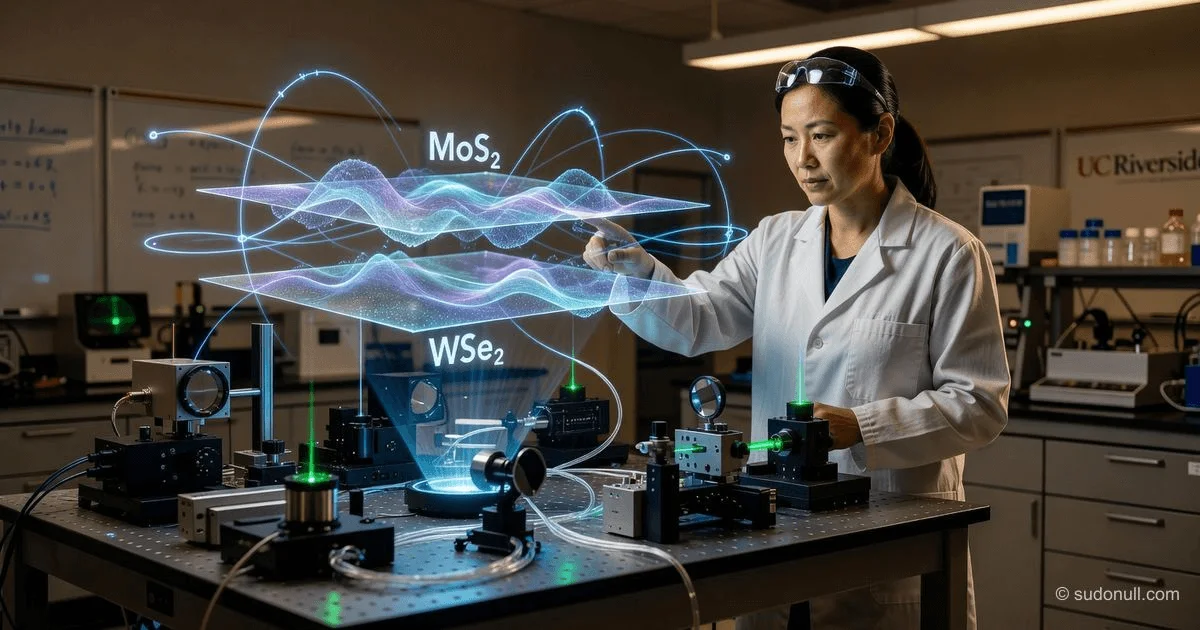
Researchers at the QuVET Center at the University of California, Riverside have experimentally demonstrated the ability to control quantum wave functions in bilayer materials of atomic thickness. By applying an electric field, they can shift the wave function between layers or hold it in both simultaneously—a critical step toward creating ultra-efficient solar cells based on the principles of photosynthesis.
Wave Function Under Voltage: Why UC Riverside's Photosynthesis Breakthrough Is More Threatening to Solar Energy Than It Seems
Analytical Review – May 30, 2026
[The Core]: What's Really Happening
On March 6, 2026, a research group from the QuVET Center at the University of California, Riverside published a paper in Physical Review Letters that should have prompted a reassessment of the entire solar energy industry.
Nathaniel Gabor, professor of physics and astronomy and director of QuVET, along with his colleagues, experimentally demonstrated that applying an electric field to a bilayer device of atomic thickness can control the position of a positively charged quantum wave function. The wave function can be shifted into the first layer, into the second layer, or exist in both simultaneously—a real-time quantum superposition.
The key figure that no one notices: all three QuVET papers received Editors' Suggestion status. For Physical Review Letters, this means the reviewers considered the work so important that the editors recommend it as mandatory reading. This happens in less than 20% of publications.
Insider understanding: Gabor and his colleagues are not just "controlling the wave function." They are replicating in synthetic materials what nature has been doing in leaves for billions of years—quantum energy transport with efficiency unattainable by modern solar panels. If they succeed, the efficiency of solar cells could surpass the theoretical Shockley-Queisser limit of 33% and approach 50-60%.
Timeline and Context
Two years ago (2024): UC Riverside founded the QuVET Center (Quantum Vibronics in Energy and Time). The university invested about $5 million in initial funding, plus a Multidisciplinary University Research Initiative (MURI) grant from the U.S. Army Research Laboratory.
Fall 2025: Gabor's team submits three papers—one to Physical Review Letters, two to related journals.
March 6, 2026: The PRL paper is officially published. Result: experimental demonstration of wave function control in bilayer tungsten diselenide (WSe₂).
May 26-28, 2026: The news spreads through scientific and tech media. But the key context—the connection to photosynthesis—gets lost in retellings.
May 30, 2026: We are here. And we see the picture most media missed: QuVET is not just a quantum lab. It is a military project disguised as civilian science. Funding comes from the Army Research Office through the MURI program. Tanya Paskova, the program manager, explicitly mentions applications for "army capabilities in quantum computing, secure communications, and sensor technologies."
Who Wins and Who Loses
Winners
- U.S. Department of Defense (via Army Research Office): They have obtained an experimental platform for controlling quantum states at room temperature. This means the first "quantum vibronic switches" will appear not in civilian laptops but in military systems—for secure communications, submarine detection (quantum gravity sensors), and possibly next-generation guidance systems.
- UC Riverside: The university, long overshadowed by Berkeley and UCLA, has just earned a reputation as a world leader in vibronics. QuVET will attract further grants. Estimates suggest that in the 2026-2027 fiscal year, UC Riverside could receive $15-20 million in federal funding to develop the center.
- Nathaniel Gabor (professor, director of QuVET): He has just staked out a new scientific niche. His citation count will soar. Next stop: full professor (if not already), membership in the National Academy of Sciences (within 3-5 years), and likely invitations to join the boards of quantum startups with options worth $2-5 million.
Losers
- Traditional silicon solar panel manufacturers (First Solar, SunPower, Chinese LONGi and JinkoSolar): Their business is built on 22-26% efficiency and prices around $0.10-0.15 per watt. Gabor's technology promises not just a 10-20% improvement but a fundamentally different level of efficiency—thanks to quantum superposition that avoids recombination losses. If QuVET or their licensees bring a "photosynthetic" solar panel with 45% efficiency to market, the entire industry will be upended.
- Labs working on classical quantum dots (Cambridge's Cavendish Laboratory, groups at ETH Zurich): Their approach requires cryogenics. Gabor works at room temperature. On exotic 2D materials (WSe₂—tungsten diselenide), but still cheaper and more scalable than cooling to 0.01 K.
- Startups betting on organic photovoltaics: Organics promised low cost and flexibility but always lagged in efficiency. Gabor's "photosynthetic" approach is not organic; it's a quantum-mechanical imitation of biology on inorganic 2D materials. Investors will ask: why settle for organic cells with 18% efficiency when you can get 45% on WSe₂ in 5-7 years?
What the Media Isn't Telling You
Insight #1: Behind This Story Is One Name—Gabor, and His Journey from Cornell to Riverside
Nathaniel Gabor is not just any professor. He is a Cornell graduate (PhD 2012), a postdoc at MIT with Pablo Jarillo-Herrero (a guru of 2D materials). In 2016, he moved to UC Riverside and has since methodically built a program in vibronics.
What press releases don't say: Gabor is an experimental physicist who builds extremely complex setups for ultrafast spectroscopy—femtosecond lasers capable of tracking wave function motion with a time resolution of 10⁻¹⁵ seconds.
Moreover, his lab is built on unique equipment purchased with the MURI grant. There is no other center like it in the world because no one else received $7.5 million from the U.S. Army for a specific vibronics program. This gives QuVET a 3-5 year head start over competitors trying to catch up on smaller budgets.
Insight #2: "Quantum Vibronic Switch" Is a Euphemism for a Room-Temperature Quantum Transistor
Gabor says outright: "The idea is that vibrations can become a control element, allowing future 'quantum vibronic switches' to use crystal vibrations to turn quantum transitions on and off."
Translate that into engineering language: a quantum transistor that switches not with electrons but with phonons (quanta of crystal lattice vibrations). And it works at room temperature.
Today's quantum computers (IBM, Google) require temperatures of 0.015 K (15 millikelvins). Gabor proposes a device that does the same thing—control a quantum state—at 300 K. That's a 20,000-fold difference in temperature.
If he succeeds, all investments in superconducting qubits (tens of billions of dollars) could turn out to be sunk into a dead-end branch. Of course, phononic switches will be slower (lattice vibrations are gigahertz, not hundreds of gigahertz in electronics), but for many tasks (quantum cryptography, distributed computing, sensors), that's sufficient.
Insight #3: Why the U.S. Army Is Involved—and Why That Changes Everything
Tanya Paskova from the Army Research Office says it plainly: "This work could significantly advance army capabilities in quantum computing, secure communications, and sensor technologies."
What this means in practice:
- Quantum gravity sensors for detecting tunnels and underground bunkers—currently done with atomic interferometers that require cooling and are not mobile. Gabor's vibronic switch could form the basis of a portable gravimeter.
- Secure communications for field conditions—quantum key distribution (QKD) over standard fibers requires single-photon detectors that only work at cryogenic temperatures. A vibronic switch at 300 K could become a new type of detector.
- Autonomous GPS-free navigation—if the vibronic switch can measure rotation with quantum precision, missiles and drones could navigate without satellites.
The civilian market will see these technologies only 10-15 years after the U.S. Army has had its turn. This is the standard trajectory: GPS, the internet, drones—all started as military projects.
Forecast: Next 30 Days and 90 Days
Next 30 Days
- June 2026: Release of extended data on arXiv or at the CLEO conference (Conference on Lasers and Electro-Optics). The team will show they can control not just one wave function but an ensemble. This will be proof of scalability.
- U.S. Department of Energy response: The DOE will allocate additional funding for applied research in solar energy. Amount: $5-10 million through the Solar Energy Technologies Office. Gabor will submit a proposal within a month.
- Military contracts: The Army Research Laboratory will announce a second round of MURI based on QuVET's results. This time, the budget could reach $10-12 million over three years.
Next 90 Days
- August 2026: Commercialization via a startup. UC Riverside has its own technology transfer office. They will likely license exclusively to a new startup founded by Gabor or his postdocs. Seed round: $5-10 million from deep-tech funds (Potential Energy, Breakthrough Energy Ventures, Lowercarbon Capital).
- Patent race: Gabor and his team will file at least 3-4 patents on the "quantum vibronic switch," "method of controlling wave function with electric field in bilayer materials," and "device for photovoltaics with quantum efficiency above the Shockley-Queisser limit." Potential licensing value for solar panel manufacturers: $100-200 million upfront plus 1-2% royalties.
- Competition from China: Chinese institutions (Tsinghua, Peking University, CAS) are already reading these papers. They have resources—about $50 million per year on quantum technologies through national programs. Expect the Chinese to publish their own results on wave function control in WSe₂ within 6-9 months. But this time, they have no head start: the Americans were first, giving the U.S. a patent advantage.
What to Do If You're an Investor
- Venture capital funds: Start a dialogue with UC Riverside Innovation now. A startup based on Gabor's technology will be created within 3-6 months. If you miss the Seed round, you'll pay 5-10 times more in the Series A round 18 months later.
- Large corporations (solar energy): If you work at First Solar, SunPower, or Chinese LONGi, your R&D department should already have a roadmap for integrating vibronic technology. Gabor's technology could make your current silicon panels obsolete in 5-7 years. License now while rates are low.
- Private investors (public market): There are no direct instruments (UC Riverside is not public). But watch stocks of companies producing 2D materials—tungsten and molybdenum diselenide. American Elements (private), 2D Semiconductors (private). If they announce capacity expansion to meet QuVET demand, that's a signal.
- Avoid: Investments in classic solar startups without differentiation. If they don't have a quantum approach to exciton management, they will lose to Gabor's technology in the long run.
Summary in one paragraph: Nathaniel Gabor and his team at UC Riverside have done more than just "learn to control the wave function." They have copied from nature the quantum mechanism of photosynthesis and reproduced it in a synthetic material at room temperature. This opens the path to solar cells with 50% efficiency and quantum transistors that work without cryogenics. But the real client for this research is not environmentalists or Silicon Valley tech giants. It's the U.S. Army, which needs quantum sensors and secure communications for the battlefield. Civilization will see the fruits of Gabor's work in a decade. The U.S. Army will see them in three years. And the fact that the MURI grant was signed before publication proves: the bet has already been placed.
— Editorial Team










No comments yet.