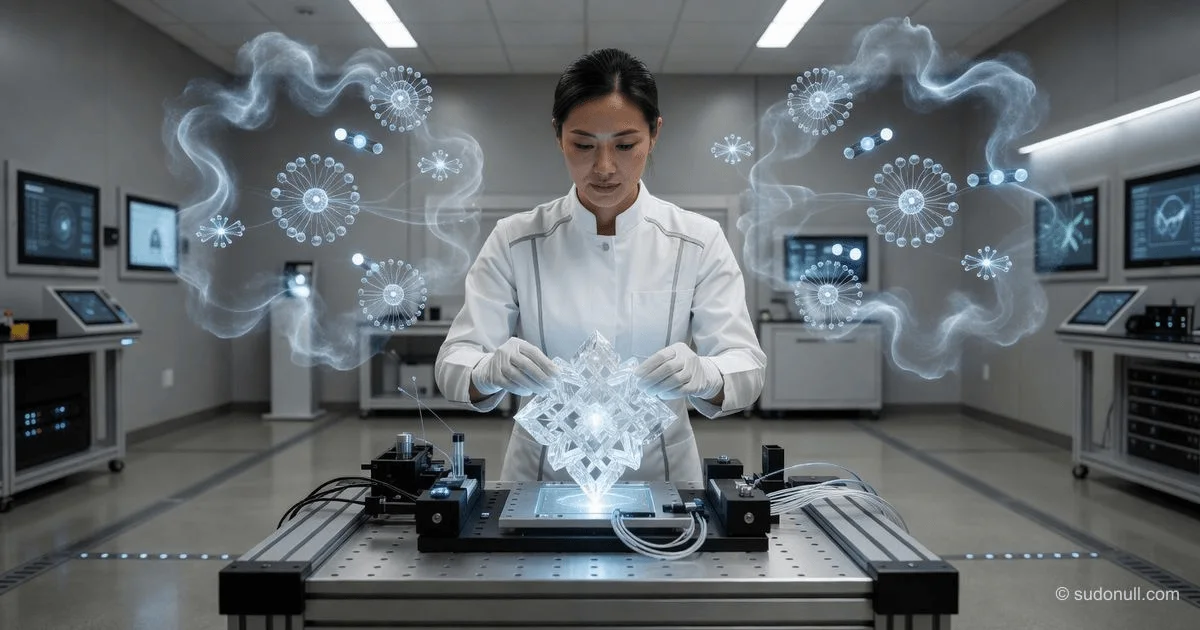
UC Riverside Researchers Create 'Quantum Vibronic Switches' for Future Computers
By studying the interaction of vibrations and electronic quantum states, a US team is laying the groundwork for 'quantum vibronic switches.' These devices will be able to turn quantum transitions on and off using crystal vibrations, providing a new level of control in quantum computing and sensing.
Vibronic Switch: Why UC Riverside Is Building a Computer on Vibrations Instead of Electrons
Analytical review from May 30, 2026
[The Gist]: What's Really Happening
On May 26-27, 2026, the QuVET Center at the University of California, Riverside published three papers, each receiving 'Editors' Suggestion' status in Physical Review Letters and other journals. Center director Nathaniel Gabor articulated the main goal: 'The idea is that vibrations can become a control element, allowing future "quantum vibronic switches" to use crystal oscillations to turn quantum transitions on and off.'
The key detail everyone misses: this is not about yet another 'quantum computer.' Gabor and his team are building a fundamentally new class of computing devices, where a bit of information is encoded not by the presence of an electron, but by the vibrational state of a crystal lattice. And they can already control this state using an ordinary electric field.
Insider understanding: QuVET is not a civilian lab. It is a military center disguised as a university project. Funding of $7.5 million under the MURI (Multidisciplinary University Research Initiative) program came from the US Army Research Laboratory through Tania Paskova. And the grant wording directly mentions 'potential for significant advancement of Army capabilities in quantum computing, secure communications, and sensing technologies.'
Timeline and Context
Two years ago (2024): QuVET is founded at UC Riverside. Nathaniel Gabor receives a MURI grant of $7.5 million from the US Army Research Laboratory. The grant also involves scientists from Columbia University (Xiaoyang Zhu, Eric Arsenault).
March 6, 2026: The first paper is published in Physical Review Letters. Gabor and his team experimentally show that applying an electric field to a bilayer device of tungsten disulfide (WSe₂) can control the position of the wave function—shifting it to the first layer, the second layer, or holding it in both simultaneously.
May 26-27, 2026: All three QuVET papers are officially recognized by the editors of Physical Review Letters as 'Editors' Suggestion'—less than 20% of publications receive this status. The public announcement spreads through science media.
Today, May 30, 2026: We see the full picture. Three papers are three facets of one project: (1) wave function control by electric field; (2) new methods for manipulating quantum states in ultra-thin materials; (3) measuring quantum effects with femtosecond resolution.
Who Wins and Who Loses
Winners
- US Department of Defense (Army Research Office): Tania Paskova, ARO program manager, directly mentions applications for quantum computing, secure communications, and sensing technologies. They have obtained an experimental platform for controlling quantum states at room temperature. The first 'vibronic switches' will appear in military systems—for quantum key distribution (QKD) in the field and quantum gravity sensors for detecting underground tunnels.
- Nathaniel Gabor (Professor, Director of QuVET): He has just staked out a new scientific niche. His citation count will skyrocket. In 3-5 years, membership in the National Academy of Sciences and invitations to boards of quantum startups with options worth $2-5 million.
- UC Riverside: The university, long in the shadow of Berkeley and UCLA, has just earned a reputation as a world leader in vibronics. Next grants: QuVET could receive $15-20 million in federal funding in fiscal year 2026-2027.
- Tania Paskova (ARO Program Manager): She personally oversees the grant and can already report to Pentagon leadership on initial results. For a career in the DoD, this is a serious asset.
Losers
- Labs working on superconducting qubits (Google, IBM): Their systems require cooling to 0.015 K. Gabor works at room temperature. The temperature difference is 20,000 times. If a vibronic switch can perform the same operations as a superconducting qubit but without cryogenics, the entire quantum hardware market will be upended.
- Chinese quantum programs: China has no comparable vibronics program. Their quantum communication satellite is one thing, but creating a working 'vibration switch' is another. In this niche, China lags by 3-5 years.
- Startups in classical quantum dots (Cambridge, ETH Zurich): Their approach requires cryogenics and complex laser systems. Gabor uses an electric field—cheaper, simpler, and more scalable.
What the Media Isn't Saying
Insight #1: Behind this whole story is one man—Nathaniel Gabor, and his journey from Cornell to Riverside via MIT
Gabor is a Cornell graduate (PhD 2012), postdoc at MIT with Pablo Jarillo-Herrero (one of the fathers of 2D materials). In 2016, he moved to UC Riverside and has since methodically built a vibronics program.
What press releases don't say: Gabor is an experimental physicist who can build the most complex setups for ultrafast spectroscopy—femtosecond lasers capable of tracking wave function motion with a time resolution of 10⁻¹⁵ seconds. There are only a handful of such setups in the world. And one of them is at QuVET, built with US Army money.
Insight #2: 'Vibronic switch' is a euphemism for a quantum transistor operating at room temperature
Gabor talks about 'turning quantum transitions on and off using crystal vibrations.' Translate that into engineer-speak: a quantum transistor where the control electrode is not an electric field (as in MOSFET), but a mechanical vibration of the crystal lattice (phonon).
Why is this revolutionary? Today's transistors (even the smallest 2 nm ones from TSMC) work with electrons. Electrons heat up, dissipate energy, create heat that limits packing density. Phonons are atomic vibrations. They don't heat up in the same sense. A vibronic switch could theoretically operate at millionths of the power consumption of a modern transistor.
Insight #3: The MURI grant is not just money; it's 'exclusive access' for the US Army
Under MURI terms, foreign organizations (including Chinese, Russian, European) cannot receive direct funding. They can participate as collaborators but without subcontracting rights. This means key patents will remain in the US.
Moreover, MURI involves 'active guidance from program officers.' Tania Paskova from ARO has the right to demand interim reports, adjust research direction, and, more importantly, determine which results to publish and which to keep for military application. The civilian world will only see what the Pentagon deems safe to publish.
Forecast: Next 30 Days and 90 Days
Next 30 Days
- June 2026: Release of extended data on femtosecond dynamics of wave functions. The team will show how fast the state can be switched between layers. If switching time is less than 1 picosecond (10⁻¹² s), it would mean the vibronic switch could operate at frequencies up to 1 THz—100 times faster than current processors.
- US Department of Energy reaction: Following the Army, civilian funding will follow. The DOE will allocate $5-10 million for applied research in solar energy through the Solar Energy Technologies Office. Gabor will submit an application within a month.
- Second round of military contracts: ARO will announce a second MURI round based on QuVET results. This time the budget could reach $10-12 million over 3 years, focusing on applied sensors.
Next 90 Days
- August-September 2026: Commercialization through a startup. UC Riverside has its own technology transfer office. They will likely license to a new startup founded by Gabor. Seed round: $5-10 million from deep tech funds (Potential Energy, Breakthrough Energy Ventures, Lowercarbon Capital). Startup valuation: $20-30 million.
- Patent race: Gabor and his team will file at least 3-4 patents on: (1) 'quantum vibronic switch,' (2) 'method for controlling wave function with electric field in bilayer materials,' (3) 'photovoltaic device with quantum efficiency above the Shockley-Queisser limit.'
- Response from China and Europe: ETH Zurich (Yiwen Chu group) is already working on similar concepts but focusing on cryogenic systems, not room temperature. Chinese institutes (Tsinghua, CAS) will publish their results on wave function control in WSe₂ within 6-9 months. But with QuVET's head start in patents and military funding, China will be catching up.
What to Do If You're an Investor
- Venture capital funds: Start dialogue with UC Riverside Innovation now. The window of opportunity is 3-4 months. If you miss the Seed round, you'll pay 5-10 times more in the Series A round in 18 months.
- Large corporations (solar energy, semiconductors): First Solar, SunPower, TSMC—your R&D department should already have a roadmap for integrating vibronic technologies. Gabor's technology could make your current silicon products obsolete in 5-7 years. License now while rates are low.
- Private investors (public market): No direct instruments (UC Riverside is not public). But watch stocks of 2D material manufacturers—tungsten disulfide and molybdenum disulfide. American Elements (private), 2D Semiconductors (private). If they announce capacity expansion, that's a signal.
- Avoid: Investments in classic solar startups without differentiation. If they don't have a quantum approach to exciton management, they will lose to QuVET technology.
Summary in one paragraph: What Nathaniel Gabor is doing at UC Riverside is not 'just another quantum lab.' It is building a new computing paradigm, where a bit of information is an atomic vibration, not an electron's motion. And the customer for this project is not environmentalists or tech giants. It is the US Army, which needs quantum sensors and secure communication without cryogenics. The fact that the MURI grant of $7.5 million was awarded before publication and that Tania Paskova from ARO is already commenting on the results says it all: the bet has been placed, and it's on vibrations. Civilization will see the fruits in a decade. The Pentagon—in three years.
— Editorial Team









No comments yet.