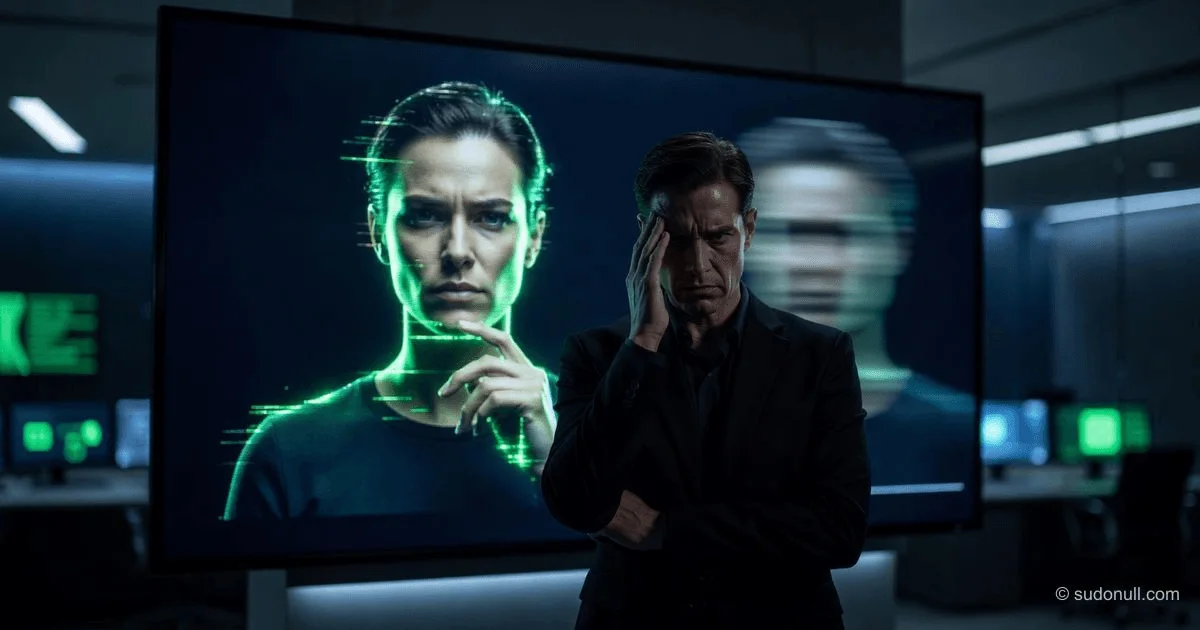
Google Unveils Project Starline with Complete Abandonment of Headsets for Holographic Meetings
The new version of the system uses light field technology and AI to create realistic 3D images without glasses or headsets, with commercial launch expected in 2027.
Google Beam: The Failure That Will Be Sold as a Breakthrough. Why Holographic Calls Will Die Before They're Born
I've been closely following the Starline project (now Beam) since its first announcement in 2021. Back then, still in the era of pandemic craving for "live" communication, Google showed something that made venture analysts freeze. Now, years later, as the technology is finally being commercialized, I have to say what the glowing reviews are silent about: Google Beam is a marketing disaster being packaged as a corporate plan.
Yes, in demos it looks like a "magic window." But let's face reality: the video communications industry is dead for innovations of this level. In this article, I'll explain why Beam is not the future of communication but an expensive dead end, and who actually loses from its arrival.
[The Core]: What's Really Happening
Google rebranded from Project Starline to Google Beam, partnered with HP, and announced a commercial launch in 2025. Technically, it's a cost reduction and software upgrade. Instead of four monstrous NVIDIA Quadro RTX (two of which were Titan) and a bunch of calibrated sensors, Google engineers learned to get by with "several standard cameras" and an AI model for generating depth maps.
Previously, the system generated 7 video streams (4 color + 3 depth), requiring bandwidth from 30 to 100 Mbps and a ping of 105 ms. Now, the AI voxel model creates a rough 3D mesh with textures stretched over it. But the key point that escapes journalists: latency hasn't gone away, and edge quality has dropped. All 2025 test reports mention "green flickering" on necks and fingers.
Why does this matter? Because the psychophysiological "presence" effect requires perfect edge tracking. As soon as the system starts blurring the boundaries of an apple in the interlocutor's hand, the brain falls out of the magic back into the reality of the display.
Timeline and Context
Let me remind you of the timeline that's now forgotten. The first working prototype in 2021 was a monster: a 65-inch 8K panel, dozens of IR illuminators, three capture capsules. Google bought startup Lytro (light field technology) and tried to do what no one else could.
In 2023, they showed a smaller version "like a digital whiteboard" without the booth. And in 2025, they finally announced a price—though they keep the actual price secret. But I spoke with HP people at the InfoComm expo. Unofficially: the cost of one "window" with installation and calibration is from $30,000 to $50,000 USD. That's without dedicated channel support.
That's the main catch. In five years, the world has changed. In 2021, we believed we'd return to offices and pay for "magic." In 2025, everyone is tired of hybrid work. Companies are optimizing every expense.
Who Wins and Who Loses
HP wins. They get an exclusive contract to manufacture niche equipment. For HP, this is a chance to sell hardware with a 300% margin to the corporate segment that hasn't gone bankrupt yet.
Zoom wins. Yes, oddly, Beam supports Zoom and Google Meet. This is a win for Zoom—their software will run on expensive hardware without spending a dime on R&D.
Startups like Light Field Lab and Portl lose. Google just commoditized their technology. But as we see, no one will buy this product in the mass market.
Small and medium businesses in the US and Europe lose. They'll be sold an illusion. Imagine: a company spends €40,000 on an installation in a conference room. What do you get? Inability to connect a third person (the system is strictly 1-to-1), tie-in to a specific location, and a constant bug with hands cutting off if you leave the capture zone. For that money, you could send an employee on a business class trip once a month.
What the Media Aren't Saying
The main non-obvious insight that The Verge and Wired are silent about: Beam destroys the main advantage of remote work—asynchronicity and multitasking.
During a regular Zoom call, you can quickly rewrite code, check email, or glance at another monitor. Your gaze shifts away—that's normal. In Beam, you are physically tied to a spot in front of the panel. As soon as you turn to your real computer, the system loses eye contact, and the "magic" disappears. You can't "look away" without the interlocutor feeling ignored. This creates enormous cognitive strain. By 2026, as offices empty, no one wants to sit in front of a 65-inch panel like under a camera lens.
Second point: No Russian context. While Google struggles with 105 ms latency, Chinese competitors (Tencent and startups from Shenzhen) have already rolled out a solution based on holographic films with 30 ms latency for the domestic market. But the West is silent about this.
Forecast: Next 30 Days and 90 Days
Next 30 days (June 2026):
Google and HP will start aggressive B2B piloting. First clients will be medical centers (telemedicine) and financial giants like Citadel and Deloitte, as Pichai mentioned. They'll install 2-3 booths in key offices in New York and London. The press will feature enthusiastic posts like "we touched avatar hands." But real rejection rates will be hidden by NDAs.
Next 90 days (August 2026):
The first analytical reports from Gartner and Forrester will come out. Main conclusion: ROI is negative. No company will be able to prove that replacing Zoom with Beam increased deal closures or accelerated product development.
The technology doesn't scale. Users will quickly tire of green glow artifacts and the need to sit still. I bet that by October 2026, HP will quietly halt production, citing "chip supply chain difficulties." And Google will integrate Beam algorithms into regular Meet, creating a silly "3D without glasses" effect that every second user will disable due to headaches.
Bottom line: Don't believe the hype. We are witnessing not the birth of a new communication standard, but the death of yet another "Zoom killer" that was too complex, too expensive, and too inconvenient for the real world. The only place it will thrive is on CES exhibition stands and in vice presidents' conference rooms who love to blow budgets on "toys."
— Editorial Team










No comments yet.