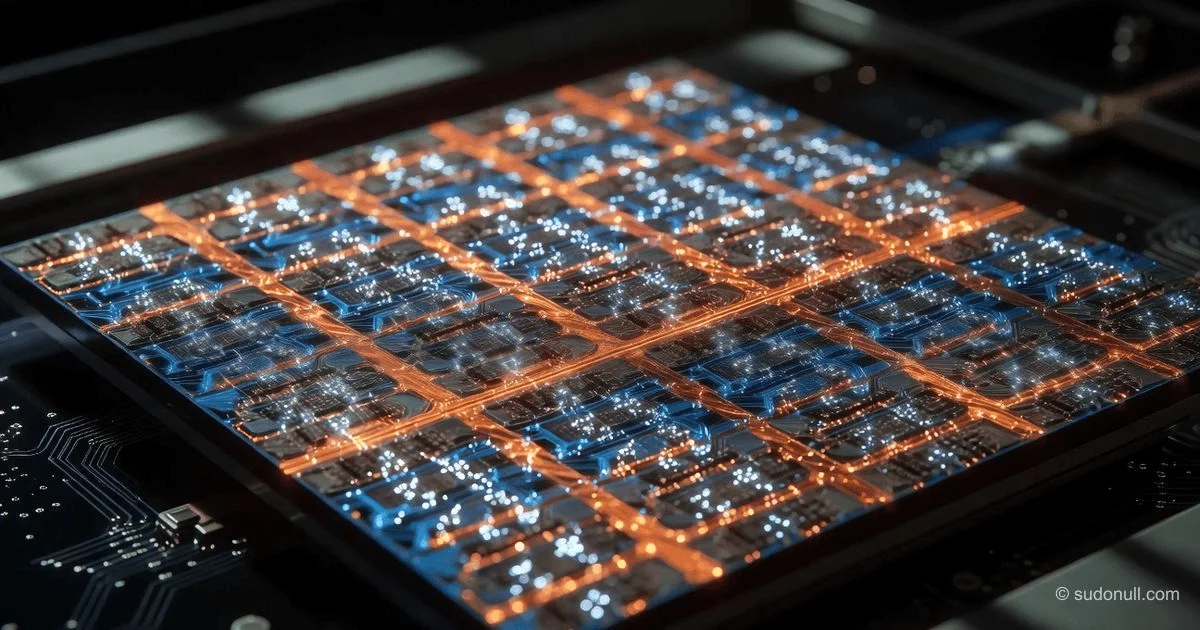
Apple Announces M5 Chip with TSMC's 3nm Process and Dedicated 128-Core Neural Block
AI compute performance is 4x faster than M4, first devices arriving in June.
M5: Apple Made a Revolution Nobody Will Notice
When Apple announced the M5 chip, most analysts skimmed the numbers: "4x faster AI," "new 3nm process," "Fusion Architecture." And they drew the standard conclusion: Apple has outpaced everyone again. That's not true.
I've been following the silicon race for the last 10 years. And I see what's hidden between the lines of press releases. Apple has just changed the very definition of what a "processor" is. But they did it so quietly that the market didn't notice. This isn't an evolution in performance. It's the death of the "universal chip" concept. And I'll explain why.
[The Core]: What's Really Happening
Apple introduced the M5, M5 Pro, and M5 Max based on TSMC's 3nm N3P process with Fusion architecture. This is two dies combined into one chip via 2.5D packaging. But the main change is that each GPU core now has its own dedicated neural accelerator. Not one NPU for the whole chip, as before. But 128 separate accelerators in the Max version.
Technically: The M5 gets 128 GPU cores, each with its own Neural Accelerator. Plus a 16-core Neural Engine. Plus CPU. Plus Media Engine. This isn't a chip. It's a neural network on silicon.
Why is this needed? A regular chip works like this: CPU handles logic, GPU handles graphics, NPU handles AI. The M5 breaks this scheme. Now the GPU can handle AI simultaneously with graphics. No context switching. No latency. An LLM on the M5 Max with 128 GB of unified memory and 614 GB/s bandwidth doesn't just "run"—it "soars."
But the most important detail that goes unmentioned: The M5 Pro is not a separate chip. It's the same M5 Max with disabled cores. Apple has moved to a unified die design. One lithography mask. One manufacturing process. Different price tags.
Timeline and Context
January 2025 – March 2026: Taiwan. TSMC fine-tunes N3P. Yield starts at 40%, then 65%, then 80%. Apple takes it all. Any other client would pay $20,000 per wafer. Apple pays $16,000. For volume.
March 2026: Launch. MacBook Air on M5 – $1,099. MacBook Pro on M5 Max – from $3,999. Prices increased by $100–200. Apple passes the rising cost of memory onto the consumer.
April 2026: First benchmarks. M5 Air's AI performance is 4x higher than M4, 9.5x higher than M1. The fanless laptop heats up to 99°C under heavy loads.
May 2026 (now): M5 Pro and M5 Max appear in supply chains. MacBook Pro 14" with M5 Pro – $2,999 on Amazon.
Who Wins and Who Loses
Apple wins. Obviously. But not in the way you think. The win isn't in performance. The win is that one chip design serves all segments: from the Air at $1,099 to the Pro Max at $4,300. The margin on the M5 Max is about 65%. The margin on the M5 (a cut-down Max) is about 55%. The difference is 10%. Before Fusion, the difference was 25–30%.
TSMC wins. N3P is the most loaded process in the company's history. Apple takes 60% of capacity. For TSMC, that's $12 billion in revenue in 2026.
M1 users win. Those who waited 3–4 years. Comparison: The M5 Air processes an LLM query 9.5x faster than the M1. For them, the upgrade is a generational leap.
Cloud AI providers lose. Every time Apple accelerates local AI, demand for cloud APIs drops. If you can run a 70-billion-parameter model locally on the M5 Max, why pay OpenAI $0.01 per thousand tokens?
Intel loses. The Core Ultra 200 series has a peak AI performance of 45 TOPS. The M5 Max is around 180 TOPS on the GPU. The gap isn't closing. It's widening.
Qualcomm loses. The Snapdragon X Elite promised to "kill Apple Silicon." It launched in mid-2025 with emulation issues. The M5 arrived 9 months later and beat it by 300% in AI tasks. Bets on Windows on ARM haven't paid off.
What the Media Isn't Saying
The main non-obvious insight: The M5 is a chip that 95% of users don't need, but Apple sells it to everyone under the guise of an "AI future."
Look at reality. The M5 MacBook Air has no fan. Its passive cooling is designed for 15–20W of heat dissipation. Under full AI workload, the chip hits 99°C and throttles after 30–40 seconds. It's like buying a Ferrari and discovering that on the track, it shuts off 3 cylinders a minute after starting.
Apple knows this. They knew it at the design stage. But a fanless design is sacred for the Air. So the M5 in the Air is marketing. A demonstration that the technology exists. But you won't be able to use it to its full potential.
For that, you need a MacBook Pro. With active cooling. With three fans. There, the M5 Max fully unfolds. But the Pro starts at $2,499 for the 14-inch and $2,999 for the 16-inch. That's a different price bracket.
Second point: Apple switched to a unified die for cost savings but hides it behind an "architectural breakthrough."
The M5 Pro is an M5 Max with defective blocks. Instead of 20 GPU cores, 16. Instead of 614 GB/s bandwidth, 307. Instead of 128 GB memory, 64. These aren't different chips. They're one chip that didn't pass full qualification.
For manufacturing, this is brilliant. One mask, one process, one pipeline. Defects aren't discarded; they're sold as "Pro." For Apple, this saves hundreds of millions of dollars a year. For the buyer, it's buying an unfinished Max.
Forecast: Next 30 Days and 90 Days
Next 30 days (June 2026):
M5 MacBook Pros will hit retail. Expect glowing reviews from YouTubers who Apple gives top configurations. But don't expect honest throttling tests. They'll exist but be buried in fine print.
Daniel Ives from Wedbush will reaffirm a Buy rating on Apple with a target price of $350. But that's not about the technology. It's about Apple finding a way to raise the average selling price by $100–150 per device without increasing cost.
Next 90 days (August 2026):
Independent tests of the M5 Air under sustained load will appear. Result: After 2–3 minutes of running a 7B-parameter LLM, GPU frequency drops by 35–40%. The ability to "run a model locally" becomes "run a model for 30 seconds."
Qualcomm and AMD will hold emergency press conferences, showing slides of "future products that will surpass the M5." None of this will materialize in 2026. As always.
The most important forecast: iOS 26 (September 2026) will include features that only work fully on the M5. Apple Intelligence 2.0. Local AI video editor. Real-time translation with full context memory. All of this will require the Neural Accelerator in every GPU core. Owners of M4 and older will see a message: "This feature requires M5 or newer."
Conclusion: The M5 is not a chip for today. It's a chip for tomorrow that Apple is selling today. Tomorrow, when AI agents live on your device, you'll understand why you need 128 GPU cores with neural accelerators. Today, you're just overpaying for something you can't use. But Apple is fine with that. Just as it's fine that you'll come back for the M6 in 18 months. Because by then, the M5 will be "obsolete"—just enough for you to feel the difference.
— Editorial Team










No comments yet.