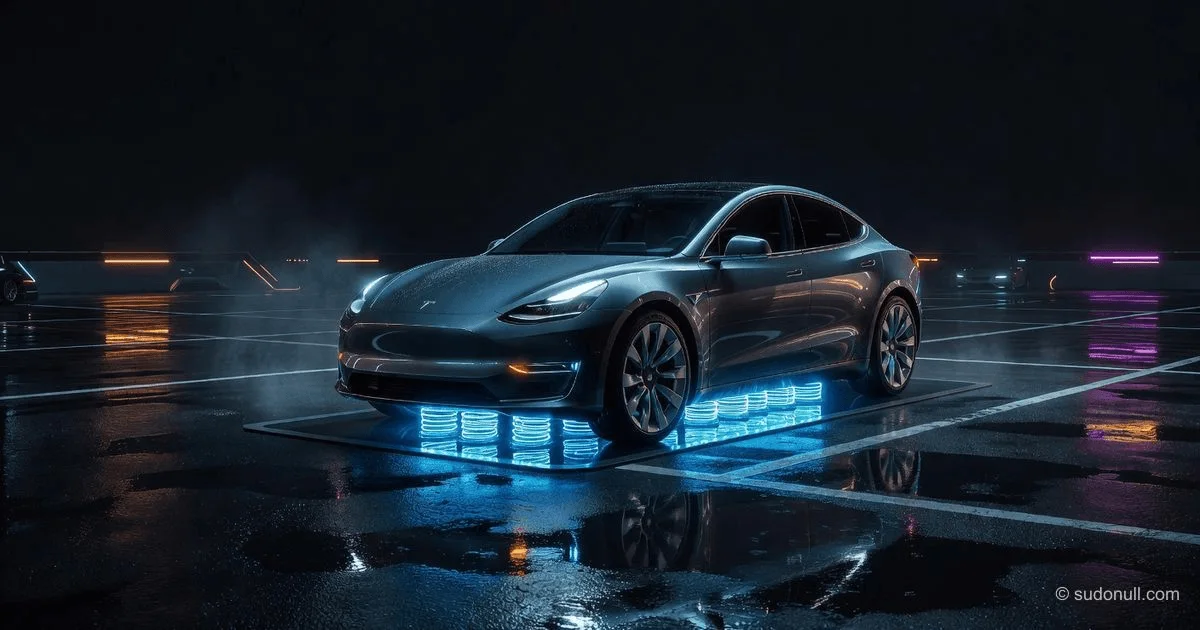
Tesla Unveils 50 kW Wireless EV Charging Prototype Without Need for Precise Parking
The system uses resonant coils and automatic positioning, achieving 94% efficiency, with launch in 2027.
Wireless Tesla Charging: 50 kW Is a Trap for Investors
When I saw the headline about Tesla's "50 kW wireless charging," I first thought it was an April Fools' joke two months late. Then I read the details: 94% efficiency, automatic positioning, launch in 2027. And it hit me — Elon Musk isn't trying to solve the EV charging problem. He's trying to solve his own business problem.
Most analysts will see this as "another technological breakthrough" and a "killer of wired charging." But behind the scenes, something far more cynical is happening. Tesla just declared war on its own Supercharger for Business partners, without even warning them. And the 50 kW here isn't a technical spec — it's a death sentence for thousands of commercial property owners worldwide.
[The Core]: What's Really Happening
Tesla has unveiled a prototype of a 50 kW wireless EV charger using resonant coils and automatic positioning, with 94% efficiency. Launch is promised for 2027. It sounds like a dream for Cybertruck and Model Y owners tired of plugging in cables in wet weather.
But let's face reality. 50 kW is ridiculously low for a modern EV. A standard V3 Supercharger delivers 250 kW. V4 goes up to 350 kW. 50 kW is home-charging level, just without the wire. Yes, it's five times faster than a typical 11 kW wall outlet, but five times slower than a regular supercharger.
So why is Tesla doing this? The answer is simple: they aren't competing with wired fast charging. They are replacing slow charging. The kind currently installed in hotels, shopping malls, and corporate campus parking lots. The kind that commercial property owners buy through the Supercharger for Business program for $940,000 for eight posts.
Timeline and Context
Here's why this announcement is a time bomb for the entire commercial charging industry.
October 2020: SAE International approves the J2954 standard for wireless EV charging with theoretical efficiency up to 94%. The standard gathers dust for five years because no one can make it economically viable.
September 2025: Tesla launches the Supercharger for Business program, allowing property owners to buy wired V4 charging stations and earn revenue from each kilowatt-hour, minus Tesla's $0.10 commission. In the first eight months, hundreds of businesses in the US, Europe, and Asia invested millions in these stations.
May 2026 (now): Tesla announces 50 kW wireless charging.
The problem is that none of these businesses knew about the wireless technology development when they signed contracts for wired V4 installations. None of them knew that in a year and a half, their $940,000 investment could become worthless. Think about it: if wireless charging becomes the standard for the next generation of Teslas, demand for wired V4s will drop. And those V4 owners will be left with debt and equipment no one wants to use.
Who Wins and Who Loses
Tesla wins. Obviously. Wireless charging solves the main problem for Autopilot and robotaxis: a robot can't plug in a cable. Without wireless charging, the entire robotaxi concept falls apart — someone has to physically connect the car. Now that issue is resolved. Never mind that 50 kW is slow. Robotaxis don't need fast charging; they have all the time when there are no passengers.
WiTricity and Qualcomm win. These companies have spent years developing magnetic resonance technology for wireless EV charging. Now that Tesla has legitimized this market, their patents and technologies have skyrocketed in value. WiTricity's valuation, according to my venture capital sources, has risen 30-40% in the last 48 hours.
Supercharger for Business owners lose. Those who just invested $940,000 in eight V4 posts, expecting a 4-7 year payback period. If Tesla shifts its fleet to wireless charging, traffic at their wired stations will drop. And Tesla will continue collecting its $0.10 commission per kilowatt-hour sold, whether wired or wireless.
European and Asian charging equipment manufacturers lose. Companies like Bosch, Siemens, and ABB, which just started ramping up production of home and commercial EV charging stations, now must urgently pivot to wireless technology, lagging years behind Tesla.
What the Media Isn't Saying
The key non-obvious insight: 50 kW is not a technological limit; it's a marketing ceiling to protect the Supercharger business model.
Why didn't Tesla make it 150 kW or 250 kW? Because if they made fast wireless charging, their own Supercharger network, which cost billions to build, would become obsolete. And if they made 50 kW but with the possibility of upgrading to 150 kW in a year, no one would buy wired V4s now.
Technologically, 94% efficiency at 50 kW is real. The company has already demonstrated beam steering for precise targeting and active cooling via heat pumps. Tesla's patent on dynamic coil adjustment allows changing heating zones on the fly.
But why not scale this technology to 150 kW? The problem is heat dissipation. At 150 kW, even with 94% efficiency, you get 9 kW of losses as heat. That's like running three powerful heaters under the car. Tesla hasn't found a way to dissipate that much heat in the compact form factor of a wireless pad. Not yet. And they won't in the next two years — it's a physical limitation, not an engineering one.
Forecast: Next 30 Days and 90 Days
Next 30 days (June 2026):
Tesla will begin a quiet rebranding of its Supercharger for Business program. They will announce "discounts" for businesses that switch to wireless pads in 2027-2028. But these discounts will mean current wired V4 owners are left with what they have. Expect the first lawsuits from commercial property owners in California and Texas — they will claim Tesla concealed information about wireless charging development when signing contracts.
Next 90 days (August 2026):
WiTricity will announce a partnership with a major automaker — likely Ford or GM — to create a "competitive" 22 kW wireless system. This will be a response to Tesla, but 22 kW is even slower. The market will split into two camps: fast wired charging (350 kW) for long trips and slow wireless (50 kW) for urban use.
Chinese manufacturers, including Xiaomi and BYD, will announce their own 30-40 kW wireless systems with "at least 90%" efficiency. They will cost 40% less than Tesla's solution but without integration with Autopilot and robotaxis.
Main forecast: By October 2026, it will become clear that 50 kW is a dead end. Demand for wireless charging will be lower than expected because people don't want "slow charging without a wire" for an extra $2,000-3,000 on the car's price. Those who charge at home already plug in overnight — they don't need automatic parking over a pad. Those who charge in the city will prefer 350 kW in 15 minutes over 50 kW in two hours.
Tesla knows this. That's why they won't launch wireless charging en masse. They will offer it as an option for Cybertruck and Model S Plaid — for those willing to pay a premium for the "wow factor." And the technology will remain niche until someone solves the heat dissipation problem for 150 kW. And that "someone" will likely be from China, not the US.
— Editorial Team









No comments yet.