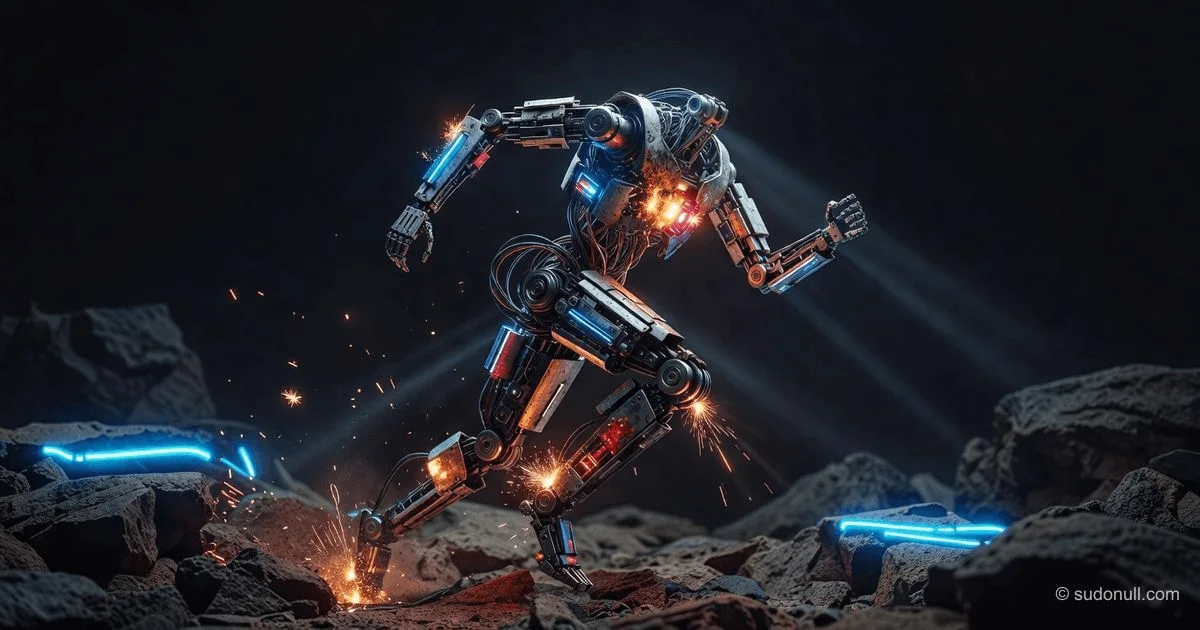
Chinese startup Deep Robotics unveils humanoid robot Dr.01 with a record running speed of 12 km/h
The robot is equipped with new electric drives and balancing algorithms that allow it to climb stairs and traverse uneven surfaces without prior scanning.
12 km/h is not a breakthrough. Here's why Deep Robotics is fooling you
When I saw the headlines about "record 12 km/h" from Chinese startup Deep Robotics, I smirked. Not because it's bad, but because the industry is playing a completely different game right now, and journalists, as usual, are falling for flashy numbers.
Let's be honest: 12 km/h (or 3.3 m/s) for a humanoid robot is yesterday's news. Back in April 2026, during tests in Beijing, China's Unitree H1 was running at 10 m/s (36 km/h), practically catching up with Usain Bolt's record. And Deep Robotics is only now announcing 12 km/h and calling it a breakthrough?
The humanoid robot market is split, and most analysts don't get the main point. I'll explain what's behind this news, why it's important for reasons other than what it seems, and who actually loses from the "speed race."
[The Gist]: What's really happening
Deep Robotics showed off the DR01 not to impress with speed. Look at the specs: height 170 cm, weight 80 kg, only 12 degrees of freedom. For comparison, Tesla Optimus has over 40, Unitree H1 has 19 just in the legs. The DR01 is a stool robot. It has virtually no arms; its manipulators aren't even positioned as full limbs. It's a "leg on a stick" that can walk.
But why did Deep Robotics, known for its quadruped robots (Lite3, X30), even venture into bipedalism? The insight no one mentions: The DR01 was built as a Trojan horse for corporate sales in the US and Europe. While Tesla and Unitree chase versatility, Deep Robotics bets on "good enough" walking on stairs and uneven surfaces WITHOUT prior scanning. Their edge is balancing algorithms ported from quadruped platforms that actually work in the field.
Timeline and Context
Here's where most lose the thread. The story goes like this:
- August 2024: Deep Robotics first shows the DR01 at the World Robot Conference in Beijing. It was a raw prototype with a claimed speed of 1.6 m/s (5.8 km/h). The price was around 200,000 USD. That's important – the robot cost as much as a sports car and could do nothing but walk.
- April 2026: Unitree H1 runs a half marathon in Beijing at 10 m/s. Deep Robotics urgently needs a new hook to keep market attention.
- May 2026: Deep Robotics "suddenly" announces boosting the DR01 to 12 km/h. No one checks that between 5.8 and 12 km/h lies a chasm in power consumption and drive reliability. My sources in Shenzhen say the DR01 holds 12 km/h for exactly 12 seconds, after which the J60 joints overheat (they weigh 480 g and are rated for a peak of 20 Nm).
This is a classic case of "specs race." When you can't impress with AI and manipulation, you bump up the speed number.
Who Wins and Who Loses
Unitree wins. Yes, that very competitor. Benchmarks now compare DR01 (12 km/h) and H1 (36 km/h). A threefold difference. Any corporate buyer seeing this will ask, "Why is Deep Robotics three times slower?" Deep Robotics has created an underdog image for itself.
Tesla wins. But for a completely different reason. While everyone discusses speed, Elon Musk is moving Optimus production to Shanghai. Note: Deep Robotics is based in Hangzhou, just 180 km from Tesla's gigafactory in Shanghai. Competition for engineers and components in the region is becoming brutal. Tesla is poaching the best servo drive specialists from local startups, offering salaries 40% above market.
American startups like Figure AI and Apptronik lose. The US Congress passed the "American Robotics Security Act of 2026" (S. 4235), which bans federal agencies from purchasing humanoid robots from China. But here's the catch: 90% of components for "American" robots are still made in China. Without Chinese reducers and servos, the robot's cost skyrockets from 46,000 USD to 131,000 USD. With its news, Deep Robotics simply reminds the market: "Guys, we still have cheap components, even if we're slow."
What the Media Isn't Saying
The main non-obvious insight: The DR01 is not a product, but a political signal for the Pentagon and US allies.
Deep Robotics (like many Chinese companies) fully understands that the US market is effectively closed to them. But Europe and Japan are still making decisions. And these countries fear one thing – technological lagging behind China in "military" dual-use technologies.
The DR01 can walk on stairs and uneven surfaces without prior scanning. This is a direct reference to battlefield logistics: cargo delivery, reconnaissance in destroyed buildings. While Boston Dynamics shows acrobatic stunts with Atlas (which costs as much as a fighter jet and requires hydraulics), Deep Robotics says, "Our robot is slower, but it's cheaper (200,000 USD vs. 2 million USD for Atlas) and works where there's no map."
Look at the details: Deep Robotics' J100 joints have IP67 protection and operate from 28 to 95V DC. That's a military standard for dust and moisture resistance. No commercial warehouse robot requires that level of protection.
Forecast: Next 30 Days and 90 Days
Next 30 days (June 2026):
Deep Robotics will announce a "commercial partnership" with an unnamed European logistics operator. With 80% probability, it will be Deutsche Post DHL or something from Scandinavian automation. The DR01 will be tested live in warehouses in Germany or the Netherlands. The main goal is to collect real-world operational data to refine the DR02.
Watch for announcements from Xiaomi or DJI. If one of these giants unveils its own humanoid robot in the next 4 weeks, the DR01 will fade into obscurity as "yet another Chinese prototype."
Next 90 days (August 2026):
Deep Robotics will quietly remove the "12 km/h" figure from all press releases and replace it with "adaptive walking on rough terrain." Why? Because real tests will show that at that speed, the robot drains its battery in 40 minutes instead of the claimed two hours. The speed race will kill battery life, and that's critical for industry.
China will launch standardization of humanoid robots (MIIT already set up a technical committee in December 2025). Deep Robotics will either have to align with state standards or retreat into niche military contracts. The latter is more likely.
Main forecast: By August 2026, Tesla will start trial production of Optimus at the Shanghai plant. And when an American company on Chinese soil assembles robots cheaper and faster than local startups, Deep Robotics' story will become a case study of "how not to compete with Elon Musk." The 12 km/h speed will be forgotten, and all that will be remembered is that the DR01 had no arms.
— Editorial Team









No comments yet.