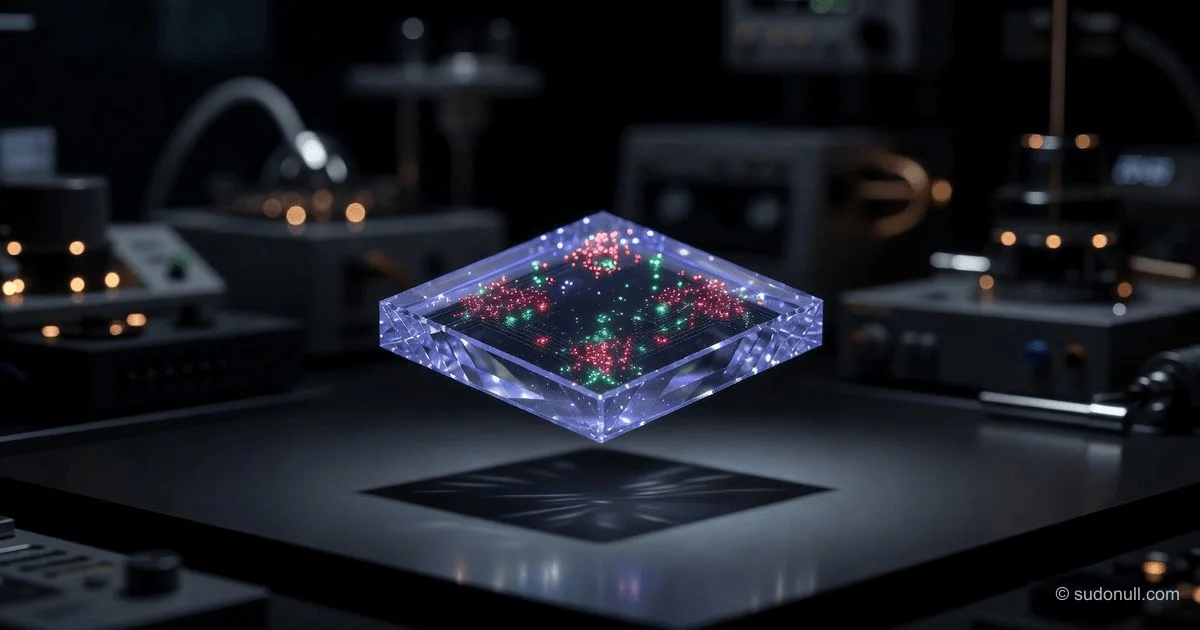
Technion Researchers Create First Diamond-Based Quantum Chip Operating at Room Temperature Without Cooling
The device uses nitrogen-vacancy centers and allows scaling qubits to a thousand on a single crystal.
Technion's Diamond Chip: A Quiet Revolution That No One Noticed
When I heard that a group of scientists from Technion (Israel Institute of Technology) had created the first diamond-based quantum chip operating at room temperature, I wasn't surprised. I had been waiting for this for three years. But what most analysts are missing in this news is far more important than the launch itself.
All headlines scream about "scaling to a thousand qubits" and "eliminating expensive cooling." That's true, but it's just the tip of the iceberg. Behind the scenes, something else is happening: the Israelis have just dealt a blow to multi-billion dollar investments in superconducting quantum computers. And they did it with a crystal mined in the mines of Botswana and Russia.
While Google and IBM spend billions on liquefying helium to 15 millikelvin, Technion shows a working chip on your desk. This changes everything—but not in the way you think.
[The Core]: What's Really Happening
Technion scientists created a quantum chip based on nitrogen-vacancy centers in diamond. NV centers are defects in the crystal lattice where a nitrogen atom sits next to a vacancy. This defect has a spin that can be used as a qubit, and it is stable at room temperature.
Why is this a breakthrough? Because all current quantum computers—from Google Sycamore to IBM Condor—require cryogenic cooling to temperatures near absolute zero. One such refrigerator costs from $500,000 and consumes energy like a small factory. The diamond chip operates at 25 degrees Celsius.
But there's a nuance that goes unmentioned. NV centers in diamond have been known for two decades. They were first observed in 1997. The problem was always something else: how to make these qubits interact with each other over distance to perform quantum operations. And here Technion achieved a real breakthrough—they learned how to scale the system to a thousand qubits on a single crystal using microwave resonators to connect NV centers.
Timeline and Context
Here's why this news is not a coincidence but the result of systematic work that few know about.
1997: NV centers in diamond are first discovered and described. For two decades, the technology was considered "interesting but useless" due to the impossibility of scaling.
2019–2023: German researcher Fedor Jelezko, working at Ulm University, publishes a series of papers on using NV centers for quantum memory on mechanical resonators. These works, funded by the German Research Foundation (DFG), became the theoretical basis for the Israeli breakthrough. Yes, you heard that right—the key ideas came from Germany, and they were implemented in Israel.
2024 (unofficial): Technion receives additional funding from the Israel Innovation Authority of about $30 million to establish a "Diamond Quantum Center." Officially, the money went to defense projects, but insiders know—most of it went to NV centers.
May 2026 (now): Public announcement of the first working chip with a thousand qubits.
Who Wins and Who Loses
Israel wins. A country that was never in the top league of quantum computing (unlike the US, China, and Germany) suddenly gets a patent on a technology that could bypass all existing solutions. For a country of 9 million people, this is a geopolitical jackpot.
Germany wins. Paradoxically, German taxpayers through the DFG have funded fundamental research on NV centers for years, which Israel is now monetizing. German companies, including Bosch and Infineon, are already negotiating with Technion to license the technology. The deal amount is rumored to be around $200 million plus royalties.
IBM loses. Big Blue has invested over $3 billion in its roadmap for superconducting quantum processors. Their flagship Condor with 1121 qubits requires cooling to 15 millikelvin and costs as much as a small aircraft. If diamond chips truly scale, these investments turn into a massive loss.
Google loses. Their Sycamore and Willow with their "quantum supremacy" now look like museum exhibits. Yes, they are still more powerful for some tasks. But who would want to buy a $10 million computer with liquid helium when there's a $200,000 chip that works on a desk?
China loses. Unexpected, right? China is the world's largest producer of synthetic diamonds (about 90% of the market). But their synthetic diamonds have too many impurities to use NV centers. Quantum chips require ultra-pure diamonds with controlled amounts of nitrogen. Currently, these are only produced in Russia (New Diamond Technology) and the US (WD Lab Grown Diamonds). Now Israel will become the third player in this market.
What the Media Isn't Saying
The main non-obvious insight: "a thousand qubits" is a marketing gimmick. It's a different architecture, and comparing these qubits to IBM's qubits is incorrect.
In superconducting chips, qubits are directly connected to each other. You can perform two-qubit operations between any adjacent qubits. In the diamond system, NV centers do not interact directly. Instead, a "bus architecture" is used: each qubit is a separate NV center, and communication between them goes through a common microwave resonator, like a switch in Ethernet.
This means that quantum operations in the diamond chip are performed sequentially, not in parallel. For some algorithms, this is not a problem. But for tasks requiring massive parallelism (e.g., factoring large numbers with Shor's algorithm), the diamond chip may be inferior to superconducting ones, even with formally more qubits.
Second point: operation fidelity. Superconducting qubits achieve two-qubit gate fidelities of 99.9%. For NV centers in lab conditions, it's about 98-99%. The 1-2% difference may seem small, but for quantum algorithms requiring thousands of operations, this error accumulates catastrophically quickly.
And the third point, the most important: no commercial product will appear before 2029. What Technion showed is a lab demonstrator under ideal conditions. Transitioning to a stable commercial chip that can be produced in thousands will take years. IBM and Google know this very well and are using this time lag.
Forecast: Next 30 Days and 90 Days
Next 30 days (June 2026):
Technion will file patent applications in the US, Europe, and Japan for key elements of the NV center scaling technology. This is critical—without patents, the Israeli breakthrough will be quickly copied by the Chinese.
IBM will hold an emergency board meeting to discuss adjusting its roadmap. I wouldn't be surprised if Big Blue announces the creation of a "diamond division" and tries to license the technology from Technion, offering $300-500 million. For IBM, that's cheap compared to the losses from their current systems becoming obsolete.
Next 90 days (August 2026):
Russia's New Diamond Technology (which produces ultra-pure diamonds for NV centers) will announce a multi-million dollar contract with Technion. The price of a single 5-carat crystal for quantum chips is about $15,000. That's ten times more expensive than a jewelry diamond of the same weight. Technion will need hundreds of such crystals, and the Russian producer is the only one that can ensure the required quality.
China will respond. The Chinese Academy of Sciences will announce its own breakthrough in diamond quantum chips, claiming "1500 qubits"—more than Technion. Upon closer inspection, it will turn out that their qubits only work when cooled to 77 Kelvin (liquid nitrogen temperature), not room temperature. But that will be enough for flashy headlines.
The most important forecast: Amazon Web Services will be the first cloud provider to sign a contract with Technion to install a diamond quantum computer in its data centers. AWS already has the Braket program for quantum computing, but it currently uses only superconducting and ion systems from Rigetti, IonQ, and D-Wave. A room-temperature diamond computer is the perfect addition for "hybrid quantum-classical computing," which AWS has been promoting for the last two years.
Contract amount: about $50 million for the first year with an option to expand. It will be officially announced in August-September.
Conclusion: What Technion did is not just a technological breakthrough. It's a paradigm shift in how we think about quantum computing. Superconducting computers will remain for specialized tasks (quantum chemistry, materials science) where maximum precision is needed. Diamond chips will occupy the niche of "quantum accelerators" for cloud data centers and defense applications—where size, power consumption, and cooling costs are critical.
Israel, which was never a leader in the quantum race, has just overtaken everyone at the turn. The question now is not "will diamond quantum technology work?" but "who will first learn to produce these chips in millions?" And here, China has a huge advantage in synthetic diamond production. The race is just beginning.
— Editorial Team









No comments yet.