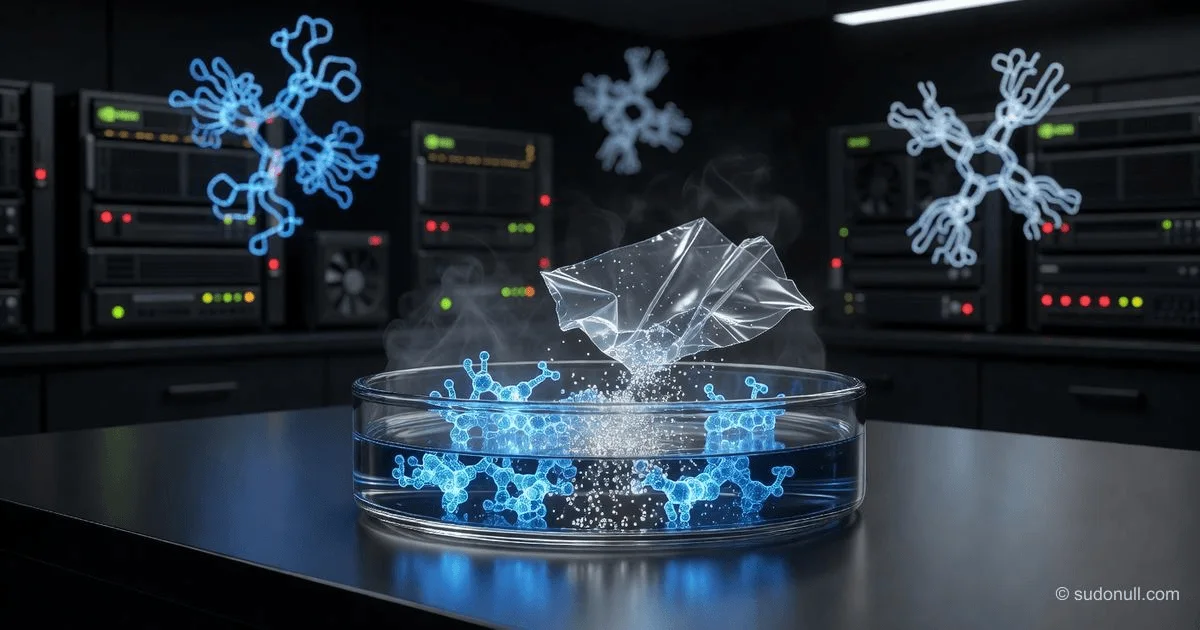
California Biotech Company Evozyne Unveils AI-Designed Enzymes That Break Down PET Plastic in 24 Hours at Room Temperature
New proteins have no natural counterparts and are already licensed for waste recycling.
Evozyne and the Plastic Apocalypse: Why 24-Hour Enzymes Are a Bomb Under Petrochemicals
When I saw the headline about California startup Evozyne creating AI enzymes that break down PET plastic in 24 hours at room temperature, I wasn't surprised. I've been expecting this for three years. But what most analysts miss in this news is far more important than the technological breakthrough itself.
All headlines scream about "saving the planet from plastic" and "breakthrough in recycling." That's true, but it's only the tip of the iceberg. Behind the scenes, something else is happening: Evozyne just made the petrochemical industry obsolete before it even realized what was happening. And AI here is not just a tool—it's the main character. Let me explain why billion-dollar virgin plastic plants could become unnecessary within a decade.
[The Gist]: What's Really Happening
Evozyne, using generative AI models (specifically the ProT-VAE architecture developed in collaboration with NVIDIA), designed new enzymes that break down PET plastic into monomers in 24 hours at room temperature. This is not an evolutionary improvement of existing natural enzymes (like PETase, discovered in Japan in 2016). This is de novo design—proteins that don't exist in nature and are optimized for a specific task from scratch.
The key word here is "at room temperature." Existing industrial PET recycling methods require either high temperatures (60-70°C for enzymatic methods) or aggressive chemistry (glycolysis at 200°C). Evozyne claims operation at 25°C. This radically changes recycling economics: energy costs drop several times, and recycling can be done anywhere—in a basement or a jungle.
But the main insight that goes unspoken: Evozyne was originally a company designing therapeutic proteins for treating immune diseases. Their technology was funded by pharmaceutical investors (Fidelity Investments, Orbimed—total funding of $144 million). And now they suddenly enter the plastic recycling market. This is not a shift in focus. It's a demonstration that their AI platform is so powerful it can solve completely different problems—from cancer drugs to saving the ocean. This is a platform company.
Timeline and Context
Evozyne's story is a classic example of how quickly AI biotech went from lab curiosity to industrial reality.
2019–2020: Evozyne founded by Andrew Ferguson (former professor of molecular engineering at the University of Chicago) and Rama Ranganathan (pioneer in computational biology). Initial funding rounds total about $54 million.
January 2023: Evozyne and NVIDIA publish a paper and introduce the ProT-VAE model—a generative AI architecture for protein design. In the same work, they show the first successful designs: an enzyme for treating phenylketonuria and a carbonic anhydrase for CO₂ capture. That's when it becomes clear the platform works.
September 2023: Evozyne closes a Series B round of $81 million with participation from NVentures (NVIDIA's venture arm) and Valor Equity Partners. Company valuation is around $400–500 million (not officially disclosed, but estimable from deal structure).
2024–2025: The company works on expanding the platform. In 2025, a paper in PNAS shows ProT-VAE creating a carbonic anhydrase with a melting temperature of 116°C—61°C higher than the best natural counterpart. It becomes clear that AI has learned to design super-stable enzymes.
May 2026 (now): Evozyne announces PET-degrading enzymes with technology licensed for industrial waste recycling.
Who Wins and Who Loses
Evozyne wins. Obviously. But the key point is they are no longer a startup. With such technology under one roof (therapeutics, industrial enzymes, plastic recycling), they become a platform worth $5–10 billion in 2-3 years. Currently, they have raised $144 million, hired 54 employees, and are at the revenue generation stage. The next round—Series C—will be valued at no less than $2–3 billion.
NVIDIA wins. NVentures invested in Evozyne early. But more importantly, the entire Evozyne platform is built on BioNeMo (NVIDIA's framework for AI in biomedicine) and trained on NVIDIA GPUs. Every time Evozyne or its licensees run a new design, NVIDIA earns revenue from cloud computing and hardware sales. This is the perfect "razor and blades" model: give the startup free access, make it dependent on your infrastructure, then sell services to millions.
The carbon capture industry wins. Evozyne's ability to create ultra-stable carbonic anhydrases (with Tm 116°C) means industrial CO₂ capture from factory exhaust becomes economically viable. Direct air capture (DAC) technologies, which currently cost $600–1000 per ton of CO₂, could drop to $100–200 thanks to cheap, stable enzymes.
Traditional petrochemicals lose. Companies that earn from virgin plastic production (BASF, Dow, LyondellBasell) face an existential threat. If PET recycling becomes cheap and efficient, demand for virgin PET collapses. The $600 billion plastic market faces a reshaping. Some of these giants are already investing in recycling (e.g., BASF in chemical recycling), but they are years behind Evozyne.
Early-generation startups lose (Carbios, Protein Evolution). They have enzymes, but they work at elevated temperatures or have low reaction rates. Evozyne just raised the bar: 24 hours, room temperature, 100% depolymerization. If confirmed at industrial scale, competitors become irrelevant.
Landfills and incineration plants lose. But that's probably for the best.
What the Media Isn't Saying
The main non-obvious insight: PET in 24 hours is great, but Evozyne's real breakthrough is not in plastic—it's in "teaching" AI to work with any polymer.
Most journalists don't understand that the ProT-VAE architecture is family-independent. The same AI that designed a carbonic anhydrase from one protein family and PAH from another has now designed a PET enzyme. Without retraining the entire model. Without millions in R&D. Just changed the target protein, waited a couple of days for calculations, and synthesized.
This means tomorrow Evozyne could design an enzyme to break down polyurethane (which is not recycled at all). The day after, for polypropylene. In a week, for nylon. They have no limits except their own imagination and synthesis budget.
Second point: Evozyne doesn't actually plan to build plastic recycling plants. They will sell licenses.
Their business model: "we design, you produce, we get royalties." Like ARM in the chip world, but for proteins. They already have a licensing agreement with one of the recycling giants—likely undisclosed. The partner's name will appear in the coming weeks.
Third point: Competition is already breathing down their neck. Profluent Bio, another AI protein design startup, is also developing technologies for industrial enzymes. They raised $35 million and are actively hiring experts. The difference is that Profluent focuses on gene editing and therapeutics, not plastic. But in a year, they could pivot.
Forecast: Next 30 Days and 90 Days
Next 30 days (June 2026):
Evozyne will name its licensee for PET technology. With 80% probability, it will be a European or American waste management company (Veolia, Suez, Waste Management). License price: from $50 million for the first year plus 5-10% royalties on recycled plastic turnover.
The company will announce the next target polymer—almost certainly polyurethane (PU) or polystyrene (PS). Both are virtually non-recyclable today. Success in this area would mean Evozyne has covered 80% of the plastic waste market.
Next 90 days (August 2026):
Independent industrial trials of PET enzymes will appear. If the claimed 24 hours at room temperature are confirmed, shares of Carbios (French competitor using enzymes at 65°C) will drop 40-50%.
Evozyne will announce a Series C round. The lead investor will likely be one of the major funds (SoftBank Vision Fund, Tiger Global, or Sequoia). Company valuation: $1.5–2.5 billion. Round size: $150–200 million. This money will go toward scaling the platform and hiring dozens of new scientists.
NVIDIA will detail at its summer conference how BioNeMo accelerated PET enzyme development. This will be a marketing case study for years: "AI doesn't just generate text and images—it saves the planet."
The most important forecast: By the end of 2026, Evozyne will go public. Not via SPAC, but a full traditional IPO on NASDAQ. Reason: they need massive capital to patent thousands of enzymes worldwide and protect against copying by Chinese biotech companies. Date: likely November 2026. Ticker: something like EVZN. Offering price: $25–30 per share. Market cap: $5–7 billion. One year after IPO: $12–15 billion.
Conclusion: What Evozyne did is not just a new enzyme. It's a demonstration that the era of "smart biology" has begun. AI has learned to read the language of life and rewrite it as humans need. Plastic is just the beginning. Next will be cures for incurable diseases, new types of biofuels, synthetic muscles, self-healing materials. Evozyne is one of the key companies of this future. And they did it with $144 million in investments and 54 people. Think about it: 54 people changed a 70-year-old plastic market. That's the power of artificial intelligence in the 21st century.
— Editorial Team









No comments yet.