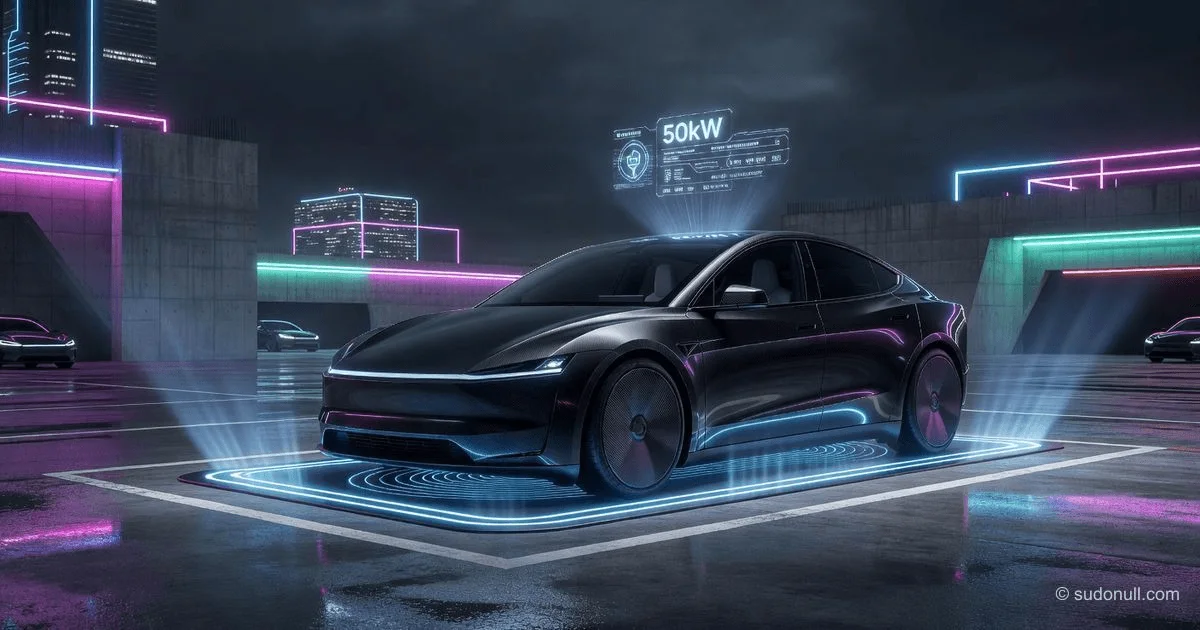
Tesla Unveils 50 kW Wireless Charging Prototype for Electric Vehicles
Tesla has announced a 50 kW wireless charging technology for electric vehicles that does not require precise parking.
Tesla's 50 kW Wireless Charging: The Quiet Death of Robotic Arms and the Birth of Energy Feudalism
[The Gist]: What's Really Happening
When Elon Musk shows off a 50 kW wireless charging prototype that "doesn't require precise parking," the naive observer rejoices at the disappearance of dirty cables and the convenience for EV owners. The insider sees something far more alarming and simultaneously promising: Tesla has just buried the multi-billion-dollar robotic charging system market and announced a shift to a model of "energy feudalism," where charging infrastructure becomes an extension of your car rather than a public good.
Note the key detail that the media completely ignores: 50 kW is not just a number. It's a magic threshold that turns wireless charging from a garage toy into a tool for commercial fleets. At this power, a Tesla Model Y with a 75 kWh battery charges from 20% to 80% in about 54 minutes—almost like a regular urban charger. But Tesla doesn't need hours. They need 15-minute windows between robotaxi trips.
The US Federal Communications Commission (FCC) granted Tesla a key permit in February 2026 to use ultra-wideband (UWB) for alignment with the charging pad. This technology determines the car's position with centimeter accuracy at distances up to 10 meters. Without this permit, Tesla could not place charging pads outdoors—the FCC usually allows UWB only for portable devices, not stationary infrastructure. Musk secured an exclusive permit while WiTricity and Qualcomm struggle with Chinese counterparts.
But the real essence isn't technical. Tesla is building not just a charger, but a system of total control over energy flow. When the car automatically parks over the pad, the system doesn't just transfer energy—it authenticates via UWB, checks battery status, and transmits telemetry. Essentially, it's an extension of the Tesla ecosystem into every parking spot where you park your Cybertruck or Cybercab.
Timeline and Context
The official timeline begins with a February event: the first production Cybercab rolled off the assembly line in Austin, Texas. Simultaneously, the FCC approved Tesla's application to use UWB for charging pad alignment. But preparations had been underway since 2024—at the "We, Robot" event, Musk first stated that the Cybercab would charge wirelessly.
In March 2026—right now—Tesla unveiled a prototype that reportedly delivers 50 kW at the input. Why is this important? Because earlier demonstrations featured 19 kW and 25 kW. The jump to 50 kW means Tesla has solved the heat dissipation problem that has plagued wireless charging for a decade. Musk's engineers used active liquid cooling technology similar to that used in 4680 cells and V4 Supercharger connectors.
The context also includes recent failures by competitors. WiTricity—the market leader with up to 11 kW—has yet to surpass 25 kW without overheating. The Qualcomm Halo project died back in 2022. BMW's 3.2 kW system for the i3 remained a niche. And Chinese startups like Anjie Wireless Technology are only now approaching 20 kW. Tesla simply left everyone in the dust.
It's also important to understand that the FCC allowed UWB with a condition: the system activates only for a short time when the car approaches. This solved the interference problem that previously prevented wireless charging in dense urban areas. Tesla has achieved an exclusive regulatory advantage—and it's here to stay.
Who Wins and Who Loses
Tesla wins—and not just from selling chargers. The company gains the ability to fully automate fleet servicing for its robotaxis. The Cybercab, which has no steering wheel or pedals, can now pull up to a charging pad without a human. Savings on charging station operator salaries for a fleet of a million cars amount to billions of dollars per year. Plus, Tesla will sell these pads to hotel chains and parking lots, turning infrastructure into a recurring revenue stream (likely $5,000–8,000 per pad).
The human driver wins in the long run. Imagine: you arrive at a mall parking lot, leave your car, and it parks itself in the right spot and charges without your involvement. Musk previously mentioned 25 kW for consumer cars, but if 50 kW proves stable, it will shift people from "I need to find an outlet" to "the car does everything itself." And that's the key to mass EV adoption.
WiTricity and the entire stationary inductive charging market lose. WiTricity has been selling the dream of wireless charging for a decade, but progress has stalled—maximum power 11–22 kW, pad cost around $2,500, and requiring precise parking within 10 cm. Tesla arrives with 50 kW, a UWB alignment system that tolerates up to 30 cm deviation, and a price that will likely be lower due to economies of scale. WiTricity will either slash prices or retreat to a B2B niche for buses.
Momentum Dynamics and Electreon lose. These companies were building dynamic wireless charging—where cars charge while driving on the road. It's expensive (millions of dollars per kilometer of road) and technically complex. Tesla has proven that high-power static wireless charging solves 90% of fleet needs at a fraction of the cost of dynamic infrastructure. Electreon, which only recently ran pilots in Tel Aviv, now looks like a solution in search of a problem.
The NACS ecosystem as we know it loses. Yes, the NACS connector will remain for ultra-fast charging. But for overnight or office parking, the wired connector will become an anachronism. This means cable, connector, and plug manufacturers—TE Connectivity, Amphenol, Phoenix Contact—will lose a huge market segment.
What the Media Isn't Saying
The main non-obvious insight that Western media completely misses concerns a hidden monopoly on land and energy distribution. Tesla's UWB system doesn't just locate the car—it links each specific car to a specific charging pad via unique digital keys. The owner of a charging pad (hotel, mall, municipality) cannot simply buy a cheap Chinese knockoff and install it. Because Tesla retains control over the authentication protocol.
This means that if you want to offer wireless charging for Teslas in your parking lot, you must either buy the pad from Tesla, pay licensing fees, or your customer will get a message: "Charging pad not certified, charging limited to 5 kW." Essentially, Tesla is pulling an Apple MFi certification trick, but in the energy world. It's legally brilliant and commercially devastating for competitors.
The second omission: thermal losses and real-world efficiency. Tesla claims efficiency "significantly above 90%." But this figure is achieved under ideal alignment and 20°C temperature. In summer on a sun-baked parking lot where the ground heats to 50–60°C, efficiency could drop to 75–80%. At 50 kW, that means 10–12 kW of heat to dissipate. In the Cybertruck or Cybercab, Tesla engineers can use the battery cooling loop to remove this heat. But what about the charging pad? It will need its own active cooler. That means noise, dirt, and a failure point. The media simply copy the press release without questioning practical thermodynamics.
The third, and most cynical: politics and lobbying. The FCC granted Tesla permission not because the technology is so wonderful, but because Tesla is an American company and the administration sees it as a strategic asset in the race against Chinese BYD and Xiaomi. The Chinese have already shown wireless charging prototypes at 40 kW, but they lack such political lobbying at the FCC. Tesla has gained a 12–18 month head start in the US market. During that time, it can install its pads in thousands of parking lots, creating a de facto standard. This is not a technological breakthrough—it's pure trade protectionism.
Forecast: Next 30 Days and 90 Days
Next 30 days (June 2026). We'll see the first wave of "independent" tests of the 50 kW prototype. Most likely, Tesla will organize them itself, but invite "neutral" bloggers like Marques Brownlee (the same one who bet Musk a shaved head on the Cybercab price being under $30,000). Bloggers will confirm 92–94% efficiency and no heating issues—under ideal lab conditions. WiTricity shares (if they go public) will drop 10–15%. Momentum Dynamics will start publicly questioning UWB safety for health—the first sign of competitor panic.
Also within 30 days, Tesla will announce its first major partner for installing charging pads. Likely candidates: Marriott hotel chain or parking operator SP Plus. Tesla won't build everything itself—it will sell 5,000 pads at an introductory price of $6,000 each, earning $30 million and setting a precedent.
Next 90 days (August–September 2026). The first scandals will emerge. Cybertruck owners who buy pads for their garages will discover that with imperfect alignment (e.g., after the wife parks), efficiency drops to 70%, and electricity bills rise because the meter counts input power, not what reaches the battery. Tesla will release a firmware update adding a "spouse" mode—lower power but higher tolerance for parking error.
Also within 90 days, the CCS (Combined Charging System) consortium—Europe's equivalent of NACS—will panic and announce its own wireless charging standard at 40 kW. But this will be purely political: real chips and cooling won't appear before 2028. Chinese BYD will likely show its answer—60 kW wireless charging with lidar-based alignment (instead of UWB). Lidar is more expensive but more accurate. The race enters a new phase.
By September, Tesla will also receive orders from municipal bus depots in California and Texas. 50 kW is enough for a city bus with a 200–300 kWh battery overnight. And if buses switch to wireless charging, it will signal the entire commercial transport market.
Bottom line: don't look at the kilowatts. Look at regulatory approvals and licensing policies. Tesla hasn't invented a perpetual motion machine. It has created an ecosystem tollbooth that everyone wanting to charge wirelessly must pay. The only question is the toll price. And don't confuse 50 kW with 250 kW Supercharger—they're different stories. The former is for "sleepy" charging at home or the office. The latter is for long trips. Wireless charging doesn't kill wired charging. It just makes it a niche for travelers, not for everyday use. And that changes the infrastructure market forever.
— Editorial Team
No comments yet.