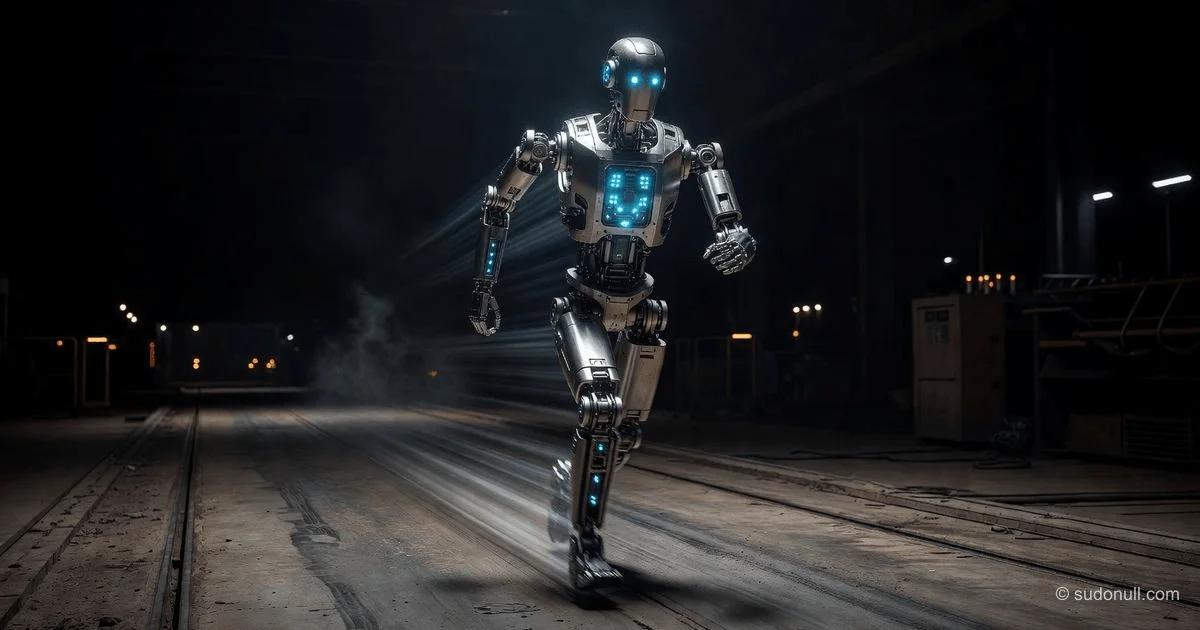
China's Deep Robotics Unveils Humanoid Robot Dr.01 with Record Running Speed
Chinese startup Deep Robotics has introduced a humanoid robot, Dr.01, which achieves a running speed of 12 km/h and maintains stability under external disturbances.
Humanoid Robot DR01 from Deep Robotics: A Silent Killer from China or Just 'Another Prototype'?
[The Core]: What's Really Happening
At first glance, the news that Chinese startup Deep Robotics has shown a humanoid robot, Dr.01, with a running speed of 12 km/h looks like another flashy but insignificant release from the 'Middle Kingdom.' Over the past two years, we've seen dozens of dancing, running, and even backflipping machines. However, digging deeper, this event is a perfect marker of a paradigm shift in the industry. It's not about a 'breakthrough' in speed, but about Deep Robotics, a veteran in the quadruped robot market, betting on what most Western companies ignore: industrial reliability, not showmanship.
The real essence is that Dr.01 is not a final product but a so-called 'embodied intelligence explorer.' This is a smart move in both marketing and engineering. While Boston Dynamics has spent years trying to monetize its reputation as the 'king of stunts,' and Tesla promises a robot for $20,000, the Chinese simply did what they do best: adapted their developments from quadruped platforms (Jueying X20) to bipedal locomotion.
Look at the numbers. 12 km/h is about 3.3 m/s. That's not a record, considering Unitree H1 has run faster, and Tesla Optimus Gen 3 (rumored) runs up to 8 km/h. But 12 km/h at a mass of 80 kg while maintaining stability under impacts indicates excellent proprioceptive sensor performance. Deep Robotics claims the robot maintains balance on slippery surfaces and under external pushes thanks to 'fusion perception.' In other words, they integrate joint state data (internal body awareness) with external sensors into a single trainable algorithm. This isn't new; it's already standard, but the Chinese were the first to admit that without tight integration with real physical data (big data training), a robot is just a pretty toy.
Timeline and Context
Media now write as if Dr.01 appeared out of nowhere. In reality, Deep Robotics' history spans nearly a decade. The company was founded in 2017 in Hangzhou, and until 2024, it was known exclusively for its Jueying series of quadruped robots, actively sold for industrial inspection and rescue operations worldwide, including Singaporean power plants.
The first public showing of Dr.01 took place on August 21, 2024, at the World Robot Conference in Beijing. Why are we discussing it now? Because the current 'leak' or 'promotional wave' is timed to the start of field trials of the prototype in industrial conditions. Deep Robotics has never been a fairy-tale company. They remained silent for almost two years, refining the 12 degrees of freedom (DoF) of Dr.01, until October 2025, when they announced Dr.02 with 31 DoF and IP66.
What we are seeing now is the 'swan song' of the first generation. The company is deliberately leaking data on Dr.01's speed and stability to the press to prepare the market for the release of Dr.02, which will cost around $200,000 (according to AI Wiki estimates). This is a classic strategy: kill the old dragon to show the new one. Currently, Dr.01 is an excellent testbed for refining fusion perception algorithms before launching the commercially successful Dr.02.
Who Wins and Who Loses
Wins primarily the industrial automation sector in China. The Middle Kingdom's government programs promoting robotics are bearing fruit. Deep Robotics is a beneficiary of this trend. Having a working (albeit slow) humanoid with a gearbox based on J100 (torque up to 315 Nm) allows Chinese factories to test scenarios that the US and Europe are only simulating.
Also wins Unitree Robotics. Competition forces them to accelerate. The emergence of Dr.01 (and the upcoming Dr.02) puts pressure on the price segment. Although the Unitree G1 is cheaper ($16,000), its functionality is closer to a toy for enthusiasts, while Dr.01 is a serious workhorse at $200,000. This expands the market: a layer appears between cheap mass-produced goods from China and the prohibitively expensive Atlas from Hyundai ($150,000+).
Loses unequivocally Boston Dynamics. Their electric Atlas is a technological monster (56 DoF, 360° joint rotation), but it's still an 'exclusive' for Hyundai labs. Deep Robotics is encroaching on the same territory but with military discipline in terms of cost. While Boston Dynamics seeks partners among chip manufacturers and spends millions on research, Deep Robotics already has a ready supply chain for J60/J100 from China.
As for Tesla, Optimus remains out of competition in terms of scalability (Tesla bets on volume and a price of $20,000-30,000). Dr.01 is not its competitor. The competitor will be the production Dr.02 if Deep Robotics can reduce the price to $50,000-70,000 in a couple of years.
What the Media Aren't Saying
The most non-obvious insight, completely ignored by global media, concerns energy efficiency and thermal regulation. Dr.01's specifications indicate an operating time of about 2 hours. This is negligible compared to Tesla Optimus Gen 3 (claimed up to 12 hours) or Agility Digit.
Why is this important? Because 2 hours is a death sentence for real industry. No factory will buy a robot that needs recharging every 2 hours. This means Deep Robotics' 'breakthrough' is purely laboratory. Their 12 km/h is likely achieved at maximum power consumption, and the cooling system in the J60 and J100 joints is not yet optimized.
What does this really mean? Deep Robotics deliberately sacrificed battery life to demonstrate dynamics. This is a marketing trick to attract investment for the Dr.02 series, which will likely feature a higher-capacity battery (possibly solid-state, as the Chinese have just started mass production this year).
The second omission: lack of hands. The Dr.01 (2024 version) has virtually no manipulation capabilities. Specifications indicate 12 DoF, but almost all are in the legs. There is no mention of high-dexterity hands. It's just a 'walking platform.' While Atlas or Figure 03 handles parts, Deep Robotics is teaching its robot simply not to fall under impacts. This is a gap in high-level control technologies. And the media downplay this, focusing on 'record speed.'
Forecast: Next 30 Days and 90 Days
Next 30 days: We will see a wave of analytical reviews from Chinese state media praising Dr.01 as a national achievement. Western outlets (TechCrunch, The Verge) will publish a couple of notes labeled 'fast but raw.' Deep Robotics will invest in a PR campaign before closing another funding round (Series C). Expect videos of Dr.01 running on rough terrain with a 15 kg load—this will be the last 'trump card' before the Dr.02 announcement.
Next 90 days: The situation will change dramatically by October-November 2026, when Deep Robotics officially presents the commercial version of Dr.02 (announced back in 2025 but not shown to the public). Dr.02 will have 31 degrees of freedom, full hands, IP66, and likely a price in the range of $150,000 – $250,000. Dr.01 will quietly fade into the background as an 'experimental prototype.' Its value now is not sales, but data collection for neural networks.
If the forecast holds, by the end of 2026 we will see a real three-way battle: Atlas (US/Korea) for premium heavy industry ($150k+), Tesla Optimus for mass production ($20-30k), and Deep Robotics/Unitree for the mid-range ($50-100k) in Asia.
Bottom line on Dr.01: don't be fooled by the speed. The most interesting thing is how quietly the Chinese integrate AI training into hardcore mechanics. Dr.01 is just a blueprint of what we will see in 2027. And that blueprint already looks more dangerous than it seems at first glance, especially given the support of the Chinese government, which spares no expense on 'embodied AI.'
— Editorial Team









No comments yet.