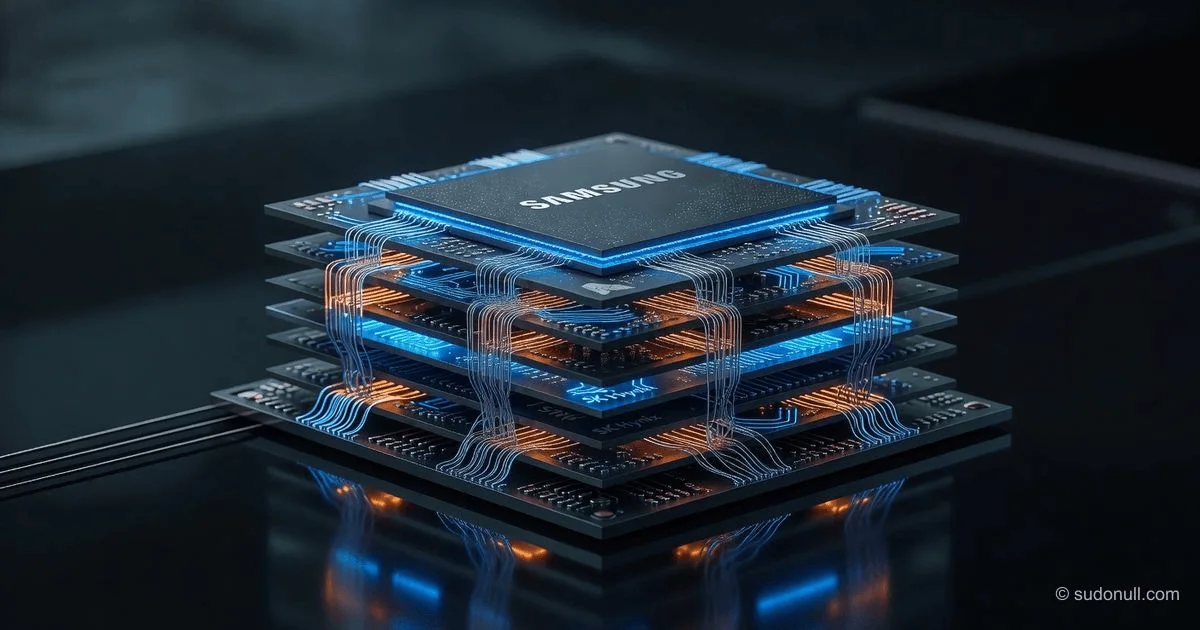
Samsung and SK Hynix Begin Mass Production of HBM4 Chips for NVIDIA AI Accelerators
South Korean giants Samsung and SK Hynix have announced the start of mass production of next-generation HBM4 memory chips for NVIDIA AI accelerators.
HBM4 from Samsung and SK Hynix: Who Actually Pays $700 per Chip and Why NVIDIA Isn't Happy
[The Gist]: What's Really Happening
If you think the news about the start of mass production of HBM4 is a story about a technological breakthrough, you're wrong. It's a story about how South Korean giants have stopped being mere suppliers and turned into the main price dictators in the AI hardware supply chain. Samsung has already started shipping chips at around $700 each — 20-30% more expensive than HBM3E and 40% higher than what SK Hynix planned just six months ago.
The real essence of what's happening is not the 3.3 TB/s bandwidth or even the 40% improvement in energy efficiency. What matters is this: demand for HBM4 is so insane, and NVIDIA is so dependent on the Koreans, that SK Hynix can afford to slow down HBM4 production expansion in Q3 2026 because it's more profitable for them to keep selling HBM3E, which has already paid off completely.
Notice the hidden dynamics: NVIDIA demands speeds above 11 Gbps per pin — higher than the JEDEC standard. Because of this, all three manufacturers (Samsung, SK Hynix, and Micron) were forced to redesign their chips, pushing mass production to the end of Q1 2026. This is not a triumphant march but a frantic race where NVIDIA has already agreed that it will only get access to HBM4 by summer, meaning the Rubin platform announcement at GTC 2026 (March 16-19) will be a beautiful presentation without real shipments.
Timeline and Context
The official timeline looks neat: Samsung announced mass production and shipment on February 12, 2026. But the real story started earlier. Back in late 2025, NVIDIA suddenly raised HBM4 requirements to 11+ Gbps, breaking all plans. SK Hynix, Samsung, and Micron sent chips back for redesign. As a result, Samsung, which reportedly passes validation without redesign thanks to its 1c DRAM and 4nm logic base die, came out ahead.
Why does this matter? Because the memory market is in a unique situation right now. Prices for regular DRAM have skyrocketed: server DDR5 has nearly doubled in two quarters, and the margin on regular DRAM has temporarily exceeded that of HBM. Samsung is already converting 30-40% of its 1a DRAM production capacity back to regular memory because that's where the money is now.
This flips the usual logic. It's generally assumed that HBM is a premium product with the highest margins. In Q1 2026, that's not the case. Operating profit on 12-layer HBM3E is about 30%, while on regular DRAM it's over 60%. That's exactly why SK Hynix officially postponed HBM4 capacity expansion to Q3 — it's simply not profitable to rush while Blackwell with HBM3E continues to sell like hotcakes.
Who Wins and Who Loses
Samsung wins — and that's the main intrigue. After the failure with HBM3 and HBM3E, where Samsung hopelessly lagged behind SK Hynix, now they can make a comeback. Samsung was the first to start commercial shipments of HBM4, its chip runs at 11.7 Gbps, and it has already passed validation with NVIDIA and AMD without needing a redesign. Moreover, Samsung integrated a custom 4nm logic layer into HBM4, allowing part of the memory controller to be placed directly on the HBM stack, freeing up space on the GPU for compute units. This is a strategic advantage that will allow them to eventually capture up to 30-40% of the HBM4 market.
NVIDIA wins, but with caveats. On one hand, HBM4 delivers 22 TB/s bandwidth in the VR200 NVL72 system — enough to compete with the AMD Instinct MI455X, which has 19.6 TB/s. On the other hand, production delays mean real Rubin shipments won't start until late summer. NVIDIA is currently aggressively buying HBM3E to fill the gap, creating a shortage in the old chip market.
Micron loses. The American manufacturer is once again playing catch-up. Although their HBM4 is already in mass production, they lag behind the Koreans in validation pace. According to TrendForce forecasts, in 2026 Micron will hold only 22% of the HBM market, compared to 50% for SK Hynix and 28% for Samsung. That's not fatal, but being the "eternal third" in a growing market means billions of dollars in lost profit.
Small cloud providers and startups lose. Not because they won't get HBM4 — they won't even see it. All initial HBM4 batches go to specific contracts with NVIDIA and possibly Broadcom/Google. There is no spot market for HBM4. If you're not one of the hyperscalers with a direct contract for tens of thousands of GPUs, you'll be waiting for HBM3E for at least another year.
What the Media Isn't Saying
The most non-obvious insight, completely ignored in headlines, concerns pricing and the hidden "tax" burden on data centers. Samsung is negotiating a price of around $700 for a 12-layer HBM4 chip. Each Blackwell/Rubin GPU uses 6-8 such chips. That means memory alone on one accelerator costs $4,200-5,600. And the full VR200 NVL72 system contains 72 GPUs — that's over $300,000 just for HBM4 memory.
But that's just the beginning. SK Hynix has developed cHBM (custom HBM) technology, where the HBM base die houses not just a buffer but actual logic — parts of the memory controller and even PHY. What does this mean in practice? It means NVIDIA can move some circuitry from the GPU to the HBM, freeing up die area for additional cores. But it also means custom HBM will cost even more — and Samsung has already announced custom HBM samples for 2027.
The media isn't reporting the main point: HBM4 sets a precedent where memory becomes not just a component but an "intelligent" coprocessor with its own added value comparable to the GPU itself. In the long term, this means the share of memory cost in total server cost will rise from the current 15-20% to 30-40% by 2028. Whoever controls HBM controls the real cost of AI infrastructure.
And one more omission: Chinese HBM manufacturers exist, but they are not talked about. CXMT and JHICC are actively developing their own HBM production to support Chinese AI chips. They are not yet competing on the global market, but for China's domestic market, this means reduced dependence on the Koreans. And if in the next two years they reach the HBM4 technology level — and China's political will is directed toward that — the three-polar memory world could become four-polar.
Forecast: Next 30 Days and 90 Days
Next 30 days (June 2026). The main event is GTC 2026 (March 16-19, but results and demos will come in late May-June). NVIDIA will officially show the Rubin platform with Samsung's HBM4 on board, but without announcing real shipment dates. Samsung and SK Hynix will publish their Q1 financial reports, showing that regular DRAM margins are still higher than HBM, causing mild panic in the market — analysts will start asking uncomfortable questions about whether the HBM market is overheated. The price for 12-layer HBM4 will settle around $650-700, and SK Hynix will match Samsung's price.
Next 90 days (August-September 2026). By then, SK Hynix will begin real HBM4 capacity expansion, which they postponed to Q3. First shipments of 16-layer HBM4 with 48GB capacity will start — most likely from SK Hynix, which already showed such modules at CES 2026. This will be a new round of the race: 48GB per stack enables GPUs with 288-384GB of memory, paving the way for full-scale LLM inference with millions of tokens of context on a single accelerator.
By September, it will also become clear whether Samsung can maintain its lead. If their 1c DRAM at 11.7 Gbps proves stable in real Rubin systems, they could increase market share to 35-40% by year-end. If heat dissipation issues arise — always Samsung's Achilles' heel in HBM — SK Hynix will quickly regain dominance.
Bottom line: don't look at speeds and names. Look at prices and who sets the terms. Right now, HBM4 is a pure seller's market, and the Koreans are exploiting it 100%. The only question is how long NVIDIA will tolerate $700 per memory chip before actively investing in alternatives like in-house development or Chinese suppliers.
— Editorial Team









No comments yet.