
 April 21, 2014 at 01:20
Quixter's new Pay-By-Palm biometric electronic payment technology scans your veins
Cashless payments using an NFC - enabled phone are a common payment method. However, today there is another, alternative and simplified technology for electronic payments - a biometric identifier. This system uses the user's palm to make the payment, or rather, the configuration of the veins in the palm of the hand.
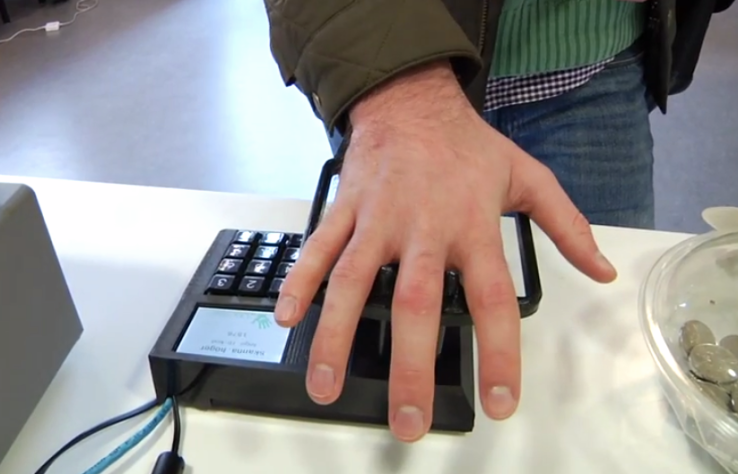
The author of the idea of the Swedish startup Quixter is Fredrik Leyflend, a student at the engineering department of Lund University, who wanted to come up with a faster system for making card payments without having to carry a lot of cards and everything else.
Quixter uses palm vein scan technology to identify the person making the payment. This technology is based on the uniqueness of each person’s vein configuration, to which a bank account is linked. “We are currently working with all major Swedish banks,” says Leyfland.
Palm vein scanning technology alone is not new. For several years, it has been used in ATMs of Japanese banks (as well as other countries) as a way to provide additional security for large transactions. However, Leyfland claims that his idea is an innovation in the market, since no one has yet launched a payment system using the user's palm. Many companies are striving to develop such a technology, but so far there is none on the market.
In essence, the advantage of the Quixter palm scanning system is that it allows you to make a payment without having to have physical money or payment cards, as well as an NFC phone.
The second advantage of the system is security. According to Leyfland, it is impossible to commit fraud with such a system, apart from, of course, cases when you can force someone to buy something by forcibly placing his palm in his hand to the identifier.
So far, this is a moot point whether the Quixter palm scanning system is faster than the credit or debit card payment system, since this system also asks the user to enter the last four digits of his phone number, and then put his hand to the terminal for scanning. So, this is not a one-step payment process.
However, the numbers of the phone number were apparently added in part to slow down the process so that the user had time to see how much he was paying - in order to avoid overpayments before the user realized that he was being robbed.
The Quixter system currently operates in approximately 15 locations on the Lund University campus and serves approximately 1,600 users (primarily students).
As is the case with NFC, to enter the mass market of a palm-based payment system, a significant number of retail transactions will be required. Therefore, focusing on small communities, like campuses, is entirely appropriate. However, it is possible that the deployment of the system may occur in the short term.
If you want to be the first to know about the latest medical and fitness gadgets, follow the news of the company, subscribe to our pages on social networks. You can subscribe on our blog page , on Twitter , join our group on
  Vkontakte and on
  Facebook . New gadgets and fitness devices in our online store Medgadgets.ru .
The author of the idea of the Swedish startup Quixter is Fredrik Leyflend, a student at the engineering department of Lund University, who wanted to come up with a faster system for making card payments without having to carry a lot of cards and everything else.
Quixter uses palm vein scan technology to identify the person making the payment. This technology is based on the uniqueness of each person’s vein configuration, to which a bank account is linked. “We are currently working with all major Swedish banks,” says Leyfland.
Palm vein scanning technology alone is not new. For several years, it has been used in ATMs of Japanese banks (as well as other countries) as a way to provide additional security for large transactions. However, Leyfland claims that his idea is an innovation in the market, since no one has yet launched a payment system using the user's palm. Many companies are striving to develop such a technology, but so far there is none on the market.
In essence, the advantage of the Quixter palm scanning system is that it allows you to make a payment without having to have physical money or payment cards, as well as an NFC phone.
The second advantage of the system is security. According to Leyfland, it is impossible to commit fraud with such a system, apart from, of course, cases when you can force someone to buy something by forcibly placing his palm in his hand to the identifier.
So far, this is a moot point whether the Quixter palm scanning system is faster than the credit or debit card payment system, since this system also asks the user to enter the last four digits of his phone number, and then put his hand to the terminal for scanning. So, this is not a one-step payment process.
However, the numbers of the phone number were apparently added in part to slow down the process so that the user had time to see how much he was paying - in order to avoid overpayments before the user realized that he was being robbed.
The Quixter system currently operates in approximately 15 locations on the Lund University campus and serves approximately 1,600 users (primarily students).
As is the case with NFC, to enter the mass market of a palm-based payment system, a significant number of retail transactions will be required. Therefore, focusing on small communities, like campuses, is entirely appropriate. However, it is possible that the deployment of the system may occur in the short term.
If you want to be the first to know about the latest medical and fitness gadgets, follow the news of the company, subscribe to our pages on social networks. You can subscribe on our blog page , on
Twitter , join our group on Vkontakte and on Facebook . New gadgets and fitness devices in our online store Medgadgets.ru .