April 9, 2014 at 13:29
Sound on an AY-3-8910 chip (or Yamaha YM2149F) hails from the ZX Spectrum on a PC via an LPT port
 I didn’t have a Spectrum in my childhood, so I knew little about its musical capabilities with an additional musical “coprocessor”, as the Yamaha AY-3-8910 three-channel oscillator chip is sometimes called .
 Comparatively recently, a Spectrum-compatible computer still appeared, but it was a Spectrum-48 clone, without a music chip. Well, all the better, I thought, there is room for creativity - you can increase memory, you can screw a drive, and of course, an important improvement is to put a music chip. A pair of YM2149F chips were ordered from China :
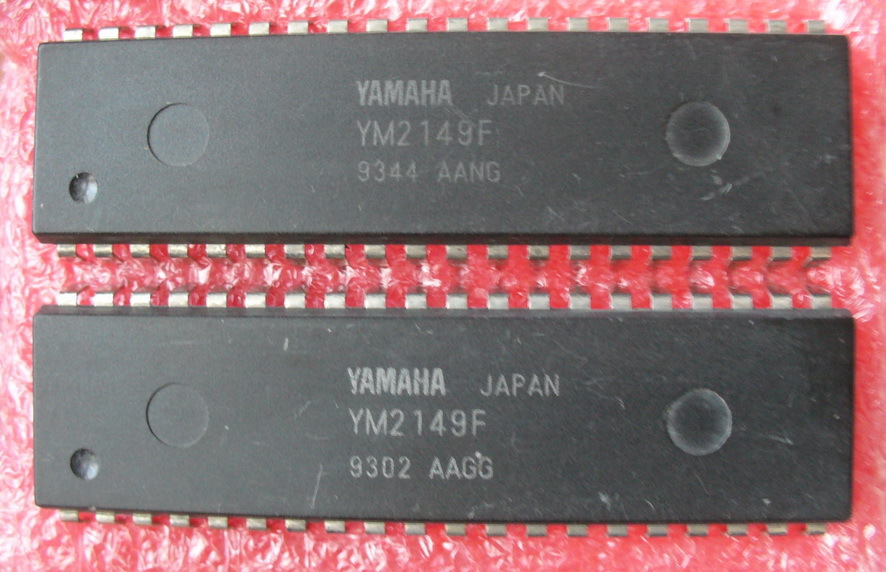
Why they are, I don’t remember now, maybe they are cheaper than AY-3-8910, maybe they were just available at that moment. In general, it is an analogue of AY-3-8910, it does not differ in pinout, differs in bit depth of the envelope, and because of this, the melodies sound a little differently (sound timbre). I thought that this was not so important for me. Will play - and that is joy. Why ordered a pair? Well, one in the Spectrum, and one in reserve, in case of marriage at the first, or my crooked hands when connected. And so they arrived, and while I was thinking about the PCB layout for the Spectrum, I wanted to somehow check the chips. And then I came across old projects of connecting these microcircuits to the LPT port of the computer.
Demo
You can listen to the sound of the finished device here: soundcloud.com/tronix286 . There are also “experimental” recordings made during debugging of the device, and therefore the quality of such recordings is not impressive. But a general idea of the "sound" should give.
Iron
Here are some of the schemes for connecting the AY-3-8910 to the LPT port of a computer that can be found on the Internet:
LPT AY by Vitaly Mayatskih & Alexander Kulik [Wolf ^ eTc / Scene]
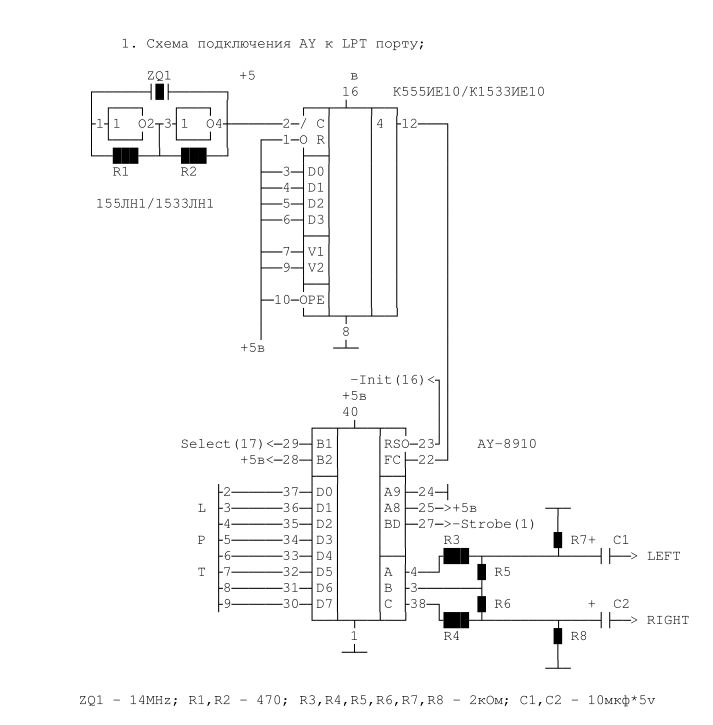
A simple circuit, in it I liked the stereo channel mixer and did not like the clock generator on two microcircuits. There is another option:
ZX Spectrum Computer Sound Chip Emulator ( LPT-YM.7z )
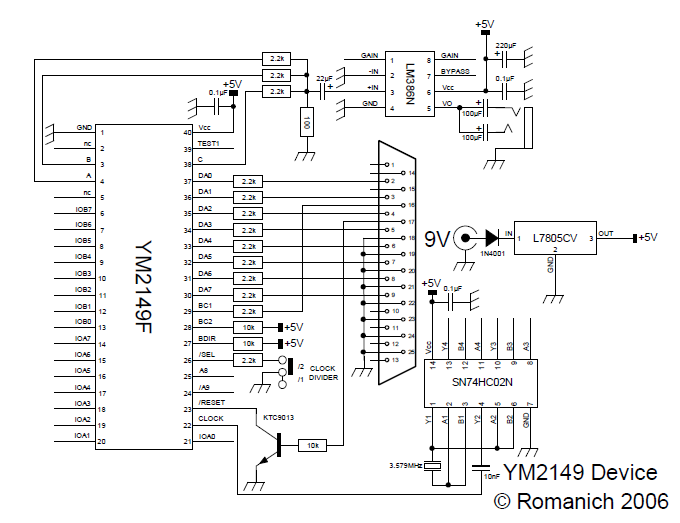
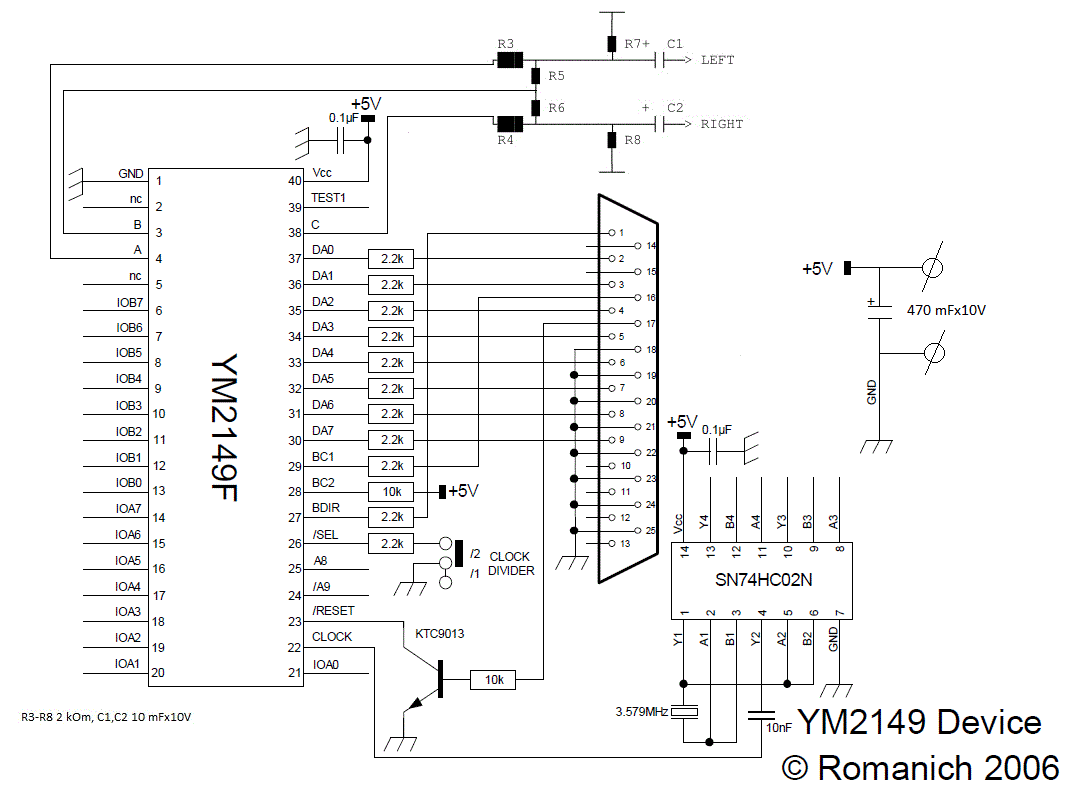
Then I liked the simple frequency generator, but I did not like the mono amplifier and the stabilizer with 9 volts. In the end, I decided to take the mixer from the first circuit, the clock generator from the second. Decided to feed the circuit from + 5V via USB, thus abandoned the nine-volt stabilizer. In a number of experiments, it turned out that for complete happiness, it is still necessary to control the BDIR control signal, so this signal appeared on the circuit, wound to the first LPT pin (Strobe). The Strobe signal in LPT is inverted, and for good it would be necessary to put a transistor, such as that of the RESET signal, for reverse inversion, but you can just remember that if helmet 1, then BDIR = 0 and if helmet 0, then BDIR = 1. As a result, the final circuit took the following form:
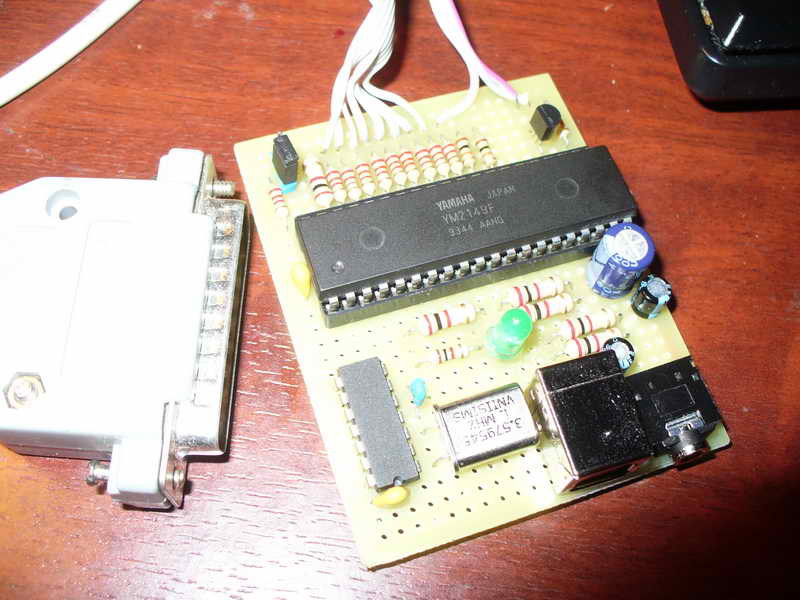
Assembled device:
Software
As for the software support, that is, a wonderful player ZXTune by Vitamin ( support thread ). The author kindly included support for this device in his player, so it became possible to play music formats not only from the ZX Spectrum, but also from other computers, for example, Atari ST or Amstrad CPC. The program runs on Win XP, Win 7 x32 and Win 7 x64 (with support for the LPT device), but in general it is cross-platform and is also available for mobile platforms.
The largest collection of Modland chip tunes is available at http://www.exotica.org.uk/wiki/Special:Modland There are about 80GB modules of all stripes and genres. Specifically for ZX there is a separate site: zxtunes.com In general, do not listen to the listen.