April 24, 2014 at 12:38
Cambium 650 Trunk Solution
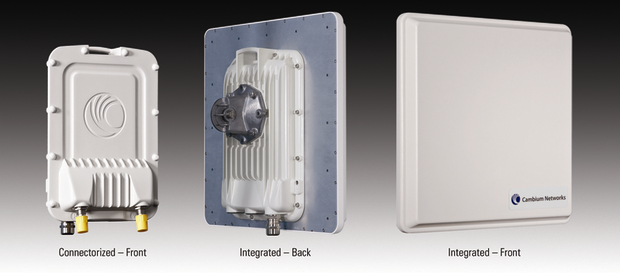
The words "Cambium", "Motorola", "Orthogon" among radio operators are widely known and are associated mainly with positive feelings. In almost every city in the country, you can see characteristic elongated devices at offices, gas stations, and houses, sometimes in a flattened reflector - pmp100 subscriber devices, better known as Canopy, known for their stable operation even in difficult interference conditions. Less often you can see the manufacturer’s PTP series, since these productive solutions are usually found on the masts, and channels with a range of up to 100 kilometers are built on them.
The key advantage of the systems of these ranges is high performance, the ability to work with obstacles in the Fresnel zone, the reliability of the solution, and the disadvantage mentioned at the beginning is the high cost.
However, in the coming year, cambium overcomes the stereotype and offers a more affordable trunk solution - with all the positive qualities of the 600 series, more performance and less heat.
So today we’ll explore the Cambium 650 Series , which offers us 450 Mbps of bandwidth, latency of less than 2 ms and high range.
Further under the cut - a lot of graphs, tables and screenshots.
The 650 Series equipment is the continuation of the idea of the 600 line - a high-performance line capable of working even if there are obstacles in the Fresnel zone. When developing the system, the objectives were to preserve the positive features of the solution, increase productivity and eliminate the following disadvantages:
- High cost;
- Large block;
- High power consumption.
Comparing solutions, we can say with confidence that the tasks are solved - the weight and energy consumed have decreased, productivity has increased:
| 650 series | 600 series | |
|---|---|---|
| Productivity, Mb / s | 450 | 300 |
| Temperature conditions, range ° С | -40 ... + 60 | -40 ... + 60 |
| Power consumption, W | thirty | 55 |
| The mass of the active part, kg | 4.1 | 4.3 |
| Cable ports | Gigabit Ethernet, SFP, 802.3at Power Supply | Gigabit ethernet |
Functionally, the device is an all-weather solution with a gigabit port and an SFP slot, thanks to which the system can be installed at a distance of more than 100 meters from the thermal container.
Power is provided by twisted pair; There are models with both a built-in antenna and a connector for connecting external antennas.
From a network point of view, the system functions as a bridge, with the ability to:
- Vlan filtering;
- Prioritize traffic
- Span overload alerts for routers.
Management is carried out through a graphical menu, but there is telnet, and support for control systems.
System performance is regulated by a license - thus, the initial costs of the system are reduced, and with increasing needs, it is enough to purchase a file to expand the performance to 125, 250 or 450 Mbps.
I would like to note the ability to temporarily activate a license of the maximum type, which allows you to evaluate whether your customers need such performance. The system works under a temporary license for up to 2 months, while the license can be suspended and renewed - this is very convenient for sets of test equipment.
Let's see what the new line can offer in comparison with the solutions of other manufacturers common in our market:
Cambium 650 | Infinet omx | Ubiquity rocket | |
|---|---|---|---|
| Useful performance, Mb / s | 450 | 210 | 200 |
| Package performance, kilopack / s | 900 | 200 | 20 |
| Power and sensitivity for 200 Mbps, dBm | 25; -69 | 23; -75 | 21; -75 |
| Power and sensitivity at maximum performance, dBm | 23; -62 | 23; -75 | 21; -75 |
| Description | The development of the famous 600 series trunk | Well-known broadband access solutions in Russia. The range includes both the point-to-multipoint family and trunk solutions. Equipment advantages: high performance, various traffic processing settings, cold resistance. | A well-known low-cost solution, the advantage is high power at a low price. |
According to the results of the analysis, a significant advantage of the Cambium solution in the main parameters can be noted:
- Performance;
- Processor power;
- Power output for complex modulations;
- Spectrum analyzer working without turning off the radio channel;
- The ability to receive and transmit at various frequencies;
- SynchroEthernet Support;
- The time division of the signal, the ratio of traffic (incoming to outgoing) in the proportions of 1: 1, 1: 2, 2: 1, adaptive.
Test results
We tested the 650 Series with the Optiview XG hardware generator and power meters.
Maximum performance in the main frequency bands was checked by an increasing flow of data (green fill - applied load, marks - achieved capacity). Traffic is transmitted through the channel, reflected and received by the transmitter. Thus, the results are considered as full-duplex, bidirectional data flow.
Cambium 650 on large frames
45 MHz, frames 9018 bytes
Bandwidth

Delay

We see that when the channel capacity is reached, the delay increases due to data buffering, but no more than 20 ms.
Jitter

Bandwidth
Delay
We see that when the channel capacity is reached, the delay increases due to data buffering, but no more than 20 ms.
Jitter
Infinet OMX on large frames
Frames 1518
Bandwidth

Delay

Jitter

Capacity does not exceed 120 Mbit (in each direction), the delay when channel overload increases to 40 ms, jitter reaches 10.
Bandwidth
Delay
Jitter
Capacity does not exceed 120 Mbit (in each direction), the delay when channel overload increases to 40 ms, jitter reaches 10.
Ubiquiti Rocket on large frames
Frames 1518 bytes
Bandwidth

Delay

Jitter

At high load, the system increased the delay to 150 ms
Bandwidth
Delay
Jitter
At high load, the system increased the delay to 150 ms
Please note: in this test we used large frames — while, according to statistics from most of our customers, the frame size of modern networks is now around 300 bytes.
We will conduct a performance test again using frames of the following sizes: for Cambium, Infinet we use 64 bytes, for Rocket - 128 bytes.
Cambium 650 on small frames
Bandwidth The

system delivers performance regardless of frame size.
Delay

We see that when the channel capacity is reached, the delay increases due to data buffering, but no more than by 20 ms.
Jitter

system delivers performance regardless of frame size.
Delay
We see that when the channel capacity is reached, the delay increases due to data buffering, but no more than by 20 ms.
Jitter
Infinet OMX on small frames
Bandwidth

Delay

Jitter

Performance was only 40 Mbps without significant congestion (23 Mbps with congestion), delays are not so beautiful, but real-time traffic will still be transmitted.
Bursts of delay on a gigabit load are single, and the supply of gigabit to a radio channel is not typical.
Delay
Jitter
Performance was only 40 Mbps without significant congestion (23 Mbps with congestion), delays are not so beautiful, but real-time traffic will still be transmitted.
Bursts of delay on a gigabit load are single, and the supply of gigabit to a radio channel is not typical.
Ubiquiti Rocket on Small Frames
Throughput

Delay

Jitter

The results are significantly different - the performance of an inexpensive solution has decreased drastically, the delay due to system load has increased to seconds, and now even the minimum version is 650 more efficient than Airmax solutions.
Delay
Jitter
The results are significantly different - the performance of an inexpensive solution has decreased drastically, the delay due to system load has increased to seconds, and now even the minimum version is 650 more efficient than Airmax solutions.
Thus, in terms of performance, Cambium wins a clear victory.
Performance test results for intermediate frame sizes, tabulated:
Hidden text
Cambium
| Size | Transmit | Receive | % Received |
|---|---|---|---|
| 64 | 999.7 Mbps | 289.0 Mbps | 28.9% |
| 128 | 999.5 Mbps | 257.1 Mbps | 25.7% |
| 256 | 999.7 Mbps | 241.4 Mbps | 24.1% |
| 512 | 999.8 Mbps | 232.0 Mbps | 23.2% |
| 1024 | 999.7 Mbps | 226.7 Mbps | 22.7% |
| 1280 | 1.000 Gbps | 225.7 Mbps | 22.6% |
| 1518 | 1.000 Gbps | 224.6 Mbps | 22.5% |
| 2518 | 1.000 Gbps | 221.4 Mbps | 22.1% |
| 9018 | 1.000 Gbps | 211.2 Mbps | 21.1% |
Infinet
| Size | Transmit | Receive | % Received |
|---|---|---|---|
| 64 | 999.9 Mbps | 23.01 Mbps | 2.3% |
| 128 | 999.9 Mbps | 61.86 Mbps | 6.2% |
| 256 | 999.9 Mbps | 125.5 Mbps | 17.8% |
| 512 | 999.9 Mbps | 135.0 Mbps | 14.4% |
| 1024 | 999.9 Mbps | 130.6 Mbps | 13.1% |
| 1280 | 999.9 Mbps | 126.4 Mbps | 12.6% |
| 1518 | 999.9 Mbps | 126.4 Mbps | 12.6% |
| 2518 | 1.000 Gbps | 0 bps | 0% |
| 9018 | 1.000 Gbps | 0 bps | 0% |
Ubiquiti
| Size | Transmit | Receive | % Received |
|---|---|---|---|
| 64 | 100.0 Mbps | 4.680 Mbps | 4.7% |
| 128 | 99.99 Mbps | 7.966 Mbps | 8% |
| 256 | 100.0 Mbps | 15.27 Mbps | 15.3% |
| 512 | 99.99 Mbps | 47.66 Mbps | 47.7% |
| 1024 | 99.99 Mbps | 90.61 Mbps | 90.6% |
| 1280 | 100.0 Mbps | 90.35 Mbps | 90.4% |
| 1518 | 99.99 Mbps | 92.02 Mbps | 92% |
Performance in various frequency bands
The data obtained for the three solutions in the tables
Cambium
| Frame byte | 20 MHz | 40 MHz | 45 MHz |
|---|---|---|---|
| 64 | 126 | 262 | 289 |
| 128 | 113 | 234 | 257 |
| 256 | 106 | 220 | 241 |
| 512 | 102 | 212 | 232 |
| 1024 | 100 | 207 | 226 |
| 1280 | 99 | 205 | 225 |
| 1518 | 99 | 205 | 224 |
| 9018 | 92 | 193 | 221 |
Infinet
| Frame byte | 20 MHz | 40 MHz |
|---|---|---|
| 64 | 24 | 23 |
| 128 | 58 | 61 |
| 256 | 65 | 125 |
| 512 | 70 | 135 |
| 1024 | 63 | 130 |
| 1280 | 63 | 126 |
| 1518 | 62 | 126 |
Ubiquiti
| Frame byte | 20 MHz | 40 MHz |
|---|---|---|
| 64 | 4 | 4 |
| 128 | 8 | 8 |
| 256 | fifteen | fifteen |
| 512 | 38 | 47 |
| 1024 | 45 | 90 |
| 1280 | fifty | 90 |
| 1518 | 40 | 92 |
Clear and beautiful graphs of the bandwidth in the frequency bands common to all decisions (abscissa axis - frame size in bytes, ordinate axis - bandwidth in Mbps):
20 MHz:

40 MHz:

For those who want to repeat the test, I draw attention to the fact that Infinet includes traffic compression - therefore, a random packet filling generator is required. When measured with uniformly filled frames, on packets of a certain size, the performance exceeds 170 Mbit / s.
Receiver sensitivity check
Probably, many noticed that the sensitivity of the line under consideration at maximum performance is lower than the compared models. On the one hand, this is logical: the useful performance of 10 Mbit / s per MHz forces the use of modulation with 256 positions, and competitors use 64 position modulation, but there is a difference in measurement methods.
We check with the help of attenuators at what level of reception the system supports performance modulations, while loading the channel with traffic. Cambium

test bench
layout, 40 MHz spectrum width
| Declared sensitivity, dBm | The measured sensitivity, dBm | |
|---|---|---|
| 256QAM | -62 | -56 |
| 64QAM | -64 | -63 |
| 16QAM | -69 | -67 |
Ubiquiti 40 MHz Spectrum
| Declared sensitivity, dBm | The measured sensitivity, dBm | |
|---|---|---|
| 64QAM | -75 | -61 |
| 16QAM | -84 | -75 |
We see that the Ubiquiti system does not set the maximum speed at the specified signal level, unlike Cambium - the use of chipsets for mobile wimax made it possible to work effectively with a significantly lower fade margin, use modulation with 256 positions and significantly improved the ability to combine networks thanks to a more stringent spectrum mask.
We see that on modulations up to 64QAM inclusive, the system showed a sensitivity corresponding to the declared one; on maximum modulation, the sensitivity is slightly less.
Ubiquiti equipment showed a significant difference in declared and tested sensitivity.
The plots of the real and declared sensitivity, having adopted the attenuation of 1.5 dB in the cable (along the ordinate axis - dBm):

Thus, we did not see any advantages for solutions on the Wi-fi platform, except for price. If we add that Cambium has full-fledged MIBs, soon the line support will be added to the CNS control system, and the proprietary radio planning product calculates obstacle channels for free, then the winner of the comparison becomes obvious. Well, we are waiting for practical confirmation outside the walls of the laboratory - in the spring we are going to compare products on real radio channels.
We also plan to write an article about the new 650S solution. This is a modification of the 650 series, specially designed for highways between cellular stations 3 and 4 generations.
As a bonus to detailed testing of the technical side of the device, without claiming to be an authorized course, we offer to take a brief look at the main menu of the device.
Много скриншотов веб-интерфейса устройства и некоторые его особо интересные возможности:
Сетевые параметры устройства:

Методы управления:

Журнал системы:

Настройки параметров радиоподсистемы:

Активация демонстрационной лицензии для измерения производительности:

Полная информация о параметрах установленного канала:

Если настроена приоритезация, доступна информация по загрузке каждой очереди:

Пропускная способность, Мбит/с (нулевая длина линка, деление полосы по трафику 1:1, IP):

Чувствительность и максимальные потери на линке на 5,4 ГГц (IP), дБм:

Анализатор спектра — без прерывания трафика:

Наглядные графики основных параметров системы:

При юстировке можно отображать уровень сигнала в графическом виде:

Сигнал с полосой 40 МГц на анализаторе:

The system is in the diversity transmission mode (the second frequency band is received by the analyzer through the attenuator and is therefore displayed with a lower level):

Методы управления:
Журнал системы:
Настройки параметров радиоподсистемы:
Активация демонстрационной лицензии для измерения производительности:
Полная информация о параметрах установленного канала:
Если настроена приоритезация, доступна информация по загрузке каждой очереди:
Пропускная способность, Мбит/с (нулевая длина линка, деление полосы по трафику 1:1, IP):
Чувствительность и максимальные потери на линке на 5,4 ГГц (IP), дБм:
Анализатор спектра — без прерывания трафика:
Наглядные графики основных параметров системы:
При юстировке можно отображать уровень сигнала в графическом виде:
Сигнал с полосой 40 МГц на анализаторе:
The system is in the diversity transmission mode (the second frequency band is received by the analyzer through the attenuator and is therefore displayed with a lower level):