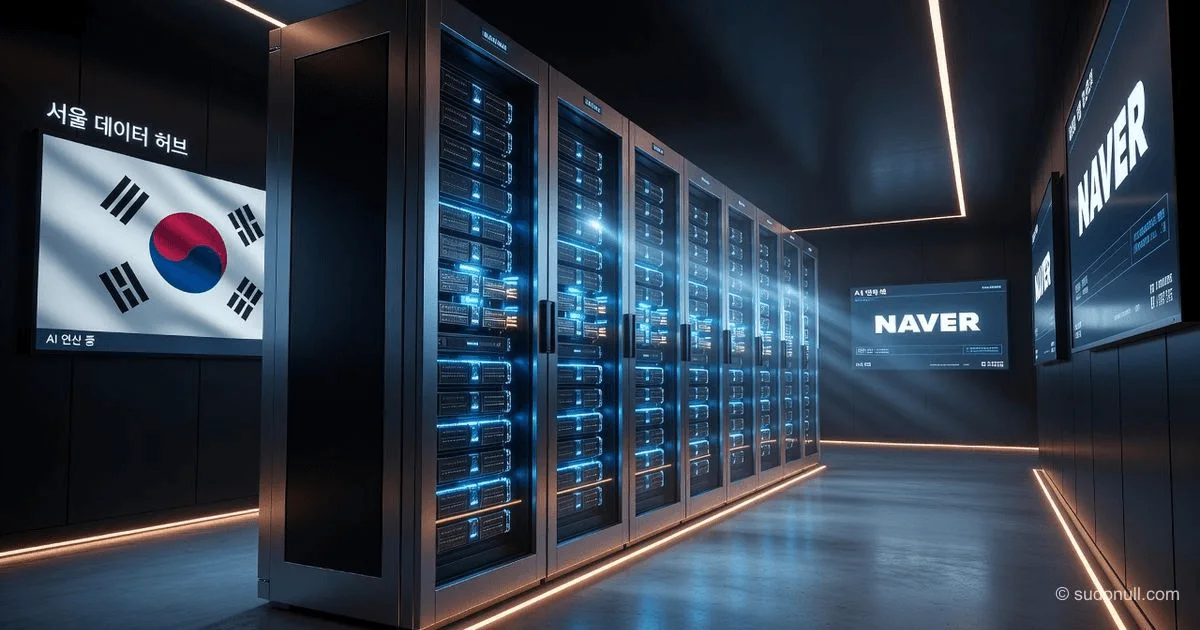
Nvidia and Naver Expand AI Infrastructure Collaboration
South Korean internet giant Naver and Nvidia have agreed to collaborate on AI factories, deepening their partnership to develop specialized models and optimize hardware for local AI services.
Analytical article: The Naver-NVIDIA Alliance — When 'Sovereign AI' Stops Being a Slogan and Becomes a Weapon
Naver is not Google or Baidu. And that's exactly why NVIDIA is betting on it in a move that will reshape the global AI infrastructure market.
While Jensen Huang met with the heads of SK Group, LG Group, and Hyundai, most analysts missed the most strategically important agreement of his Korean tour — the partnership with Naver. Big mistake. Because while the deals with SK Hynix and LG are about hardware and manufacturing, the deal with Naver is about sovereign AI, data control, and who will own the AI infrastructure of the next decade.
Naver is the 'Google of Korea': a search engine with an 80% market share, maps, e-commerce, and cloud services. But Naver is also the only non-Chinese internet company in Asia that owns its own data centers, its own LLMs (HyperCLOVA X), and real experience building AI services for hundreds of millions of users. And now NVIDIA is giving Naver the keys to global expansion.
[The Core]: What's Really Happening
Officially: Naver is expanding its 'Gak Sejong' data center from 55 megawatts to gigawatt capacity using the NVIDIA DSX platform. Unofficially: NVIDIA and Naver are creating a global AI factory operator that will compete with AWS, Google Cloud, and Microsoft Azure on their own turf.
Here's what was actually signed. First, Naver becomes an AI infrastructure operator for NVIDIA. Naver builds data centers, NVIDIA supplies GPUs, and together they sell computing power to clients worldwide — from the Asia-Pacific region to Europe and the Middle East. This isn't 'Naver buys GPUs' — it's a joint venture where risks and profits are shared equally.
Second, Naver joins the Nemotron Coalition — a global alliance of open LLM developers under NVIDIA's umbrella. Naver will fine-tune the Nemotron 3 Ultra model on its Korean data, creating the next-generation HyperCLOVA X. This makes Naver NVIDIA's gateway to the Korean market: any Korean company wanting to use cutting-edge LLMs will have to go through Naver.
Third, Naver is developing the 'Seoul World Model' — a digital twin of Seoul based on NVIDIA Cosmos. This isn't just a '3D map'. It's a platform for testing autonomous vehicles, delivery robots, and drones in a virtual environment that reproduces the real city with centimeter accuracy. And Naver is the only company in the world with such a detailed mapping database for an entire metropolis.
Timeline and Context
This deal isn't a 'flash' but the culmination of a two-year rapprochement that most observers underestimated.
November 2025: Naver announces investments of 1 trillion won (about $690 million) in GPUs for physical AI, starting in 2026. It also becomes known that Naver will receive 60,000 Blackwell GPUs — the largest allocation among NVIDIA's Korean partners. This was the first signal: Naver is not just a 'client' but a strategic partner.
June 7, 2026, morning: Huang visits Naver's office in Pangyo (the '1784' office building, itself a testing ground for robots and AI technologies). The meeting lasts several hours.
June 8, 2026, official announcement: Naver files an official disclosure with the Korean Financial Supervisory Commission (DART), publishing details of the partnership. This isn't a 'memorandum of understanding' — it's a legally binding agreement with specific milestones and timelines.
Key detail everyone missed: Naver reveals a phased infrastructure expansion plan:
- First half of 2027: 55 megawatts
- End of 2027: 100 megawatts (cumulative)
- 2028: 200 megawatts
- Final goal: gigawatt
This isn't just 'we want to grow'. These are concrete numbers with concrete dates. Naver is committing to NVIDIA and, more importantly, to its shareholders to execute this plan. No other Korean NVIDIA partner has provided such detail.
The most important contextual fact not reported in the news: Huang told journalists that same evening that one gigawatt of AI factory costs about $60 billion. SK Telecom's plans (5 gigawatts) and Naver's (1 gigawatt) together total 6 gigawatts — potential investments of $360 billion over five years. That's more than the GDP of many countries.
Who Wins and Who Loses
Winner #1: Naver (and its founder Lee Hae-jin). This is the biggest win in the company's history. Naver Chairman Lee Hae-jin, who personally met with Huang, stated that Naver is 'the only Korean company ready to meet the sharp increase in GPU demand'. That's not boasting. Naver has experience managing large-scale online services, its own data centers, and, critically, the Korean government's trust in matters of 'sovereign AI'. Naver's stock rose 13.5% on the day of the deal announcement.
Winner #2: NVIDIA. NVIDIA gains not just a 'GPU buyer' but an AI infrastructure operator that will build data centers under the NVIDIA brand, use the NVIDIA DSX platform, and sell capacity to clients worldwide. This is the 'NVIDIA Inside' model for cloud computing — just like Intel Inside for PCs in the 1990s. NVIDIA becomes not just a chip supplier but the architect of a global AI ecosystem.
Winner #3: The Korean government (and the idea of 'sovereign AI'). Korea has long tried to build its own AI infrastructure independent of US cloud giants. The Naver-NVIDIA partnership delivers that: data centers on Korean soil, a Korean operator, data staying in the country, while using the world's best NVIDIA chips and software. This is a model for other countries (Japan, India, Gulf states) that want 'their own AI' but can't build it from scratch.
Winner #4: Naver Cloud clients (Korean enterprises and government agencies). They will gain access to cutting-edge AI capacity without having to buy GPUs themselves. For small and medium businesses, this is critical. Naver will sell GPU-as-a-Service — cheaper and simpler than building their own infrastructure.
Loser #1: Amazon Web Services (AWS) in Korea. AWS has dominated the Korean cloud market for years. But Naver+NVIDIA's AI infrastructure is a direct competitor. Korean companies, especially those handling sensitive data (finance, healthcare, government), will prefer a 'national champion' over a US giant. AWS will lose market share in Korea over the next 2-3 years.
Loser #2: Google Cloud. Google also tries to sell its TPUs as an alternative to NVIDIA. But in Korea, Google doesn't have a partner like Naver. Naver is the 'Google of Korea', and now this Google works with NVIDIA, not Google Cloud. Google Cloud in Korea can forget about major AI contracts.
Loser #3: Microsoft Azure. Microsoft has investments in OpenAI and its own AI services. But in Korea, it doesn't have 'its own Naver'. Korean corporations wanting to use AI will now go to Naver, not Microsoft. Azure will remain for general cloud workloads, but the AI weight will shift to Naver.
Loser #4: Chinese cloud providers (Alibaba Cloud, Tencent Cloud, Huawei Cloud). They've already been pushed out of the Korean market for political reasons. But now the Korean AI market is consolidating around Naver+NVIDIA. The Chinese have nothing to gain here.
What the Media Isn't Saying
Typical news feeds reprint press releases and write about 'AI infrastructure collaboration'. But there are three things you won't read in official statements.
Insight #1: Naver becomes NVIDIA's 'Chinese censor'
Pay attention to the wording: Naver will use its own data to fine-tune Nemotron 3 Ultra. What does this mean in practice? Any AI model running on Naver's infrastructure will pass through Naver's filters — and Naver, as a Korean company, must comply with Korean content laws (which prohibit, for example, pro-Japanese or pro-Chinese statements, as well as certain political content).
NVIDIA can't afford to be 'for censorship', but the Korean government can. Naver becomes a 'buffer': NVIDIA supplies the technology, Naver ensures compliance with local regulations. This allows NVIDIA to sell its solutions in Korea without political risk. Smart and cynical.
Insight #2: The 'Seoul World Model' is bigger than it seems
Naver is developing the 'Seoul World Model' based on NVIDIA Cosmos — a digital twin of Seoul for testing physical AI. But what happens when this model is ready? It can be scaled to any other city. Want a digital twin of Tokyo? Sign a contract with Naver. Want a digital twin of Singapore? Sign a contract with Naver.
Naver becomes a global supplier of 'virtual proving grounds' for testing robots and drones. This is a market currently valued in the billions of dollars, and Naver enters it with exclusive access to NVIDIA technologies.
Insight #3: $360 billion in investments is not a typo
When Huang said a gigawatt costs $60 billion, and the combined plans of SK Telecom and Naver are 6 gigawatts, he cited $360 billion in potential investments. But he didn't specify that this money will be split between NVIDIA (supplying GPUs) and Korean partners (building data centers, land, electricity, cooling).
Even if half of that ($180 billion) materializes, it's the largest infrastructure project in South Korea's history since post-Korean War reconstruction. And Naver will get its share — as the operator of 1 gigawatt out of 6. That's $60 billion in potential investments for which Naver doesn't even need to pay in full: they will attract external financing, and NVIDIA will supply GPUs on installment against future revenues.
Forecast: Next 30 Days and 90 Days
Next 30 Days (to mid-July 2026)
1. Naver stock rises 15-20% from current levels. Shares already rose 13.5%, but that's not the limit. When investors realize the scale — that Naver is becoming not just the 'Korean Google' but a global AI infrastructure operator — a second wave of growth will follow.
2. Naver announces a specific location for the Gak Sejong expansion. Currently, the data center is in Sejong. But expanding to a gigawatt will require new space and new capacity. I expect Naver to announce land purchase or lease of existing capacity within 30 days.
3. The Korean government announces tax incentives for Naver. To support the 'national champion', the Ministry of Science and ICT will grant Naver a 5-7 year tax holiday on profits from AI infrastructure. This will cost the budget billions but is politically necessary.
Medium-Term Forecast (90 days, to September 2026)
1. Naver launches GPU-as-a-Service for external clients. Using the 60,000 Blackwell GPUs it received, Naver will start selling computing power to Korean startups and enterprises. This will become a new revenue stream that could generate hundreds of billions of won as early as 2027.
2. First clients outside Korea emerge. Naver and NVIDIA will begin talks with the governments of Japan, Singapore, and the UAE about building 'sovereign AI factories' following the Korean model. Naver will be the operator, NVIDIA the technology supplier. The first such contract could be signed by the end of 2026.
3. Competition with AWS in Korea intensifies. AWS, seeing the threat, will cut prices on its GPU instances in Korea by 20-30% to retain clients. This will trigger a price war that benefits end users but hurts margins for all players.
4. Kakao (Naver's main competitor in Korea) will seek an alliance with Microsoft or Google. Seeing Naver gain exclusive access to NVIDIA, Kakao will realize it cannot compete in AI infrastructure. They will form a strategic partnership with Microsoft Azure (for access to OpenAI) or Google Cloud (for access to TPUs). This will be announced by September 2026.
Summary for those who read this far: The Naver-NVIDIA partnership is not a deal. It's the creation of a new global player in the AI infrastructure market. Naver becomes NVIDIA's 'operator of choice' in Asia, and NVIDIA becomes Naver's 'supplier of choice' worldwide.
The most important thing to understand: Naver is NVIDIA's only partner that is neither a chip manufacturer, a telecom operator, nor an automaker. Naver is an internet company with users, data, and experience. That's why NVIDIA is betting on them.
In a world where 'sovereign AI' becomes a matter of national security, countries will seek partners who can build AI infrastructure without losing data control. Naver+NVIDIA offers such a model. And if it works in Korea, it will be replicated worldwide.
Jensen Huang flew to Korea for memory, robots, and autopilots. But the most important thing he took away was a partnership with a company that has 80% of the Korean search market and ambitions to become a global AI operator. Don't look at the chips. Look at the data and who owns it. Naver owns Korea's data. And now they have the GPUs to process it.
— Editorial Team





No comments yet.