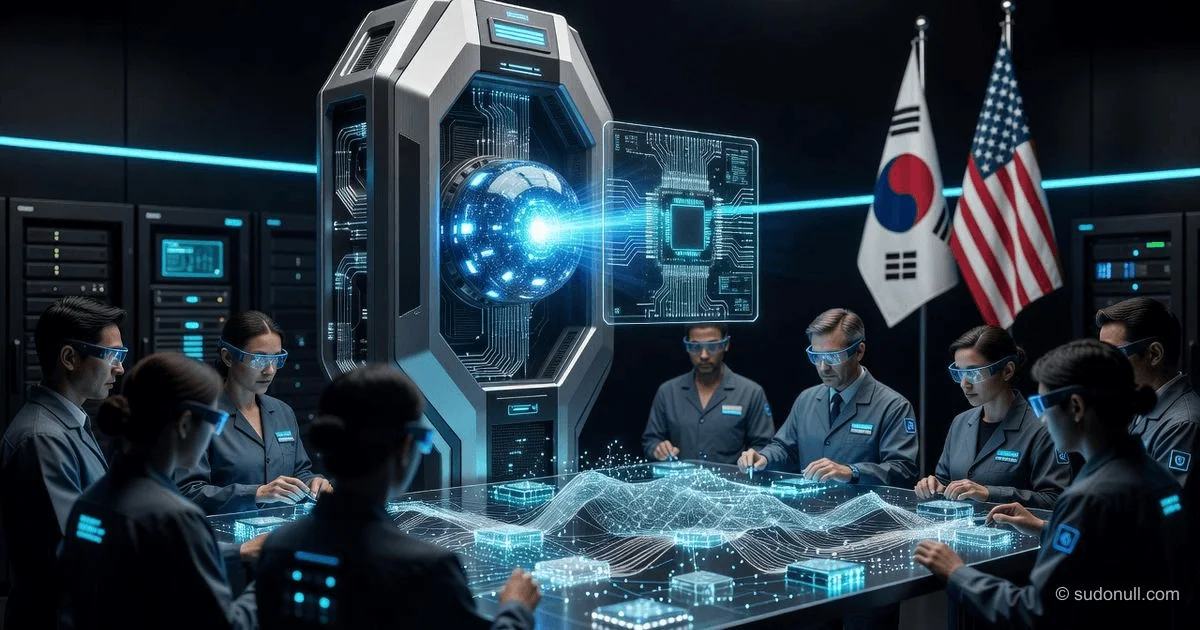
US and South Korea Join Forces to Develop Energy-Saving Technologies for 6G
As part of South Korea's new AI-RAN project, a joint research program with the US is planned. The focus will be on AI methods to reduce base station power consumption and digital twin technologies for wireless environments.
Analytical Article: The US-Korea 6G Alliance — When 'Energy Saving' Becomes a Weapon
The war for 6G is won not in laboratories, but in power grids. The Koreans and Americans understood this first.
When news broke on June 9, 2026, about US-South Korea cooperation within the AI-RAN project, most commentators focused on technical details — AI optimization, digital twins, energy efficiency. Sounds a bit dull for headlines, doesn't it? Where are the promised terabits per second? Where are the holographic calls?
But let me explain why this "boring" news is the most dangerous event for European and Chinese telecom vendors in the last five years. Because the US and South Korea have just announced not just joint research. They have announced the creation of a new competitive standard where the winner is not the one with the highest speed, but the one with the lowest electricity bill.
[The Essence]: What's Really Happening
Officially: Under South Korea's AI-RAN Global Leading Project with a budget of 47 billion won (approximately $39 million through 2030), a joint program with the US is planned. From South Korea, the consortium includes SK Telecom, KT, LG Uplus, Samsung Electronics, as well as smaller vendors like Ucast, HFR, and CleverLogic. From the US, Northeastern University is involved.
What is Northeastern University in the context of 6G? It's not just an "academic partner." It owns two unique infrastructures: "Colosseum" — the world's largest open wireless testbed capable of emulating thousands of devices simultaneously, and a commercial 5G/6G test network deployed on campus. Their Wireless Internet of Things Institute (WioT) already collaborates with AT&T, T-Mobile, and Qualcomm.
The essence of the deal, which won't be written in press releases: South Korea gains access to US test facilities and expertise in AI/ML for networks. The US gains access to Korean manufacturing (Samsung), the three largest operators, and, more importantly, to the Korean model of public-private partnership where government, universities, and corporations work as a single mechanism.
But that's just the tip of the iceberg. The focus on "energy saving" is not just a technical task. It's a political and marketing maneuver designed to make US-Korean solutions non-competitive for Chinese and European alternatives. Why? Because in 2030, when 6G begins mass deployment, electricity bills will become a critical factor in vendor choice for any operator in any country.
Timeline and Context
This deal didn't come out of nowhere. It follows a series of events that have been building over the past year and a half.
April 2026: The South Korean government officially launches the "AI-RAN Global Leading Project" under the leadership of ETRI. Budget: 47 billion won. Participants: three operators, Samsung, Ucast, HFR, CleverLogic, four universities (SNU, Yonsei, Sungkyunkwan, Ajou), and TTA. Goal: by 2029, create a prototype AI-native RAN and test it in real-world conditions.
February-March 2026: At MWC Barcelona, the AI-RAN Alliance (which by then has 132 members) presents its first report on applying AI/ML to improve RAN, including energy efficiency. Koreans and Americans actively participate in these working groups. It was likely there that a basic agreement on bilateral cooperation was reached.
June 2026 (now): Official announcement of Northeastern University's participation in the Korean project. The university will share expertise in digital twins and AI optimization of radio networks.
Parallel context — what's happening in science: In the first half of 2026, several key publications emerged that provide the theoretical foundation for this work. In February, IEEE published a paper on an AI/ML framework for energy optimization using 3GPP functions. In April, a study on deep reinforcement learning for O-RAN showed a 34.6% reduction in energy consumption. And a very recent paper, from June 8, 2026, proposes a framework based on generative AI and digital twins, promising energy savings of up to 69.2%. This means science has already provided the tools; now they just need to be packaged into a commercial product.
Who Wins and Who Loses
Winner #1: Samsung Electronics. Samsung is the only Korean telecom equipment manufacturer in the consortium. Through this project, Samsung gains access to US test facilities and the opportunity to test its 6G solutions on US soil with US operators (AT&T, T-Mobile — partners of Northeastern). This is a path to the US market, where Huawei is already banned, and Europeans (Nokia, Ericsson) are present but don't have such a "home" alliance with the Koreans.
Winner #2: Korean operators (SKT, KT, LG Uplus). All three operators are in the consortium. For them, AI-RAN is not just about "making the network better." It's an opportunity to stop being a "dumb pipe." When the network optimizes its own energy consumption, the operator reduces OPEX. And drastically — RAN consumes over 70% of all mobile network energy, and electricity bills can reach 5% of operator revenue. Every percentage point of savings translates to billions of dollars globally.
Winner #3: Northeastern University (and the US in general). The university receives funding from the Korean government and access to best practices in commercialization. And the US gains leverage over the Korean 6G ecosystem. Without American science, the Korean project would be a "local story." With US participation, it becomes a "global alliance" that can dictate standards.
Winner #4: Qualcomm (indirectly). Northeastern University works closely with Qualcomm. Qualcomm is the main chip supplier for phones and potentially for 6G devices. If AI-RAN becomes a standard, Qualcomm chips optimized for this standard will gain an edge over competitors (MediaTek, Huawei).
Loser #1: Ericsson and Nokia. Europeans are not participating in this project. But they should be. Europe is betting on its own projects (EU-JP 6G-MIRAI), but they are lagging in pace. Koreans and Americans work in a "code written today — tested in Colosseum tomorrow — at the Seoul test site the day after" format. European bureaucracy can't do that. As a result, Ericsson and Nokia risk becoming "second-tier" 6G suppliers, losing the efficiency race to Samsung.
Loser #2: Huawei. The Chinese have their own 6G project, but it develops in isolation from the US. Moreover, Chinese scientists have no access to US testbeds like Colosseum, and US scientists have no access to Chinese ones. The "US+South Korea" project is creating a "Western" 6G stack that will be incompatible with the "Chinese" stack. Huawei loses not technologically — they are smart guys, they will make their own AI-RAN. They lose geopolitically: half the world (Europe, Japan, Australia, India) will choose the "Western" stack because it's safer and integrated with the US ecosystem.
Loser #3: Small Open RAN vendors (Mavenir, Parallel Wireless, etc.). The AI-RAN being developed by Koreans and Americans is a deeply integrated solution where AI models are "stitched" with Samsung hardware. This is not an "open" ecosystem, despite the slogans about Open RAN. Small vendors that bet on software for standard servers will be left out. Because AI optimization requires tight coupling between software and hardware — exactly what Samsung and Nokia do, but software startups don't.
What the Media Isn't Saying
Most news feeds will write: "US and South Korea will jointly make energy-efficient 6G." And that's it. But there are at least three things they miss.
Insight #1: Digital twins are not about testing, but about intelligence
The project includes creating a "digital twin-based virtual network environment." At first glance, it's a common tool for testing AI models. But what happens when you create a digital twin of a real network? You get an exact copy of network behavior under different loads, with different interference, with different traffic. This data is gold. It will allow Korean and US companies to train models that will outperform any competitors because they "know" the network from the inside.
Europeans and Chinese don't have access to this data. Moreover, the digital twin created from US and Korean networks will be tailored to an architecture that may differ from the European one. As a result, European operators buying Ericsson equipment will get models trained on "foreign" data, and they will perform worse. It's like teaching a driver on a left-hand drive simulator and then putting them behind a right-hand drive.
Insight #2: 40% energy savings is not theory; it's already proven
Look at the dates. In February 2026, a scientific paper showed that adaptive federated learning (AFL) can reduce energy consumption in 6G networks by 40.1%. In April 2026, a paper on deep reinforcement learning for O-RAN showed a 34.6% reduction. And on June 8, 2026, the day before the announcement, a paper on arXiv about generative AI for digital twins promised savings of 69.2%.
What does this mean? It means the Korean-US project is not starting from scratch. They are taking already proven algorithms and scaling them to real infrastructure. 40-70% energy savings is not fantasy; it's reproducible results in simulations. The only question is how well these algorithms work in the real world. But they have Colosseum and Korean test sites to verify that.
Insight #3: The role of small Korean vendors — Ucast, HFR, CleverLogic
The consortium includes not only giants but also small companies — Ucast, HFR, CleverLogic. Few outside Korea have heard of them. But this is key to understanding the Korean strategy. They don't want to rely solely on Samsung. They are creating a "second tier" of manufacturers that can compete globally in the AI-RAN niche.
CleverLogic, for example, specializes in RAN software. Ucast focuses on small base stations. The Korean government is deliberately "growing" competitors to Samsung within the country to create an ecosystem, not a monopoly. This is smart. And it's something Europeans cannot replicate, where Nokia and Ericsson are already "everything." The European telecom equipment market is a duopoly. The Korean one is potentially a competitive market with multiple players.
Forecast: Next 30 Days and 90 Days
Next 30 Days (through mid-July 2026)
1. Northeastern University will publish a specific work plan. The university already has experience working with Qualcomm and US operators. Within a month, it will announce which tests will be conducted on Colosseum and how results will be transferred to the Korean side. Likely, the focus will be on validating algorithms from the June 8, 2026 paper on real hardware.
2. Samsung will accelerate 6G chipset development. Samsung Electronics, as the only major equipment vendor in the consortium, will start openly discussing its 6G prototypes. Rumors in Korea suggest that trial chips for AI-RAN will appear by the end of 2026, not in 2027 as previously planned.
3. Statements from Ericsson and Nokia. Europeans won't stay silent. They will make loud announcements about their "independent" energy efficiency programs for 6G, but without specifics. Ericsson and Nokia stocks may correct 2-4% downward as investors see Koreans and Americans moving faster.
Medium-term forecast (90 days, through September 2026)
1. China will respond by creating a "counter-alliance." The Chinese government will announce the launch of its own AI-RAN program involving Huawei, ZTE, and likely Russian or Pakistani universities (as alternatives to US ones). But without access to advanced testbeds (Colosseum is American; Chinese can't go there), their program will lag. Nevertheless, the propaganda effect will be strong.
2. Japan will face a choice. Japan has its own 6G-MIRAI project with Europe. But now Japan sees that South Korea has bet on the US. The Japanese will start quiet talks with Koreans about parallel or coordinated AI-RAN development. I wouldn't be surprised if by September 2026 a "Korea-Japan-US" memorandum on 6G appears, leaving Europe isolated.
3. First AI-RAN pilot zones in the US. AT&T or T-Mobile (Northeastern partners) will announce a small test zone using Korean Samsung equipment optimized with Northeastern AI algorithms. The goal is to demonstrate energy savings in real conditions. If results are close to 40-50%, it will become the biggest telecom industry news of 2026.
4. Growing interest in "energy-efficient networking" from ESG investors. Funds investing according to ESG principles will start actively including companies related to energy-efficient networks in their portfolios. This will boost stocks of Samsung, SK Telecom, and even Northeastern University (through its venture funds). Expect articles in Financial Times and Bloomberg about the "investment appeal of green 6G."
Summary for those who read this far: The US-South Korea alliance on energy-saving technologies for 6G is not a scientific project. It's the creation of a new industrial standard where "whoever consumes less electricity wins." Europeans missed this trend by betting on speed and latency. Chinese bet on independence at any cost. But Koreans and Americans simply calculated: in 2030, electricity bills will matter more than gigabits per second. And they were right. Watch the bills — they will tell you more about the future of 6G than any MWC presentations.
— Editorial Team






No comments yet.