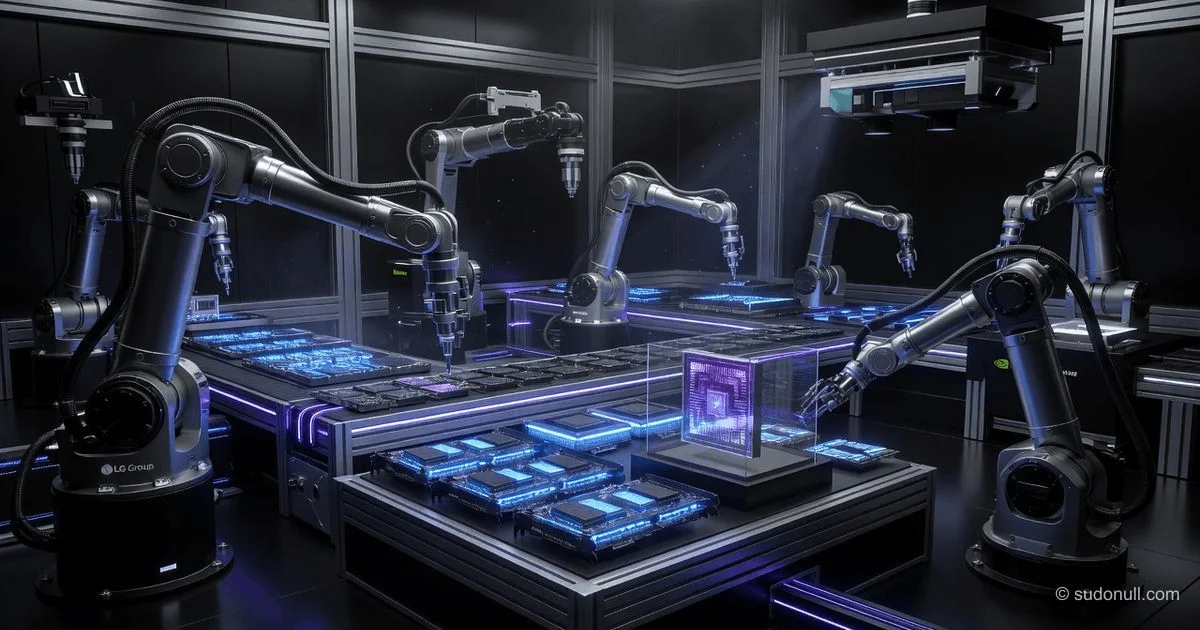
LG Group and Nvidia Agree to Collaborate on AI Factories
During Nvidia CEO's visit to South Korea, LG Group became a key partner in deploying artificial intelligence technologies. The collaboration includes building AI factories and integrating robotics.
Analytical article: The LG Group and NVIDIA Alliance — When 'Physical AI' Becomes Reality and the Conglomerate Transforms into an AI Empire
Jensen Huang didn't come to Korea for chips or memory. He came for 'physical AI' — technology that will turn factories, homes, and cars into living organisms. And LG turned out to be the only partner that can give him all of that at once.
On June 7, 2026, on the 32nd floor of LG Twin Towers in Seoul, an event occurred that will change the balance of power in global industry for years to come. LG Group Chairman Koo Kwang-mo personally met Jensen Huang in the lobby, escorted him to the meeting room, and closed a deal whose details are now spreading across global media.
Officially: NVIDIA and LG Group are building an 'AI factory' to accelerate robotics, autonomous driving, data centers, and GPU cloud services. Unofficially: LG has just undergone the largest technological transformation in its 76-year history, spending over $665 million on chips alone, and NVIDIA has gained the key to a Korean conglomerate that spans everything from electronics to energy solutions.
[The Core]: What's Really Happening
Forget the 'AI factory' as a building with servers. What NVIDIA and LG are building is not a data center. It's the nervous system of future industry, where AI is embedded in every machine, every robot, every vehicle.
Here's what's really happening: LG is set to become the world's largest integrator of 'physical AI' — technology where AI models don't just generate text or images, but control physical objects in the real world. To do this, LG is mobilizing all its divisions: LG Electronics makes robots and auto components, LG Innotek makes optical sensors for autonomous driving, LG CNS provides software platforms for factories, LG Uplus builds data centers, and LG Energy Solution develops next-generation power systems.
Numbers that should scare you: LG is purchasing 10,000 Blackwell GPUs from NVIDIA — the largest single purchase in the group's history. The total investment, including chips and infrastructure, exceeds 1 trillion won ($665 million). For comparison, the South Korean government allocated $970 million in 2025 for a national program to purchase 10,000 GPUs. LG is doing this alone, at its own expense.
Why is this important? Because these 10,000 GPUs will go toward three things: (1) training the sovereign AI model EXAONE, (2) developing LG's humanoid robots, and (3) creating a commercial physical AI data factory that will generate synthetic data for training robots across Korea and the world. LG isn't just buying chips — it's buying the future.
Timeline and Context
This deal wasn't sudden. Behind it are months of quiet negotiations, public hints, and strategic maneuvers. I've pieced together the timeline.
January 2026, CES, Las Vegas: LG Electronics introduces the CLoiD home robot on the NVIDIA Jetson Thor platform. This was the first public hint: LG and NVIDIA are working together, but the scale wasn't yet revealed.
June 5-6, 2026, Seoul: Huang arrives in Korea after a seven-month absence. On the first evening, he has dinner with the heads of SK Group, Naver, and... LG Group at a restaurant in Hongdae. A video of 48-year-old Koo Kwang-mo (the youngest at the table) grilling meat for 63-year-old Huang goes viral on social media. Behind this BBQ was not etiquette, but business: the key parameters of the deal were agreed upon then.
June 7, 2026, morning: Huang arrives at LG Twin Towers, where Chairman Koo personally greets him in the lobby — a gesture of the highest respect in Korean business culture. Negotiations last several hours. Huang emerges to journalists and says: 'The partnership is growing and becoming impressive.' His most important statement: robotics is 'the most important area of collaboration,' and LG possesses 'many technologies that will matter in the future.'
June 8, 2026, official announcement: NVIDIA publishes details of the collaboration on its blog. It becomes clear that this is not 'just another contract' but deep integration across all LG divisions. Simultaneously, Korean media reveal details of the 10,000 Blackwell GPU purchase.
Important context almost no one noticed: On the same day, Huang meets with Doosan Group and signs a separate agreement on physical AI and robotics collaboration. This is no coincidence. NVIDIA is building multiple partners in Korea, not just one. But LG is the main and most ambitious one.
Who Wins and Who Loses
Winner #1: LG Group (and especially Chairman Koo Kwang-mo). This is a triumph of the strategy Koo began in 2018 when he became the youngest chairman in LG's history. He bet on AI and transformation. Today, that bet is paying off. LG is becoming not just a 'refrigerator and TV manufacturer' but a world-class integrator of physical AI. LG Electronics' market capitalization has already risen on the news, and this is just the beginning.
Winner #2: NVIDIA. Jensen Huang got what he came for: access to Korea's industrial power. LG has 90,000 employees, 120 production sites worldwide, and 75 years of manufacturing experience. And now all of this will run on the NVIDIA platform. Every LG robot, every LG Innotek sensor, every LG CNS AI system is another customer for NVIDIA's GPUs and software. This isn't just a deal — it's an ecosystem capture.
Winner #3: LG Innotek (unexpectedly). This division, which makes optics and camera sensors, is LG's 'quiet giant.' Now they will supply components optimized specifically for NVIDIA's GPU architecture. This means any robot or car manufacturer wanting to use the NVIDIA platform will have to consider LG Innotek as a supplier. Revenue and margin growth are guaranteed.
Winner #4: LG Energy Solution. Their role in the deal is developing power systems for next-generation data centers at 800 volts DC. This isn't just batteries for electric vehicles. It's a critical component for AI infrastructure, where energy consumption is growing exponentially. LG Energy Solution becomes a supplier to NVIDIA — and thus to the entire industry.
Loser #1: Samsung Electronics (unexpectedly). Samsung has its own robots, sensors, and chips. But Samsung didn't sign such a large-scale agreement with NVIDIA. Why? Because Samsung is trying to develop its own AI ecosystem (Samsung Gauss, its own chips, its own platform). That's commendable, but for now, they're losing to LG in the race for a partnership with NVIDIA. LG got exclusive access to NVIDIA Isaac, DRIVE, and DGX, while Samsung is left watching from the sidelines.
Loser #2: Hyundai Motor Group. Hyundai is also developing robots (Boston Dynamics is its subsidiary) and autonomous driving. But Hyundai couldn't secure a deal comparable to LG's. The reason: Hyundai doesn't have as broad a portfolio — from sensors to data centers. LG is unique in being able to offer NVIDIA everything in one place. Hyundai will have to catch up, but they're already in the role of an outsider.
Loser #3: Chinese robot manufacturers (UBTech, Fourier Intelligence, etc.). Are they cut off from NVIDIA? No, they can formally buy chips. But they don't have access to the level of integration that LG gets. The NVIDIA Isaac platform, trained on data from LG factories, will be 'tuned' to real conditions in Korean industry. The Chinese will have to develop their own analogs from scratch. The efficiency gap will only grow.
What the Media Isn't Saying
Regular news feeds will reprint NVIDIA's press release and write about 'collaboration in robotics.' But there are at least three things you won't read in official statements.
Insight #1: LG is building a 'physical AI data factory' not only for itself but for all of Korea
In NVIDIA's materials, there's one phrase almost no one noticed: 'LG Electronics is developing a physical AI data factory poised to help Korean and global companies accelerate physical AI projects.' What does this mean? LG won't just use data for its own robots. LG will sell synthetic data generation services for training robots to other companies.
Imagine: you're a startup making delivery robots. You don't have millions of kilometers of real-world testing. You go to LG, pay money, and they generate virtual worlds on the NVIDIA Cosmos platform where your robot can 'drive' a million kilometers in a week. LG becomes a 'cloud provider' for physical AI. This is a business with potential in the tens of billions of dollars that no one is talking about.
Insight #2: 'Joint development of reference robots' means creating a de facto standard
NVIDIA and LG agreed to 'jointly develop reference robots in the Isaac GR00T ecosystem.' In plain English: they will create the 'iPhone for robots.' A reference design that will become the industry standard. Any robot manufacturer wanting to be compatible with the NVIDIA platform will have to copy LG's architecture.
This is a repeat of Google's strategy with Android: make a reference device (Pixel), and let everyone else copy it. Only here, LG makes the reference device. And this means the Korean conglomerate could become the 'Microsoft' of the robotics world — not just a manufacturer, but an architect of the standard.
Insight #3: LG's cooling systems role — an underrated trump card
Huang specifically noted that LG does a 'fantastic' job with cooling and power distribution systems for data centers. LG Electronics is already certifying its CDUs (coolant distribution units) and cold plates to NVIDIA standards. This sounds like a boring technical detail.
But here's what it really means: the next NVIDIA Rubin Ultra chip (2027) will consume even more power and generate even more heat. Without efficient liquid cooling, it's impossible. LG, having passed NVIDIA certification, will become one of the few suppliers in the world whose systems are approved for use with top-tier GPUs. Prices for such systems can be set arbitrarily — demand will far exceed supply.
Forecast: Next 30 Days and 90 Days
Next 30 Days (to mid-July 2026)
1. LG Group stock rises 10-15%. The news is already priced in, but analysts will revise their models. LG Electronics (robots, auto components) and LG Innotek (sensors) will rise especially strongly. I expect target prices to be raised by 20-30% within a month.
2. Tender launched for building the physical AI data factory. LG will announce a specific construction site (likely Pyeongtaek or Chungcheongbuk-do) and commissioning timeline. Investment in the building and infrastructure alone will be at least $1-2 billion. This will be LG's largest construction project in 10 years.
3. Competitors (Samsung, Hyundai) will try to respond. Samsung will hastily announce 'strengthened cooperation with NVIDIA' — but on a much more modest scale. Hyundai may make a new statement about Boston Dynamics. But this will be 'catch-up' rhetoric without real contracts.
Medium-Term Forecast (90 days, to September 2026)
1. First prototypes of LG robots on the NVIDIA Isaac GR00T platform. LG Electronics will show a prototype humanoid robot trained on synthetic data from the physical AI data factory. This will be a demonstration not of a 'robot that walks,' but a 'robot that understands natural language commands and performs complex tasks' — thanks to integration with GR00T. The presentation will likely take place at IROS 2026 in October, but insider information will emerge as early as September.
2. LG Innotek will start supplying sensors for autonomous vehicles on the NVIDIA DRIVE platform. This will be the first commercial contract stemming from the deal. Clients will likely be Korean manufacturers (Hyundai, Kia) already using NVIDIA DRIVE. LG Innotek will displace current sensor suppliers (Sony, Omnivision) from the Korean market.
3. China's reaction — creation of a 'national champion' for physical AI. The Chinese government, seeing the NVIDIA+LG alliance, will announce the creation of a consortium of Huawei, DJI, and Baidu to develop 'physical AI on Chinese chips.' Budget: at least $10 billion over 5 years. But without access to the NVIDIA platform and without LG's manufacturing experience, the Chinese will need 2-3 times longer to reach the same level.
4. New round of AI engineer hiring at LG. LG will open positions for 500-800 AI engineers specializing in robotics, computer vision, and reinforcement learning. This will cause a 'talent war' in Korea — Samsung, Hyundai, and Naver will start poaching engineers from each other, raising salaries in the sector by 20-30%.
Summary for those who read to the end: The NVIDIA and LG alliance is not a deal. It's a reshaping of the Korean conglomerate into an AI superpower. LG, which just 5 years ago was associated with TVs and washing machines, is now building robots, generating synthetic data, creating cooling systems for the world's most powerful GPUs, and developing standards for physical AI.
Jensen Huang didn't choose LG by chance. He chose a partner that can give him everything: manufacturing, sensors, software integration, infrastructure, and most importantly — access to Korean industry, which remains one of the most innovative in the world.
The next 12 months will show whether LG can realize this ambitious plan. If yes, we will witness the birth of a new type of technology corporation. If not, we'll be left with a nice presentation and 10,000 GPUs that won't pay off. But I'm betting on success. Because Koo Kwang-mo, the youngest chairman in LG's history, has something many old leaders lack: the courage to make bets and the patience to wait for results.
And he has already waited 8 years. Now it's time to reap the rewards.
— Editorial Team





No comments yet.