
 February 14, 2014 at 16:49
Software Defined Network (SDN) Based on Intel ONS Open Platform
In this article, we want to recall a concept such as SDN and talk about how its implementation now looks like the Intel ONS platform.
First, a life hack for those who are too lazy to read a lot of text and watch pictures: at the very end of the article, the conditions for obtaining a 10G switch are given. “Without a meal, that is, for nothing,” said the Owl throughout the famous cartoon.
A lot of materials have already been written about SDN, so we’ll briefly recall that the main idea is to separate the management of network equipment and the management of data transfer.
The advantages of this approach:

The concept causes a lot of controversy, but we consider the direction promising.
Last year, Intel introduced a number of switch solutions based on the
Intel Ethernet FM6000 acquired by Fulcrum Microsystems.
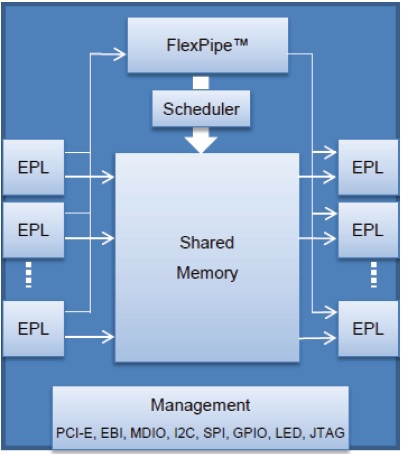
the idea of the matrix
Matrices are positioned as hybrid switches with the ability to easily switch from traditional switching to SDN. The main feature is the ability to direct threads to an OpenFlow handler or a traditional packet handler. The processor in Intel FM6000 is extremely flexible, it allows you to work with any standards, even if the administrator wants to create his own protocol - it does not matter, you can do it. The basis of this flexibility is the structure of the handler.
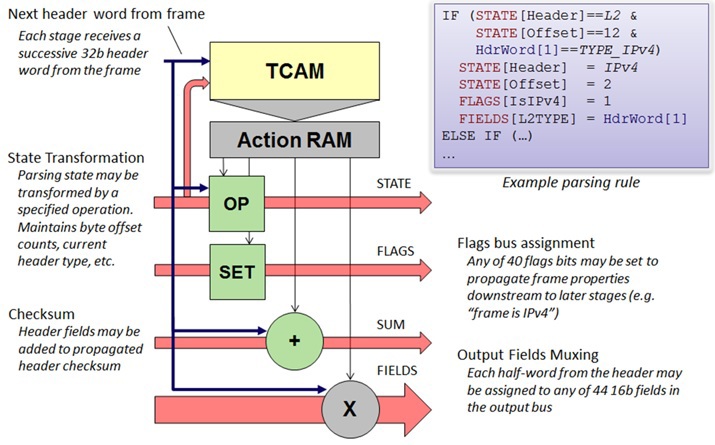
TCAM / RAM / MUX structure in the processor.
A switch based on such a matrix can simultaneously work in traditional networks and OpenFlow with record low latencies and high performance.
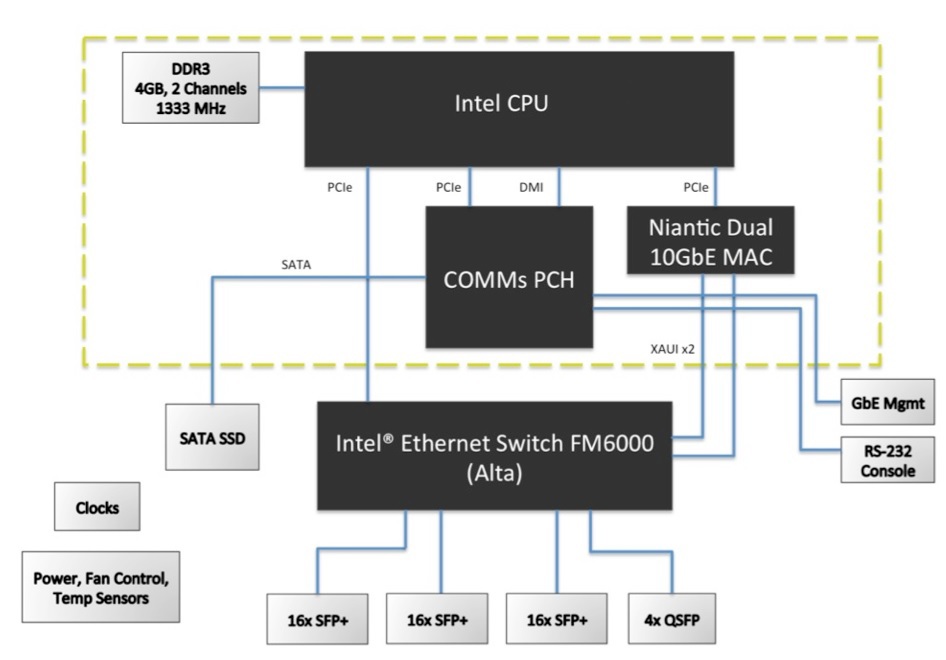
reference design
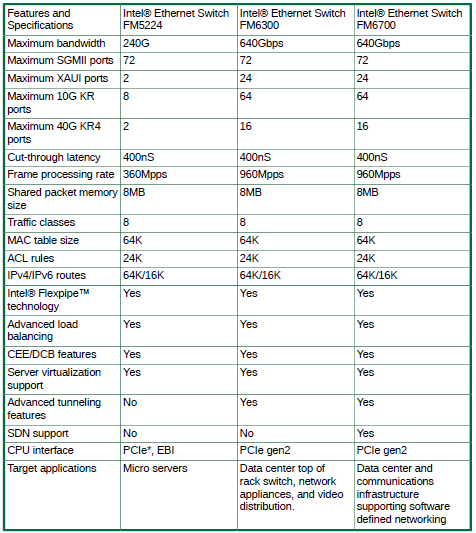
Models in the series
To work with such wonderful matrices Intel introduced a solution from Wind River - Open Network Software.

ONS Structure
Features:
Main protocols L2 and L3 are supported, functionality for data centers.
Layer 2:
Layer 3:
Control:
Data Center Application:
Marked "*" will be supported in future versions.
This is what the ideal switch of the future looks like (according to Intel):

What will happen if we take the older Intel FM6764 matrix model and the ONS network stack? Great switch!
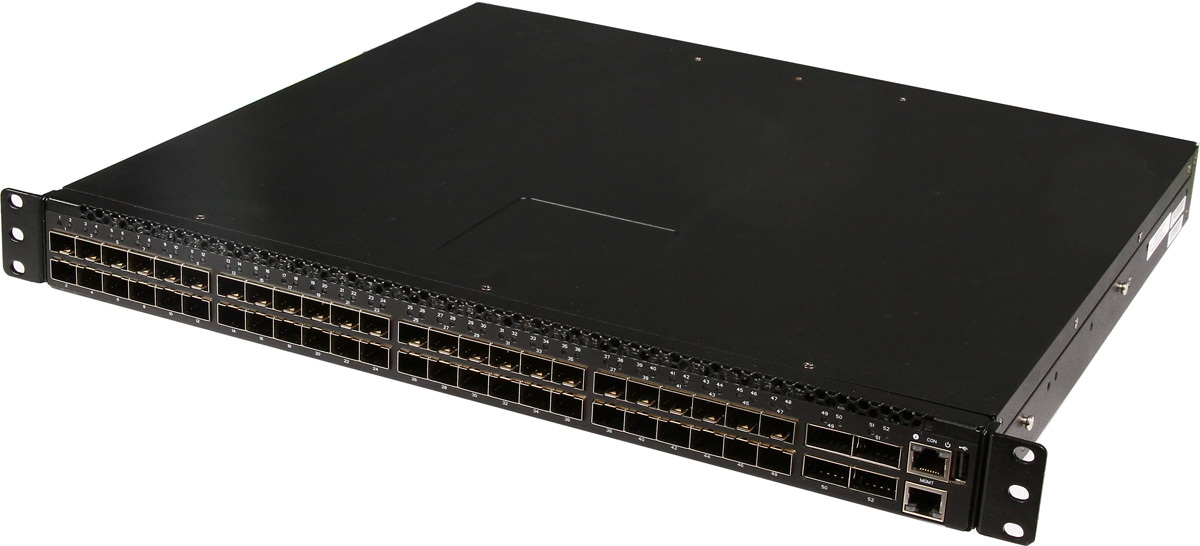
48 10G SFP + ports, 4 40G QSFP ports, USB port, console and management ports.
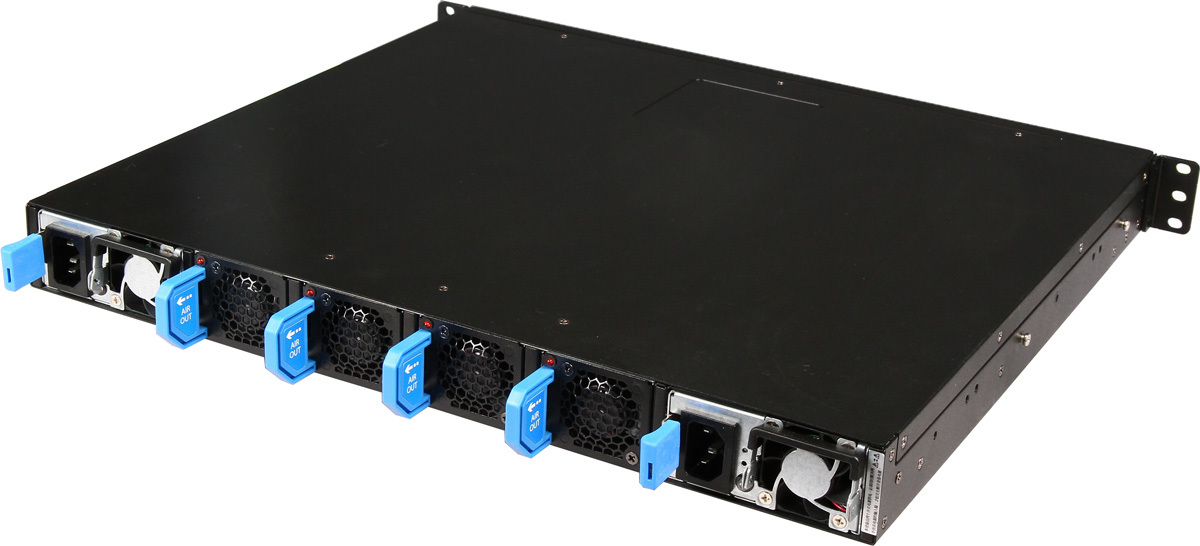
Two power supplies, ventilation with hot swap.
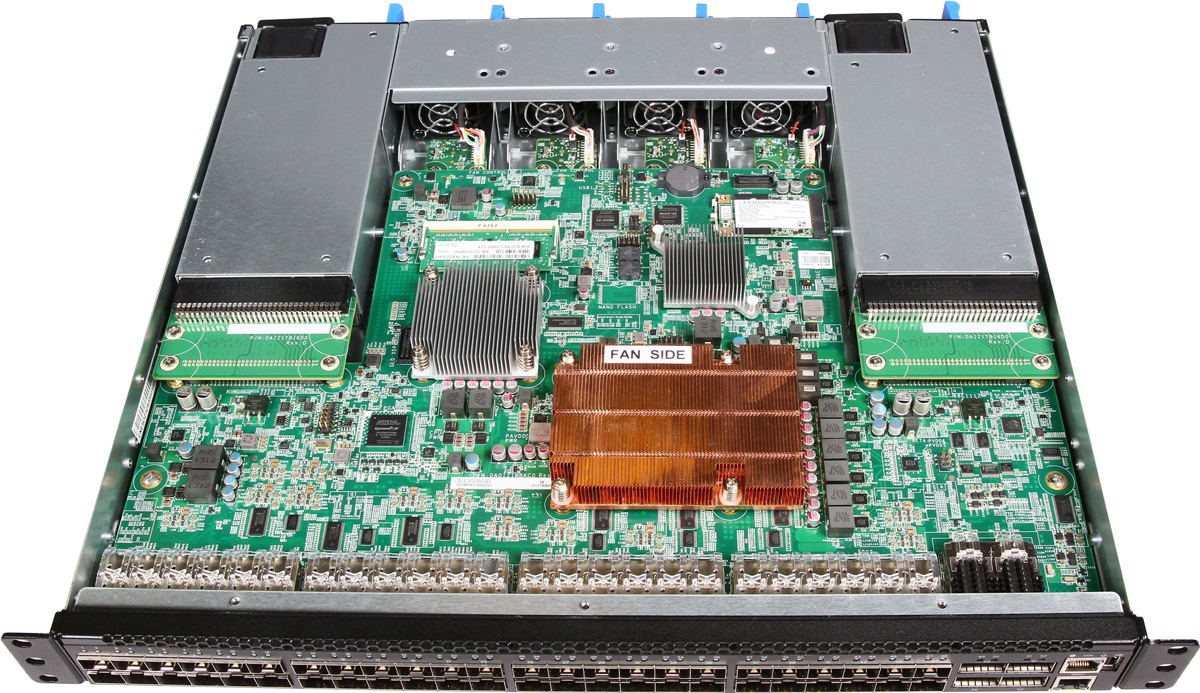
Intel Core i3, 2GB RAM, 30 gigabyte SSD drive.
In our laboratory, the switch is up and running successfully.
We invite developers of network applications and companies that are going to test / implement SDN solutions for testing the switch in real tasks.
The authors of the most interesting project, including highly loaded solutions on traditional switching, will receive one switch :)
Summing up - March 31.
First, a life hack for those who are too lazy to read a lot of text and watch pictures: at the very end of the article, the conditions for obtaining a 10G switch are given. “Without a meal, that is, for nothing,” said the Owl throughout the famous cartoon.
A lot of materials have already been written about SDN, so we’ll briefly recall that the main idea is to separate the management of network equipment and the management of data transfer.
The advantages of this approach:
- Direct network programming: Separating control levels allows you to create an architecture directly.
- Flexibility: The administrator can change the rules of the network "on the fly" to adapt to changing requirements.
- Centralization of management: All network management is concentrated (logically) in one place, in the SDN controller. For applications, the network looks like a single logical switch.
- Software configuration: SND allows you to configure, manage, set security rules, optimize network resources in a short time using automated tools, including in-house development.
The concept causes a lot of controversy, but we consider the direction promising.
Last year, Intel introduced a number of switch solutions based on the
Intel Ethernet FM6000 acquired by Fulcrum Microsystems.
the idea of the matrix
Matrices are positioned as hybrid switches with the ability to easily switch from traditional switching to SDN. The main feature is the ability to direct threads to an OpenFlow handler or a traditional packet handler. The processor in Intel FM6000 is extremely flexible, it allows you to work with any standards, even if the administrator wants to create his own protocol - it does not matter, you can do it. The basis of this flexibility is the structure of the handler.
TCAM / RAM / MUX structure in the processor.
A switch based on such a matrix can simultaneously work in traditional networks and OpenFlow with record low latencies and high performance.
reference design
Models in the series
To work with such wonderful matrices Intel introduced a solution from Wind River - Open Network Software.
ONS Structure
Features:
- Modular, open and extensible architecture with access to low-level features.
- System interfaces with an open API and RPC calls.
- XML-RPC-based management software interface.
- Object oriented design using XML and database schemas.
- Application Development Kit for embedding new applications on the switch.
- Native protocol support and extension through modules.
Main protocols L2 and L3 are supported, functionality for data centers.
Layer 2:
- Port-based VLAN
- 802.1Q VLAN
- IGMP snooping
- Lacp
- Storm control
- STP / RSTP / MSTP
- Q-in-Q
- QoS / DiffServ
- L2 / L3 / L4 ACL
- LLDP (802.1ab)
Layer 3:
- Static route
- VLAN routing
- OSPF v2
- ECMP
- ARP
- IGMP *
- PIM-SM *
- VRRP *
- OSPF v3 *
- PIM-SM6 *
- DHCPv6 relay
- BGP
Control:
- CLI / WEB / SNMP
- IPv6 management
- Auto-Installation
Data Center Application:
- 802.1Qaz (ETS)
- 802.1Qbb (PFC)
- DCBX
- VM Tracer
- EVB / 802.1Qbg
- OpenFlow v1.0
- VXLAN
- NVGRE *
Marked "*" will be supported in future versions.
This is what the ideal switch of the future looks like (according to Intel):
What will happen if we take the older Intel FM6764 matrix model and the ONS network stack? Great switch!
48 10G SFP + ports, 4 40G QSFP ports, USB port, console and management ports.
Two power supplies, ventilation with hot swap.
Intel Core i3, 2GB RAM, 30 gigabyte SSD drive.
In our laboratory, the switch is up and running successfully.
We invite developers of network applications and companies that are going to test / implement SDN solutions for testing the switch in real tasks.
The authors of the most interesting project, including highly loaded solutions on traditional switching, will receive one switch :)
Summing up - March 31.